
路边那口锅,才是一座城市的真心话 | The Roadside Wok Doesn't Lie
路边那口锅,才是一座城市的真心话 | The Roadside Wok Doesn't Lie
全世界大概没有哪个国家,像中国这样把街头饮食做得如此认真。
No country in the world takes street food as seriously as China does.
这不是一句客套话。2019年,一项针对中国十二座城市的饮食调查显示,受访者中有67%的人表示,他们最难忘的一顿饭发生在街边、市场或夜市,而不是餐厅。街头食物不是正餐的替代品,它本身就是目的地。
This isn't a pleasantry. A 2019 food survey across twelve Chinese cities found that 67% of respondents said their most memorable meal happened on a street corner, in a market, or at a night market — not in a restaurant. Street food isn't a substitute for a real meal. It is the destination.
早上六点,西安回民街
冬天的西安,天亮得晚。早上六点,回民街的化觉巷里已经有人在干活了。一个戴白帽的男人蹲在炉子前,往馕坑里贴饼,动作熟练得像是手臂自己在运动。旁边的摊子上,一口大锅里炖着羊肉,白色的蒸汽在冷空气里升起来,飘过整条巷子。
Winter in Xi'an, and dawn comes late. By six in the morning, Huajue Lane in the Muslim Quarter already has people at work. A man in a white cap squats before a clay oven, slapping flatbreads against the inner wall with a motion so practiced his arm seems to move on its own. At the stall beside him, a large pot of lamb simmers, white steam rising into the cold air and drifting the length of the alley.
羊肉泡馍是西安街头最具代表性的食物,但它有一个外地人常常不知道的规矩:馍要自己掰。服务员端来一个碗和两个硬面饼,你要把饼掰成黄豆大小的碎块,放进碗里,再交还给厨师去煮。掰馍这件事,快的人十分钟,慢的人半小时。有人说,掰馍的时间是用来想事情的。
Yang rou pao mo is Xi'an's most iconic street food, but it has a rule outsiders often don't know: you tear the bread yourself. The server brings a bowl and two hard flatbreads; you break them into soybean-sized pieces, fill the bowl, then hand it back to the cook. Fast people finish in ten minutes, slow ones take half an hour. Some say the time spent tearing bread is time for thinking.
成都的串串香与人间烟火
成都人发明了一种把火锅变成街头食物的方法:串串香。食材提前穿在竹签上,顾客自己从冰柜里取签,放进锅里烫熟,按签计费。一根签五毛钱到一块钱,吃完数签结账。
Chengdu people invented a way to turn hot pot into street food: skewer hot pot, or chuan chuan xiang. Ingredients are pre-skewered on bamboo sticks; customers pull their own from a refrigerated case, drop them in the communal pot, and pay by the stick — fifty cents to one yuan each, counted at the end.
玉林路附近有一条小巷,傍晚五点开始,十几家串串摊依次摆开,红色的塑料凳子摆到了马路边。上班族下班路过,顺手拿几根签,站着烫,站着吃,吃完继续走。也有人搬个凳子坐下来,一坐就是两个小时,从天亮吃到天黑。串串香没有正式的开始和结束,它就这样流动在成都人的日常里。
In a small alley near Yulin Road, a dozen skewer stalls set up in sequence starting at five in the evening, red plastic stools spilling onto the roadside. Office workers pass by on their way home, grab a few skewers, eat standing up, and keep walking. Others pull up a stool and stay for two hours, eating from dusk into dark. Skewer hot pot has no formal beginning or end — it flows through Chengdu daily life like water.
广东的肠粉车与上海的生煎包
广东的街头早餐是一场速度竞赛。肠粉档的师傅站在蒸柜前,一只手倒米浆,一只手铺料,蒸两分钟,刮皮,卷起,淋酱,递出去。整个过程不超过三分钟,后面排队的人已经等不及了。
Guangdong's street breakfast is a speed competition. The cheung fun master stands before the steam cabinet, one hand pouring rice batter, the other laying out fillings, two minutes of steaming, then scraping, rolling, saucing, handing over. The whole process takes under three minutes, and the people queued behind are already impatient.
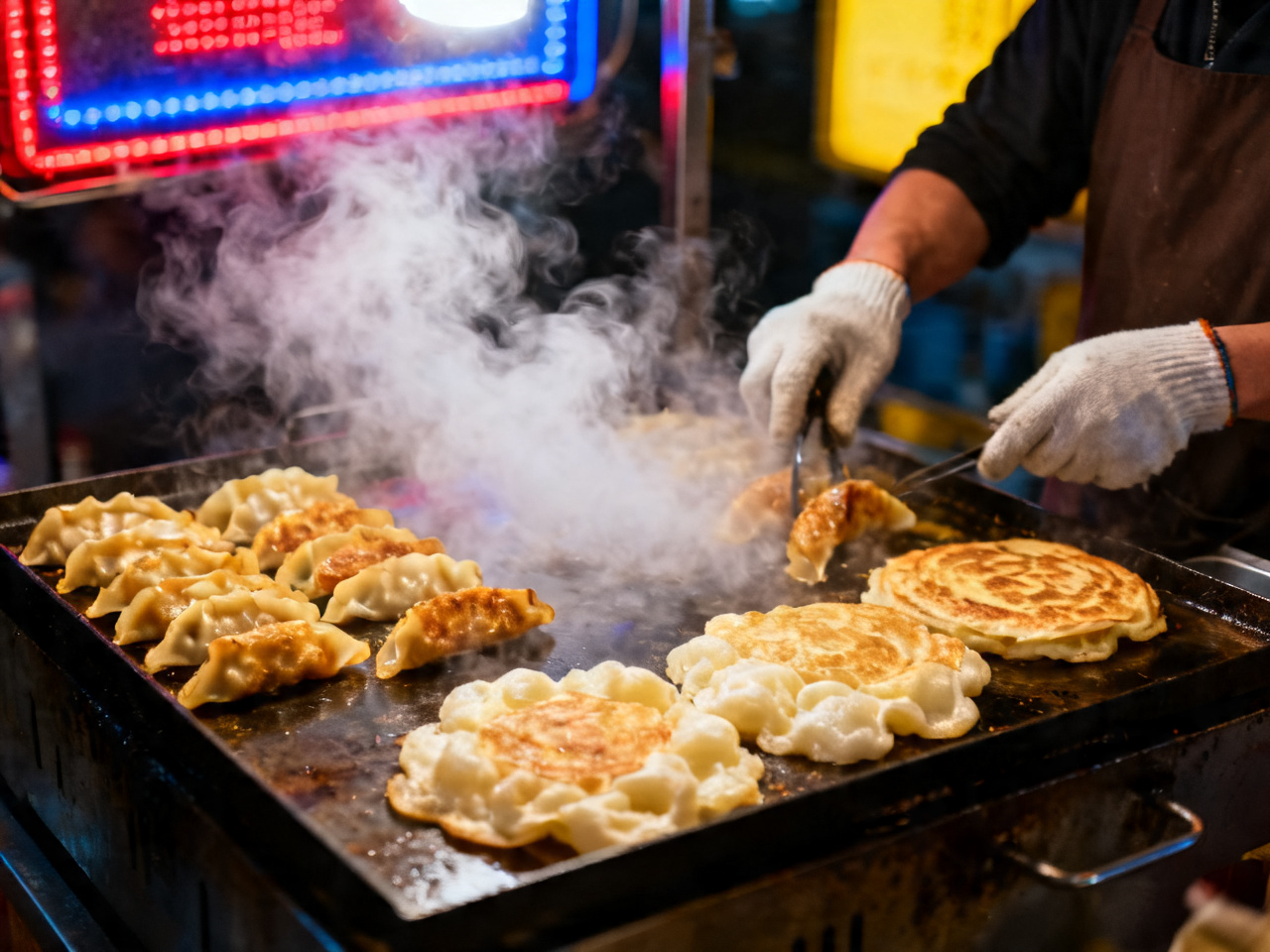
上海的生煎包是另一种节奏。铁锅里排满了包子,先煎底部,再加水焖,最后撒芝麻和葱花。等待的时间比广东肠粉长,但那个等待是值得的——咬开酥脆的底部,汤汁涌出来,要小心,会烫嘴。上海人管这叫"生煎",外地人管这叫"惊喜"。
Shanghai's pan-fried buns move at a different pace. The iron pan fills with buns, first fried on the bottom, then steamed with added water, finally scattered with sesame and scallion. The wait is longer than for Guangdong cheung fun, but it's worth it — bite through the crisp base and broth surges out. Be careful: it will burn your mouth. Shanghai people call this sheng jian. Visitors call it a surprise.
夜市:城市的另一张脸
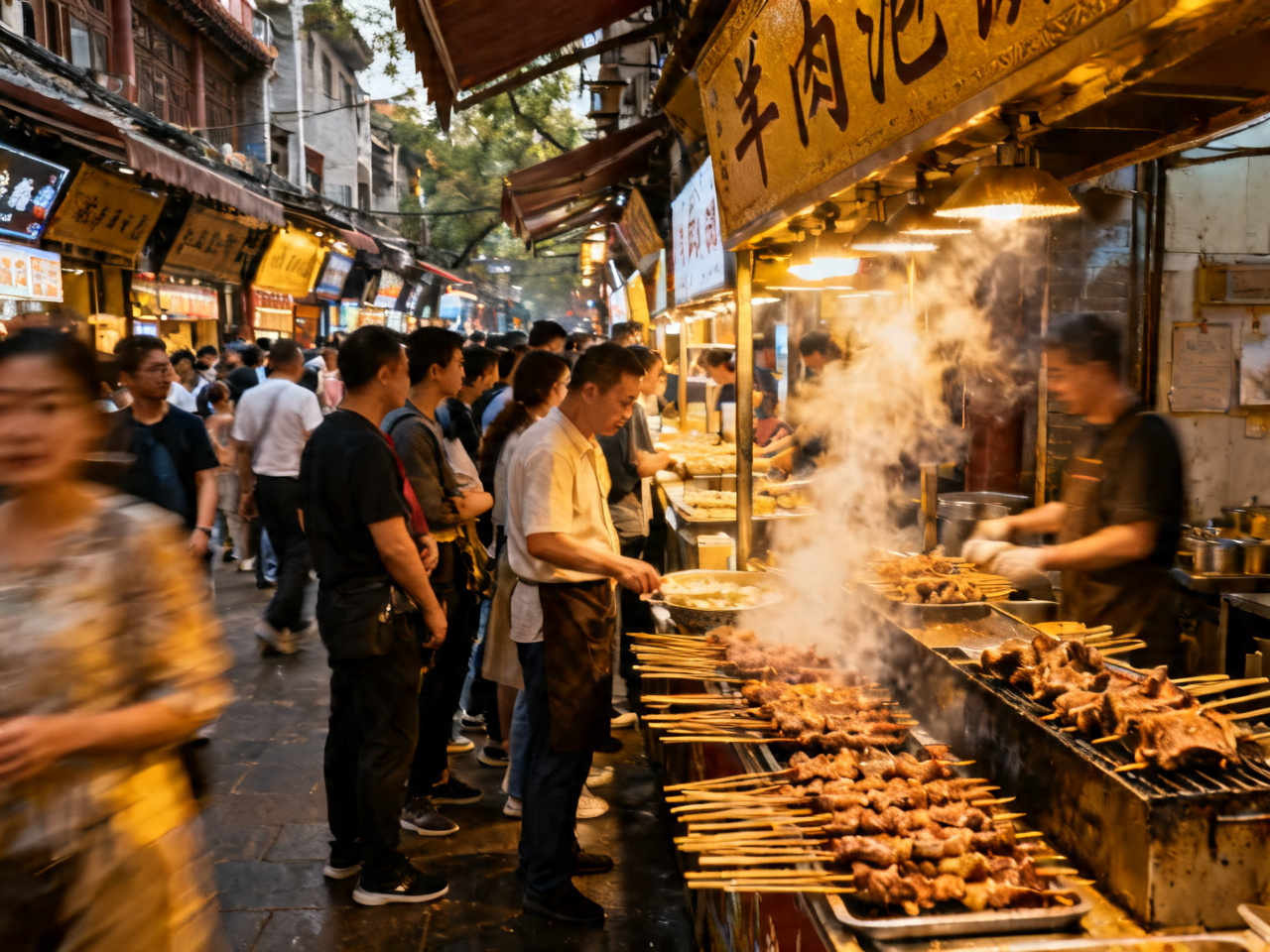
中国的夜市在晚上九点之后才真正活过来。台湾的夜市文化影响了大陆,但大陆的夜市有自己的逻辑:更大,更嘈杂,更混乱,也更真实。
China's night markets don't truly come alive until after nine. Taiwan's night market culture has influenced the mainland, but mainland night markets follow their own logic: bigger, louder, more chaotic, and more honest.
长沙的文和友,把夜市做成了一个四层楼的建筑,复原了1980年代的长沙街景,臭豆腐、龙虾、糖油粑粑在同一栋楼里共存。这是夜市的博物馆版本,精致但略显刻意。真正的夜市在城市的毛细血管里:武汉的户部巷,南京的夫子庙,西宁的城东夜市——那些地方,食物是真实的,人也是真实的。
Changsha's Wenheyou turned the night market into a four-story building, recreating 1980s Changsha streetscapes where stinky tofu, crayfish, and tang you ba ba coexist under one roof. It's the museum version of a night market — refined but slightly self-conscious. The real night market lives in a city's capillaries: Hubu Alley in Wuhan, Confucius Temple in Nanjing, the East City Night Market in Xining — places where the food is real and so are the people.
街头食物的本质,是一种诚实。它没有装修,没有服务脚本,没有摆盘。食物好不好,一口就知道。如果不好,摊主明天就没有生意。这种赤裸裸的市场逻辑,反而造就了中国街头食物的高水准。下次去一座陌生的中国城市,别急着打开大众点评找五星餐厅。先在街上走走,跟着人群,跟着香气,跟着那些排队的人。他们知道答案。
Street food is honest by nature. No décor, no service script, no plating. Whether the food is good, one bite tells you. If it isn't, the vendor has no customers tomorrow. This naked market logic is precisely what drives Chinese street food to such high standards. Next time you arrive in an unfamiliar Chinese city, don't rush to open a review app hunting for five-star restaurants. Walk the streets first. Follow the crowds, follow the smells, follow the people in line. They know the answer.
延伸阅读 / Related Reads
- 中国八大菜系全览 | The 8 Great Cuisines of China
- 第一口就着了魔:一个外乡人在成都的麻辣沉沦 | Spellbound at First Bite: A Stranger's Descent into Chengdu's Heat
- 街头那碗热气,才是中国城市的真实体温 | Street Steam: The Real Pulse of Chinese Cities
- 花椒档案:一个植物学者眼中的四川味觉地图 | The Peppercorn Dossier: Sichuan's Flavor Map Through a Botanist's Eyes
- 华东五城10日经典环线 | 10-Day East China Five-City Loop
- 在中国生活:完整指南 | Living in China: A Complete Guide
- 中国最美高铁线路TOP5:窗外就是风景 | Top 5 Most Scenic High-Speed Rail Routes in China
- 酒店前台帮我确认订单时,我学会别只依赖邮箱 | At a Hotel Front Desk, I Learned Not to Rely Only on Email
- 从兰州牛肉面开始理解一座河谷城市 | Understanding a River-Valley City Through Lanzhou Beef Noodles
- 凌晨五点的生料粉摊,把我带进了玉林 | A 5 A.M. Rice-Noodle Stall Led Me into Yulin
- 中医传统疗法指南 | Traditional Chinese Medicine
- 第一次在中国药店买感冒药,我学会先说症状再看品牌 | The First Time I Bought Cold Medicine in a Chinese Pharmacy, I Learned to Describe Symptoms Before Looking at Brands
- 中国民间艺术:剪纸、皮影与年画 | Chinese Folk Art: Paper-Cutting, Shadow Puppets & New Year Prints
- 我在高铁站丢过方向,但没丢掉行程 | I Lost My Direction at a High-Speed Railway Station but Not My Trip
- 泉州西街入夜以后,一盏圆灯就能把面线糊和人情都照热 | Once Night Falls on West Street in Quanzhou, One Round Lamp Can Warm Both Noodles and Human Feeling
Comments (0)