
敦煌老街真正留人的,常常不是夜色多辽阔,而是灯下那口杏皮水和炉火 | What Truly Holds You on Dunhuang’s Old Street Is Not the Vast Night but the Apricot Drink and Firelight Under the Lamps
敦煌老街的一盏灯,让我看见生活比景点更耐看 | One Lamp on an Old Street in Dunhuang Showed Me Daily Life Outlasts Attractions
-
敦煌的夜来得并不突然,它像沙丘上的影子,一寸一寸从城外推到老街。傍晚时我走进那条街,天边还留着一层浅橙,店铺的灯却已经陆续亮起。灯光不是大城市那种锋利的白,而是带着一点琥珀色,落在木牌、砖墙和摊位的布面上,让一切都显得有旧时的温度。风从沙地方向吹来,夹着细微的干燥,吹动灯笼底下的穗子,也吹动卖杏皮水摊位前的塑料招牌。敦煌的老街灯一亮,白天的辽阔就收拢成一段可以慢慢走的夜。
-
Night in Dunhuang does not arrive suddenly. It is like a shadow on the dunes, moving inch by inch from outside the city into the old street. I entered the street at dusk, when a pale orange layer still remained at the horizon, while shop lights had begun to appear one after another. The light was not the sharp white of big cities; it carried a touch of amber, falling on wooden signs, brick walls, and stall cloth, giving everything an old warmth. Wind came from the sandy direction, dry and fine, stirring tassels under lanterns and plastic signs before stands selling apricot peel drink. Once the lamps of Dunhuang’s old street are lit, the vastness of daytime folds into a night that can be walked slowly.
-
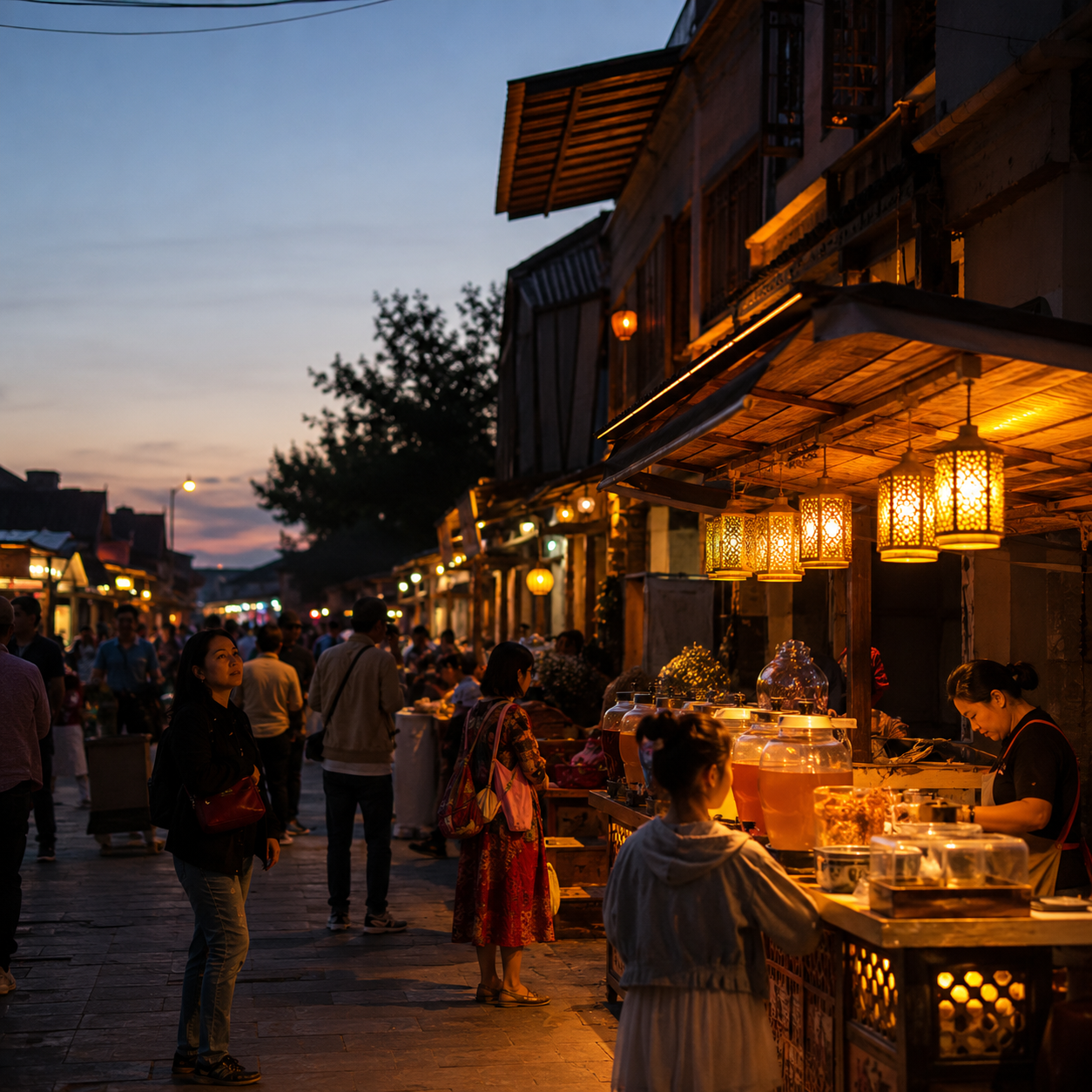
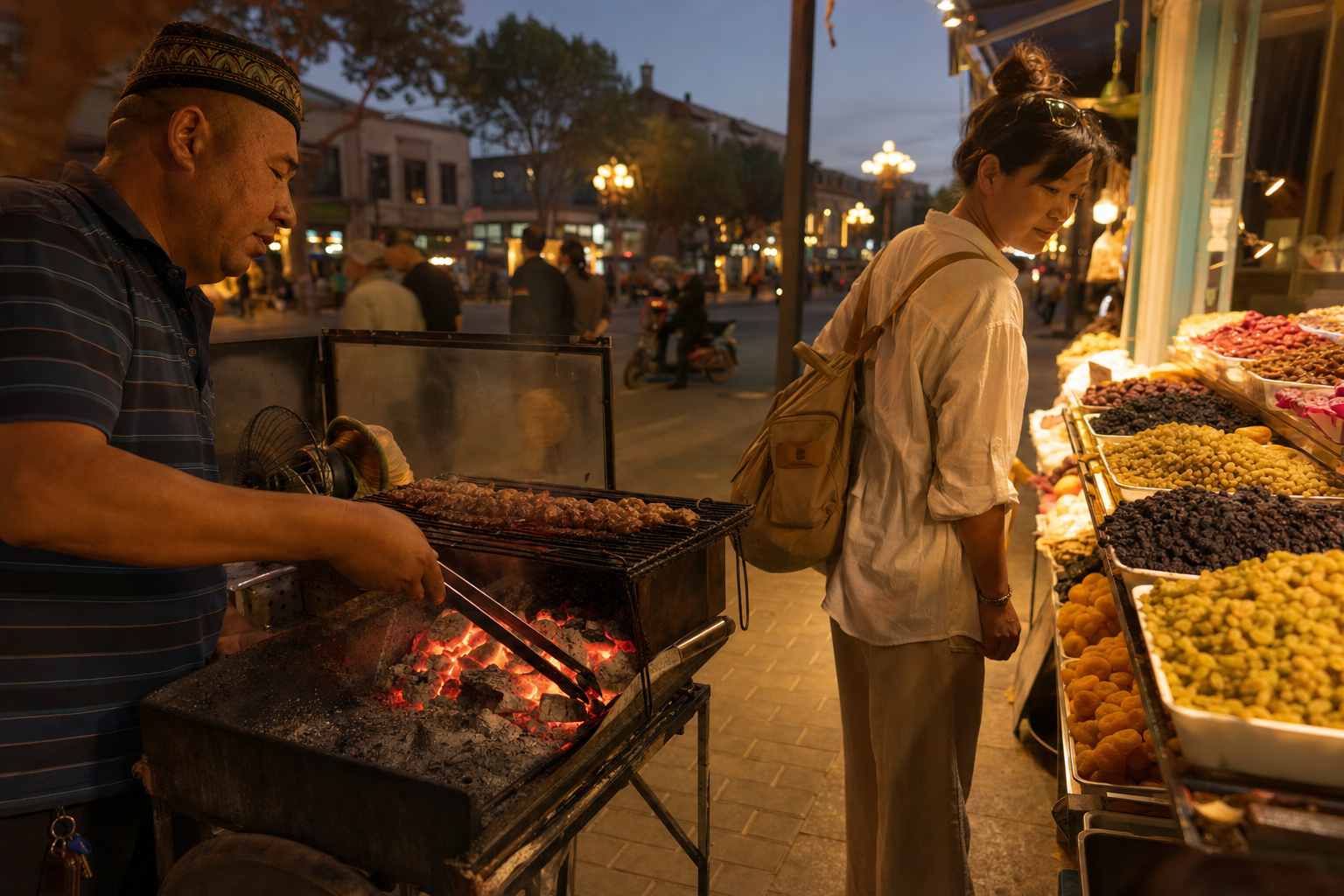
我喜欢在灯刚亮的时候看一条街,那时它还没有完全交给夜晚,许多细节在明暗之间摇摆。卖烤肉的师傅把炭火拨开,红光从铁架下面透出来,和头顶的灯泡相互照应。旁边的摊主把葡萄干、杏干、李广杏整齐码好,黄色、棕色、深紫色在灯下显得更浓。游客经过时会放慢脚步,先被香味牵住,再被颜色留下。敦煌的老街并不靠高楼制造气势,它靠的是这些低处的灯:照着手、照着食物、照着脸上的笑,也照着一座边塞城市长久积累下来的烟火气。
-
I like looking at a street when its lamps have just come on, before it has fully surrendered to night and many details still sway between light and shadow. A grill master spread the charcoal, and red light rose from beneath the iron rack, answering the bulbs overhead. Beside him, a vendor arranged raisins, dried apricots, and Li Guang apricots in neat rows, their yellows, browns, and deep purples growing richer under the light. Travelers slowed as they passed, first caught by scent, then held by color. Dunhuang’s old street does not create grandeur with tall buildings. It relies on lamps close to the ground: lighting hands, food, smiling faces, and the everyday warmth accumulated by a frontier city over a long time.
-
老街的灯有很多种。店门口挂着仿古宫灯,红色灯罩把门楣染得热闹;小吃摊上悬着裸露的白灯泡,直接照亮锅沿和油烟;纪念品店里有小小的驼铃灯,金属影子落在墙上,像一队微缩的商旅正穿过沙漠。最吸引我的是一家书画铺外的灯,光从半透明的纸罩里散出来,照着几幅飞天图案和写着敦煌二字的扇面。那光不强,却有一种安静的坚持,好像莫高窟壁画里的颜色经过千年暗处,仍愿意在街头轻轻亮一下。
-
The lamps on the old street come in many forms. Antique-style palace lanterns hang at shop doors, their red shades coloring the lintels with festivity. Bare white bulbs dangle above snack stalls, directly lighting pot rims and cooking smoke. In souvenir shops, tiny camel-bell lamps cast metal shadows on the walls, like a miniature caravan crossing the desert. What drew me most was the lamp outside a calligraphy and painting shop. Light spread through a translucent paper shade, falling on apsara patterns and fans bearing the characters for Dunhuang. It was not strong, but it had a quiet persistence, as if the colors of Mogao’s murals, after a thousand years in dimness, were still willing to glow softly on the street.
-
吃饭的人渐渐多起来,灯光也像被人声点旺。烤串的烟升到灯下,变成一团团带香味的雾;面馆里有人端出驴肉黄面,汤气贴着碗口往上翻;卖胡杨木摆件的店主坐在门边,一边扇风一边看街。敦煌的夜市和许多地方一样热闹,却又有自己的底色。这里的热闹背后,总站着沙漠、石窟、关隘和古道。哪怕你只是坐在塑料凳上吃一碗面,也会觉得头顶那盏灯照着的不只是当下,还有无数经过这里又离开这里的人。
-
More people came to eat, and the lights seemed to brighten with their voices. Smoke from skewers rose under bulbs and became fragrant clouds. In a noodle shop, someone carried out donkey meat yellow noodles, steam curling over the bowl’s rim. A shopkeeper selling poplar-wood ornaments sat by the door, fanning himself while watching the street. Dunhuang’s night market is lively like many places, yet it has its own undertone. Behind the liveliness here stand desert, grottoes, passes, and ancient roads. Even if you are only sitting on a plastic stool eating a bowl of noodles, you feel that the lamp above you shines not only on the present but also on countless people who once passed through and moved on.
-
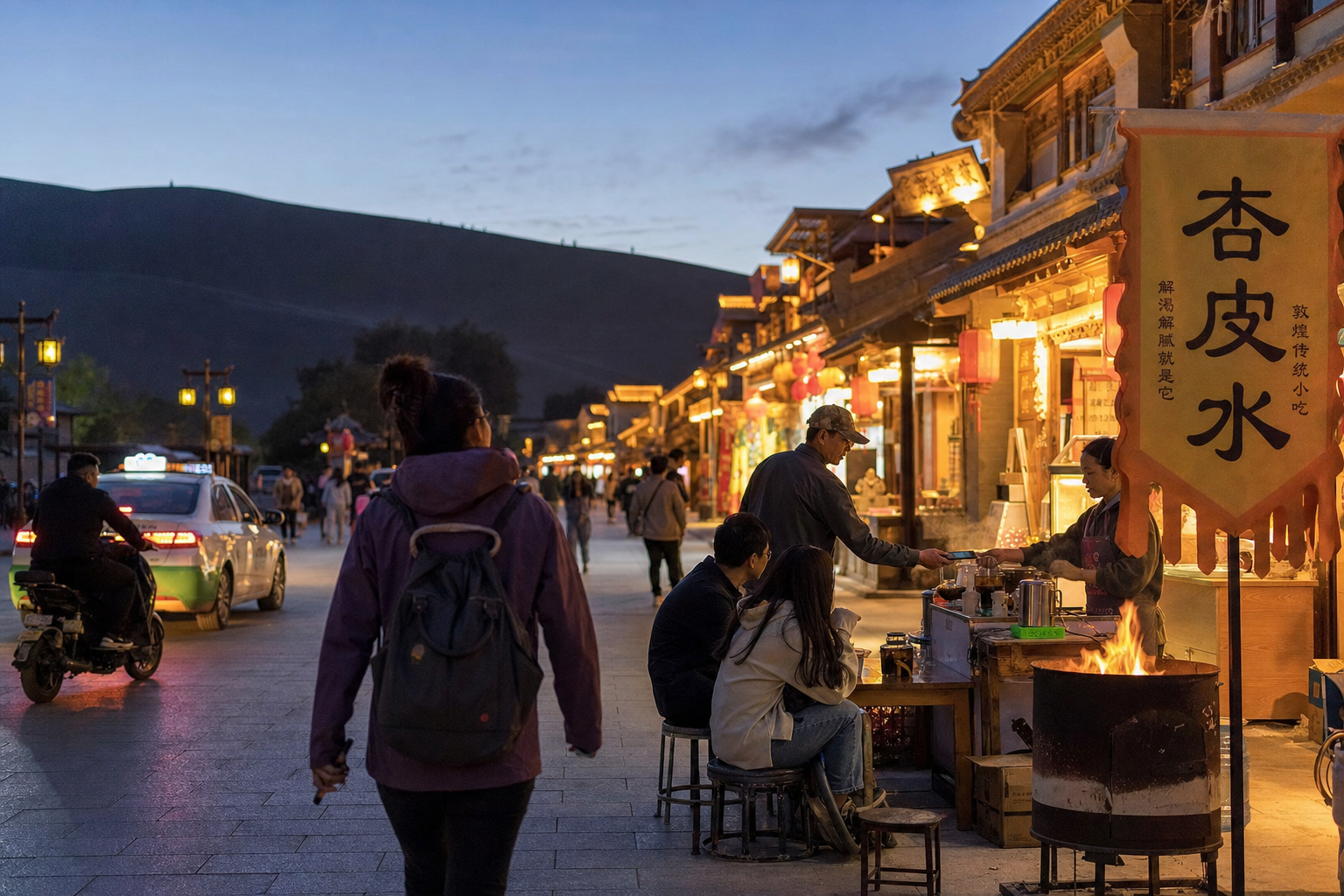
我在一家小店前停下,店里卖的是明信片、印章和仿壁画的小册子。门口有一盏旧式台灯,绿色玻璃罩下压着暖黄的光,照在木桌的纹路上。店主是个中年男人,见我看得久,便说这灯不算古董,只是用了很多年,搬店也舍不得丢。他说老街改过几次,招牌换过,路面修过,游客多了又少,少了又多,但有些灯一亮,就像把旧日子又叫回来。我听着,忽然明白,所谓老街并不一定全是老建筑,也可能是一些被人反复使用、反复珍惜的光。
-
I stopped before a small shop selling postcards, seals, and booklets of reproduced murals. At the entrance stood an old-style desk lamp, its green glass shade pressing warm yellow light onto the grain of a wooden table. The owner, a middle-aged man, noticed me looking and said the lamp was not an antique, only something used for many years and too hard to discard whenever the shop moved. He said the old street had changed several times: signs replaced, pavement repaired, visitors more and fewer, fewer and more. But when certain lamps came on, they seemed to call old days back. Listening, I suddenly understood that an old street is not necessarily made only of old buildings; it may also be made of light repeatedly used and repeatedly cherished.
-
往前走时,我看见一面墙上投着骆驼的影子。影子来自旁边店铺的装饰灯,几只小骆驼排成一线,背上驮着微小的包裹。孩子们发现后很兴奋,伸手去摸,影子却被手掌盖住又重新出现。敦煌让人容易想到遥远的路,而老街的灯把遥远变得亲近。丝路在课本里是一条宏大的线,在博物馆里是一件件器物,在夜晚的街上却可能只是墙上一排摇晃的骆驼影,是一杯酸甜的杏皮水,是摊主找零时递过来的一枚硬币。
-
Walking on, I saw camel shadows projected on a wall. They came from a decorative lamp in a nearby shop: several small camels in a line, carrying tiny bundles on their backs. Children were delighted and reached out to touch them, only for the shadows to disappear under their palms and return again. Dunhuang easily makes one think of distant roads, while the lamps of the old street make distance feel intimate. In textbooks, the Silk Road is a grand line; in museums, it is a collection of objects. On a night street, it may simply be a row of swaying camel shadows on a wall, a cup of sweet-sour apricot peel drink, or a coin handed back by a vendor as change.
-
老街灯最迷人的地方,是它们从不只照亮商品,也照亮人与人短暂相遇的表情。一个年轻人问老板哪种杏干更酸,老板直接拿起一颗让他尝;两个老人坐在店门口聊天,灯光把他们的皱纹照得很深,却也很柔和;一位背包客低头看地图,手机屏幕的冷光和头顶灯笼的暖光同时落在脸上。每个人都只在这里停留一会儿,灯却像耐心的见证者,替街道记住这些片刻。它们不问你从哪里来,也不问你明天去鸣沙山还是莫高窟,只把今晚的一小段路照清楚。
-
The most charming thing about the old street lamps is that they do not only illuminate goods; they also illuminate expressions during brief encounters. A young man asked which dried apricot was more sour, and the vendor simply picked one up for him to taste. Two elders sat chatting at a doorway, the light deepening their wrinkles while softening them too. A backpacker looked down at a map, the cold glow of a phone and the warm glow of a lantern falling on the same face. Everyone stays here only for a while, but the lamps act as patient witnesses, remembering these moments for the street. They do not ask where you came from or whether tomorrow you will go to Mingsha Mountain or Mogao Caves; they only make this small stretch of tonight clear.
-
我买了一杯杏皮水,杯壁上凝着细小水珠,在干燥的风里显得格外清凉。摊位上的灯泡把琥珀色的饮料照得像一小杯夕阳。第一口入口酸甜,带着果皮熬出的厚味,喉咙立刻被安抚。站在灯下喝东西时,我注意到脚边的影子被拉得很长,和来往行人的影子交叠又分开。白天在鸣沙山看见的沙脊线条,此刻似乎换成了街上的影线。敦煌就是这样,把宏大的地貌和细小的生活互相折叠,让人分不清自己是在旅行,还是在一盏灯下临时安家。
-
I bought a cup of apricot peel drink, tiny droplets clinging to the cup wall and looking especially cool in the dry wind. The bulb above the stall lit the amber liquid like a small cup of sunset. The first sip was sweet and tart, with the dense flavor of boiled fruit peel, immediately soothing my throat. Standing under the lamp, I noticed my shadow stretched long at my feet, overlapping with and separating from the shadows of passersby. The ridgelines I had seen at Mingsha Mountain by day seemed now transformed into lines of shadow on the street. This is Dunhuang’s way: folding grand landscapes and small daily life into each other until you cannot tell whether you are traveling or briefly making a home beneath a lamp.
-
街中段有一处灯牌写着老字号,字体被做成复古样式,边缘已经有些磨损。很多游客会在这里拍照,站到灯牌下面摆姿势,笑声一阵一阵传开。我本来想避开人群,却被一个瞬间留住:一位母亲替孩子整理帽子,孩子抬头看灯,眼睛里映出两点亮光。那画面很普通,却比摆好的姿势更像旅行的纪念。敦煌的灯并不只是为了让人看清路,也让人看见自己在远方的样子。人在陌生城市里常会变得敏感,灯光一柔,心也容易柔下来。
-
In the middle of the street, a lit sign announced an old-established shop, its characters designed in a retro style and worn slightly at the edges. Many travelers took photos there, posing beneath the sign as laughter spread in waves. I intended to avoid the crowd, but one instant held me: a mother adjusted her child’s hat, and the child looked up at the lamp, two points of brightness reflected in the eyes. The scene was ordinary, yet it felt more like a travel souvenir than any arranged pose. Dunhuang’s lamps do not only help people see the road; they let people see themselves far from home. In an unfamiliar city, one often becomes sensitive. When the light softens, the heart softens too.
-
夜深一点,老街的颜色开始变得饱满。红灯笼更红,蓝色招牌更蓝,铜器反射出一点金,烤炉里的火像一枚低处的星。远处传来弹唱声,旋律带着西北的开阔,不华丽,却很直。有人端着食物从我身边走过,孜然味和炭火味在空气里交汇。我想到敦煌这个名字,本身就像一盏灯:敦,大也;煌,盛也。它曾在历史深处照亮道路,如今又在夜晚的老街上,用更日常的方式继续发光。那些灯不宏伟,却把城市的名字照得亲切。
-
Later in the night, the colors of the old street grew full. Red lanterns became redder, blue signs bluer, bronze objects reflected a little gold, and the fire in grills looked like a low star. Singing and plucked strings came from somewhere ahead, the melody carrying the openness of the northwest, not ornate but direct. Someone passed with food, and the scents of cumin and charcoal met in the air. I thought of the name Dunhuang itself, which resembles a lamp: dun meaning grand, huang meaning brilliant. It once lit routes deep in history, and now, on the old street at night, it continues to shine in a more ordinary way. The lamps are not majestic, but they make the city’s name feel intimate.
-
有些店铺关得早,卷帘门放下一半,灯仍从里面漏出来。这样的半明半暗很有意思,像一天还舍不得结束。清洁工开始沿街收拾纸杯和竹签,车轮压过地面发出轻响。游客渐渐往出口方向走,手里拎着小袋子,袋子里的纪念品在灯下晃动。我也跟着人流慢慢走,却不急着离开。回头望去,老街灯一盏接一盏连成线,像有人把一段小小的银河放低到人间。它没有沙漠星空那么辽阔,却更靠近手掌和呼吸。
-
Some shops closed early, their rolling shutters lowered halfway while light still leaked from inside. This half-bright, half-dark state was interesting, as if the day was reluctant to end. Cleaners began collecting paper cups and bamboo skewers along the street, cart wheels making soft sounds over the ground. Travelers gradually moved toward the exit with small bags in their hands, souvenirs swinging under the lamps. I followed the flow slowly but was not eager to leave. Looking back, the old street lamps connected one by one into a line, like someone lowering a small Milky Way to earth. It was not as vast as the desert night sky, but it was closer to palms and breath.
-
我想,白天的敦煌让人抬头:看洞窟,看山,看沙,看天空;夜晚老街的敦煌让人低头:看碗里的面,看杯里的水,看摊主的手,看灯下自己的影子。一个地方若只有宏大,难免让人敬而远之;有了这些灯火,它就变得可以亲近。老街灯把敦煌从历史和地理的高处带回到普通人的身边,让遥远的丝路有了可触摸的温度。走在这样的灯下,我不再只把敦煌想成传奇的节点,也把它想成一个有人做饭、有人聊天、有人等客的夜晚。
-
I think daytime Dunhuang makes people look upward: at caves, mountains, sand, and sky. The Dunhuang of the old street at night makes people look downward: at noodles in a bowl, water in a cup, a vendor’s hands, and one’s own shadow under a lamp. If a place has only grandeur, it can easily inspire respect from a distance. With these lights, it becomes approachable. The old street lamps bring Dunhuang down from the heights of history and geography to the side of ordinary people, giving the distant Silk Road a touchable warmth. Walking beneath them, I no longer thought of Dunhuang only as a legendary node, but also as a night where someone cooks, someone chats, and someone waits for customers.
-
离开老街时,风比来时更凉,灯却显得更暖。我把空杯扔进垃圾桶,又在街口站了一会儿。远处的车灯流过,近处的灯笼轻轻摆动,天空上只有几颗星,却足够让人想起城外的沙。敦煌老街灯给我的不是惊艳,而是一种缓慢的照看。它们照看晚归的人,照看收摊的手,照看外地人短暂停靠的心情,也照看这座城市在宏大叙事之外最柔软的部分。后来我记起敦煌,除了莫高窟的庄严和鸣沙山的辽阔,也一定会记起这条街上琥珀色的灯。
-
When I left the old street, the wind was cooler than before, but the lamps seemed warmer. I threw my empty cup into a bin and stood at the street entrance for a while. Car lights flowed in the distance, nearby lanterns swayed gently, and there were only a few stars overhead, yet they were enough to remind me of the sand outside the city. The lamps of Dunhuang’s old street did not give me astonishment; they gave me a slow kind of care. They cared for late returners, for hands closing stalls, for the mood of travelers briefly stopping, and for the softest part of the city beyond grand narratives. Later, when I remember Dunhuang, besides the solemnity of Mogao Caves and the vastness of Mingsha Mountain, I will surely remember the amber lamps on this street.
- 泥塑体验:我第一次觉得泥土不是材料,而是一种很慢的语言 | Clay Figurine Experience: The First Time I Felt Earth Was Not a Material, but a Slow Language
- 风沙把莫高窟的时间吹慢了 | The Sandstorm Slowed Time at the Mogao Caves
- 英歌舞:潮汕街头的战鼓与脸谱 | Yingge Dance: War Drums and Painted Faces on Chaoshan Streets
- 成都最会让国外镜头停久一点的,往往不是熊猫,而是人坐下来以后那股松弛 | What Most Often Makes Foreign Cameras Linger in Chengdu Is Not the Pandas but the Ease That Begins Once People Sit Down
- 和爸爸在周庄躲雨的半天,我第一次发现他其实比我更会旅行 | A Rainy Half Day in Zhouzhuang with My Father Showed Me He Was Better at Traveling Than I Was
- 中国高铁网络全解:线路图与购票技巧 | China High-Speed Rail: Network Map & Booking Tips
- 一根提线停在掌心时,我在泉州听见了海风 | When a Puppet String Rested in a Palm, I Heard the Sea Wind in Quanzhou
- 婚礼与节庆中的传统服饰 | Traditional Dress in Chinese Weddings & Festivals
- 新疆北疆12日深度游 | 12-Day Northern Xinjiang In-Depth Tour
- 牛肉下锅前,潮州人先把时间切薄 | Before the Beef Enters the Pot, Chaozhou Cuts Time Thin
Comments (0)