
石板街尽头那杯毛尖冷泡茶,让我慢下来 | A Cold Brew of Maojian at the End of a Stone Street Slowed Me Down
石板街尽头那杯毛尖冷泡茶,让我慢下来 | A Cold Brew of Maojian at the End of a Stone Street Slowed Me Down
那天上午,我原本只打算穿过一段石板街,去赶一处已经在地图上标好的下一站。天刚放亮不久,街面还留着夜里潮气,浅灰色石板被鞋底磨得发亮,缝隙里有细小的水珠。我的背包一侧塞着水瓶,另一侧夹着折好的路线纸;我每走十几步就抬头看一次手机,担心自己在弯弯绕绕的巷口多耽误几分钟。街上已经有人开始一天的活计:有人把门前的小凳挪开,有人把一盆刚浇过水的植物往里收,还有人拎着装着早饭的袋子,从我身边走过去。那些动作都不急,却让我显得格外着急。
That morning, I meant only to cross a stretch of stone-paved street and hurry to the next stop already marked on my map. Daylight had barely arrived, and the pavement still held the dampness of the night. The pale gray stones shone where countless shoes had polished them, while tiny drops of water sat in the seams. A bottle was tucked into one side of my backpack and a folded route sheet into the other; every few steps I raised my phone, afraid that one wrong turn among the winding lanes would cost me time. The street was already beginning its working day: someone moved a small stool away from a doorway, someone drew a newly watered plant farther inside, and someone else passed me carrying breakfast in a swinging bag. None of them hurried, which made my own hurry feel especially obvious.
我对石板街原先的理解很简单:它适合拍照,也适合在行程里留出一个短小的步行段。可真正走进去,石板并不配合这种效率。它们有高低,有被雨水冲得圆润的边缘,有窄到必须侧身让人的拐角;有些地方被树影盖住,看不清水迹,有些地方则被早晨的光照得发白。我不得不放慢脚,先看落脚处,再看前面的人流。这个被迫减速的过程并不浪漫,开始时甚至有些烦人,因为我以为自己正在丢失时间。后来我才发现,我丢掉的只是那种把每段路都当成连接两个目的地的习惯。
My earlier idea of a stone street was simple: it was good for photographs and useful as a short walking segment in an itinerary. But the real pavement refused to cooperate with that kind of efficiency. The stones rose and fell, their edges rounded by rain, and some corners narrowed enough that I had to turn sideways to let people pass. Tree shadows hid damp patches in some places, while morning light bleached others almost white. I had to slow down, look at where I placed my feet, and then look again at the flow ahead. The enforced reduction in speed was not romantic at first; it was mildly irritating because I thought I was losing time. Later I realized that what I was losing was only the habit of treating every road as a connector between two destinations.
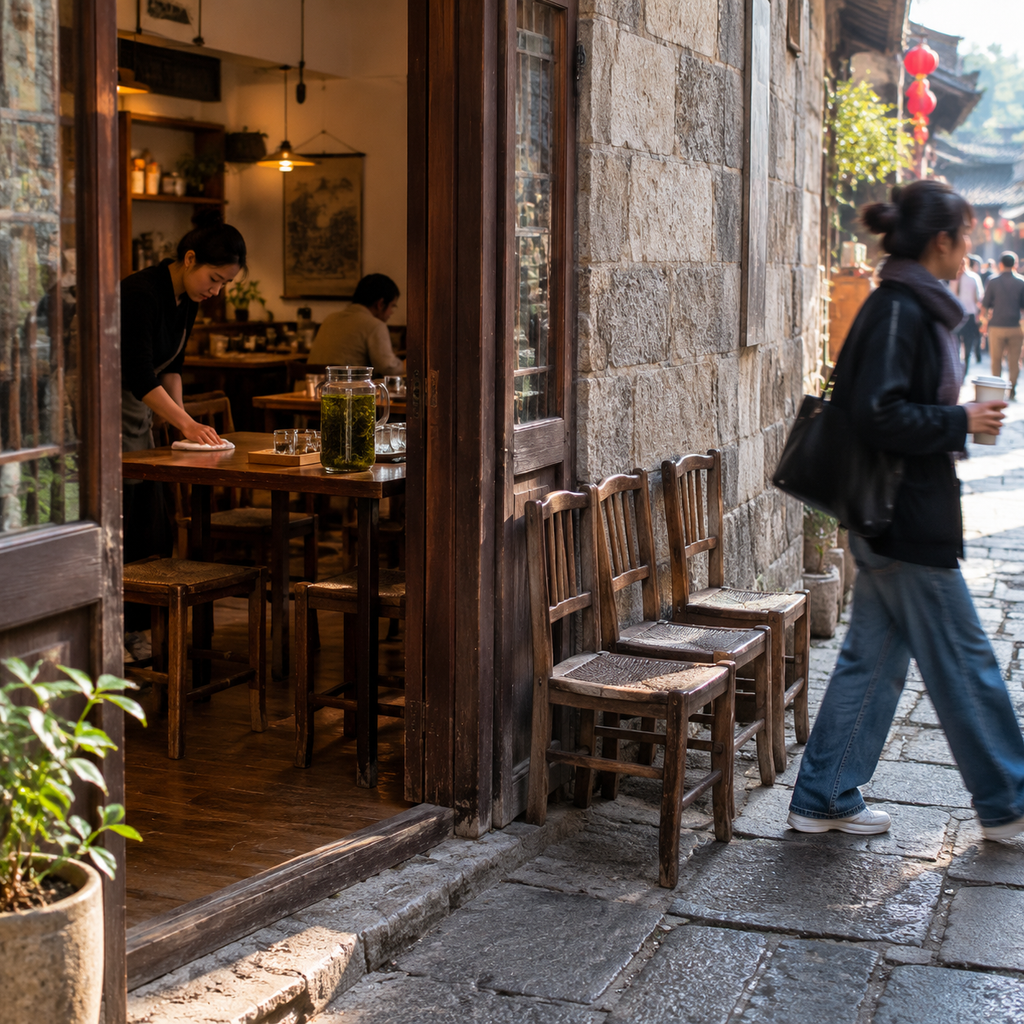
走到一处略宽的街口时,我看见一间临街的小茶店。门没有完全敞开,门槛旁放着几把靠墙的椅子,店里的人正在把桌面擦干,把玻璃杯一只只摆到光线较稳的位置。我没有因为招牌上的任何承诺停下,也没有把它当作必须打卡的地点;真正让我停住的是桌上一只透明容器里的茶叶。细直的绿叶在水里安静下沉,杯壁上没有热气,颜色也不是浓烈的绿,而是很浅、很清的一层黄绿。和街外匆匆端着热饮的人相比,这杯看起来像是在等,而不是在催促谁赶紧喝完。
At a slightly wider junction, I noticed a small tea shop facing the street. Its door was not fully open. A few chairs rested against the wall beside the threshold, and someone inside was drying the tabletops and arranging glass cups where the light was more even. I did not stop because of a promise on a sign, nor did I treat the place as a required check-in point. What held me was a transparent vessel of tea leaves on the table. Slender green leaves were settling quietly in water. There was no steam on the glass, and the color was not an intense green but a pale, clear wash of yellow-green. Compared with the people outside carrying hot drinks in a rush, this cup looked as though it was waiting rather than urging anyone to finish it.
我站在门边犹豫了一会儿,先问自己有没有这个空当。那时我还用“空当”来衡量停留,仿佛喝一杯茶必须从别的安排里扣除。店里的人没有催我进,也没有替我安排座位,只是继续做手上的事:把杯盖放好,把茶叶从容器里拨散,检查水面有没有浮起太多叶片。我于是坐到靠近街面的地方,把背包放在脚边。坐下以后,我才意识到自己已经走了不短的一段路,脚掌因为不断寻找平整石面而有点发紧。原计划中的下一站忽然没有消失,但它从一个逼着我前进的命令,变成了晚一点也能抵达的地点。
I hesitated by the door and first asked myself whether I had room in the schedule. At that point, I still measured a pause as “free time,” as though a cup of tea had to be deducted from another arrangement. No one inside urged me to enter or assigned me a seat. The work simply continued: lids were put in place, leaves were gently separated in the vessel, and the surface of the water was checked for too many leaves floating up. So I sat near the street and placed my backpack by my feet. Only then did I notice that I had already walked quite far; the soles of my feet were tight from constantly searching for level stones. My next planned stop had not disappeared, but it changed from an order that pushed me forward into a place I could reach a little later.
冷泡毛尖的开始几乎没有戏剧性。茶叶先在凉水里舒展,最初只是浮着、斜着,像还没决定要不要留下颜色。过了一阵,叶片逐渐沉下去,线条变软,水色也从透明慢慢有了层次。我看着这个过程,才明白为什么它不适合被催。热水能迅速把香气和滋味推出去,冷水却像把门开得很窄,让叶子一点点交出东西。它没有立刻给我一个明确答案:香不香、浓不浓、值不值得等。它要求我把注意力留在杯子附近,而不是每隔几十秒就把手机亮起来确认下一步。
The beginning of cold-brewed Maojian was almost without drama. The leaves opened in cool water. At first they merely floated or tilted, as if they had not decided whether to release any color. After a while, they gradually sank, their lines softened, and the water moved from transparency toward layers of tone. Watching this process, I understood why it did not suit being rushed. Hot water can force aroma and flavor forward quickly, while cool water seems to open a very narrow door and let the leaves give something up little by little. It did not immediately answer my questions: Was it fragrant? Was it strong? Was it worth waiting for? It asked me to keep my attention near the cup instead of lighting my phone every few moments to confirm the next step.
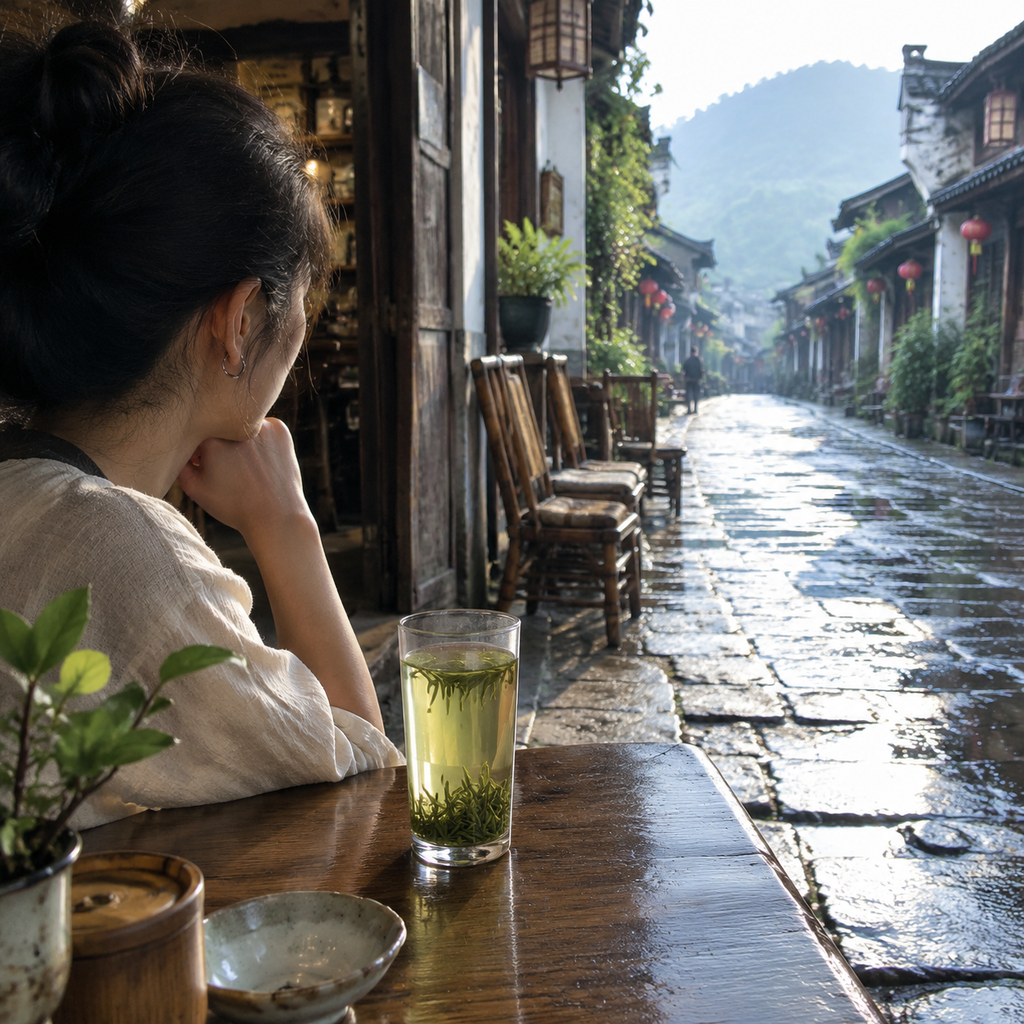
我后来仔细看了看杯里的变化。叶片并不是整齐地同时下沉,有的先贴住杯壁,有的仍在水面附近转动,有的已经在底部摊开。水温不高,杯子摸起来没有烫手的警告,反而有一点凉意。这样的冲泡方式让我自然放弃了“趁热喝”的动作,也放弃了把茶当作提神工具的想法。等候本身变成一件可见的事:我能看见叶片的姿态变了,能看见光透过水时颜色更清楚,能听见街上推车轮子压过石缝的声音。一杯茶没有替我解决路线,却先把我从路线的紧张里拉出来。
I later watched the changes in the glass more closely. The leaves did not sink together in a neat formation. Some attached themselves to the wall of the cup, some still turned near the surface, and others had already spread across the bottom. The water was not hot, and the glass gave no warning burn when I touched it; it carried a slight coolness instead. That method of brewing made me give up the automatic motion of drinking quickly while hot, and it also made me stop thinking of tea as a tool for stimulation. Waiting itself became visible: I could see the posture of the leaves change, see the color become clearer when light passed through the water, and hear the wheels of a cart crossing the seams between stones outside. The tea did not solve my route, but it first pulled me out of the tension created by that route.
第一口的味道比我预想得轻。它不是我熟悉的那种立刻占住口腔的浓烈茶味,而是先有清凉的水感,再慢慢露出一点植物般的鲜意。入口时没有热饮常带来的猛烈香气,舌头两侧却能感觉到一种很干净的收束感。咽下去以后,嘴里没有被苦味压住,反而留下了比较长的清爽感。我没有急着给它下“好喝”或“不好喝”的判断,只是又喝了一口。第二口之后,味道开始变得更容易辨认:淡淡的青绿气息、接近嫩叶的鲜感、很轻的回甘,都不像在抢着出现,而像在我停下来之后才愿意被发现。
The first sip was lighter than I expected. It was not the strong tea flavor I knew, the kind that immediately occupies the whole mouth. First came the cool feeling of water, and then a gradual vegetal freshness. It lacked the forceful aroma often carried by a hot drink, yet the sides of my tongue felt a clean, narrowing finish. After I swallowed, bitterness did not press down on my mouth; a fresh sensation remained for a surprisingly long time. I did not rush to call it good or bad. I simply took another sip. After the second one, the flavor became easier to recognize: a faint green scent, a freshness close to tender leaves, and a very gentle returning sweetness. None of them seemed to compete for attention; they appeared only after I had stopped long enough to notice.
那杯茶也让我重新注意到水的作用。旅行时,我常把喝水当成补充体力的步骤,拧开瓶盖、喝几口、继续走,动作快得像在完成任务。冷泡茶里的水却保留了自己的存在感。它先是凉的、软的,然后才带着茶叶给出的气味和涩感向前走。因为水没有被高温推到最前面,叶片的细节显得更慢,也更容易分开感受。我能尝到一点微微的涩,却不觉得它粗糙;我也能感到茶味不厚,却不觉得空。这样的口感让我想到石板街:表面并不平整,但脚步放稳以后,细小的不平反而让人知道自己正在走路。
That cup also made me notice the role of water again. When I travel, I often treat drinking water as a step in restoring energy: twist the cap, take several gulps, keep walking. The action is so fast that it feels like a task. In cold-brewed tea, the water kept its own presence. It arrived cool and soft before carrying forward the aroma and slight astringency released by the leaves. Because heat had not pushed everything to the front, the details of the leaves unfolded more slowly and were easier to distinguish. I could taste a mild astringency without finding it rough; I could feel that the tea was not heavy without finding it empty. The flavor reminded me of the stone street: its surface was not smooth, but once my steps became steady, the tiny unevenness told me that I was actually walking.
茶店里的动作持续得很安静。有人把刚洗过的杯子倒扣在布上,有人把散在桌边的水珠擦到一处,有人朝街口看一眼,再回到手里的茶具。隔壁桌的一位客人没有一直低头看屏幕,而是把杯子挪到窗边,等光线从叶片上移过去。我不需要知道这些人的身份,也不该替他们编出故事;仅仅是这些重复而细小的动作,就足以改变我对“停留”的理解。街坊经过门口时,有人放慢脚步看看里面,有人仍旧赶路,有人把手里的东西换到另一只手。没有谁宣布这里是一个慢下来的地方,但每个人的身体都在用不同的速度说明时间并不只有一种用法。
The movements inside the tea shop continued quietly. Someone placed freshly washed cups upside down on a cloth. Someone gathered scattered drops of water from the table. Someone glanced toward the street corner and then returned to the tea utensils in hand. At the next table, a customer did not keep looking down at a screen, but moved a cup toward the window and waited for the light to travel across the leaves. I did not need to know who these people were, and I should not invent stories for them. Those small, repeated actions alone changed my understanding of what it meant to pause. Neighbors passing the doorway slowed to look inside, while others kept moving, and some switched what they were carrying from one hand to the other. No one announced that this was a place to slow down, yet every body used a different speed to show that time has more than one purpose.
我原来给这一天排得太满:先走街巷,再去看一个室内地点,然后找午饭,下午再赶另一片区域。这个安排在屏幕上看起来顺滑,像一条没有缝的线;放到脚下,却暴露出许多没有算进去的东西:湿滑的石面、为了避让而绕出的几步、停下来认路的时间、身体开始疲劳时注意力变窄的感觉。坐在茶店里,我把路线纸摊开,没有把任何一个目标划掉,而是把顺序改了。原本必须在上午完成的部分,改成看当天脚力和天气再决定;离得更远的一段不再硬接在午饭前;眼前这条街则被允许多走一会儿。
I had packed the day too tightly: first the lanes, then an indoor stop, then lunch, and then another area in the afternoon. On a screen, the arrangement looked smooth, like a line without seams. Under my feet, it exposed everything I had not calculated: slippery stones, the extra steps needed to make way for others, the time spent stopping to find my direction, and the narrowing of attention when the body began to tire. Sitting in the tea shop, I unfolded my route sheet. I did not cross out any destination, but I changed the order. What had seemed mandatory for the morning became something to decide according to my energy and the weather; a farther segment would no longer be forced in before lunch; and the street in front of me was allowed to take a little more time.
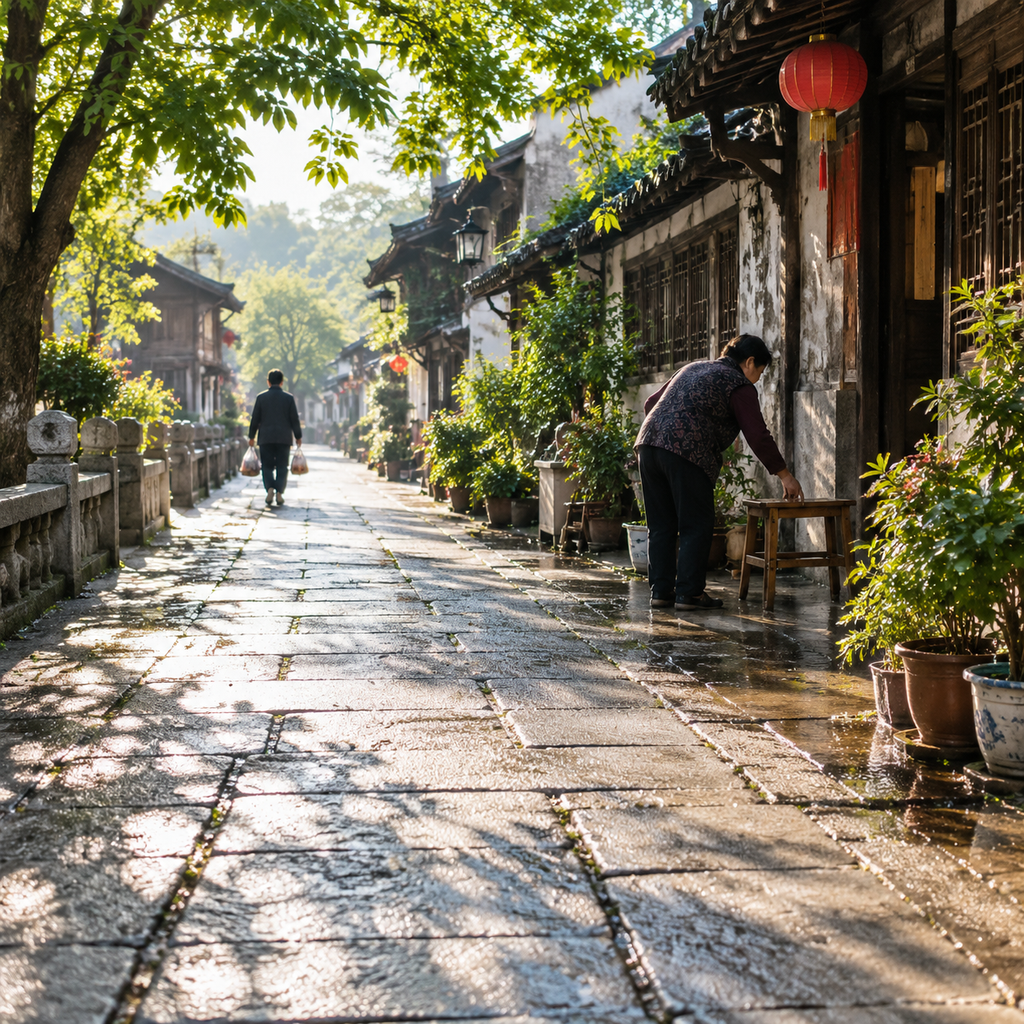
这个调整听起来很小,但它改变了我走出去时的眼神。我不再只找能把我带离这条街的出口,也开始看街面怎样转折,屋檐下的阴影怎样移动,哪些地方有人停下来整理东西,哪些位置会突然传来碗碟碰撞或脚步变密的声音。我发现一条老街并不是一条固定的观光线路,它会被送货的人、出门买菜的人、临时避雨的人和寻找方向的游客一起使用。若我只想用最快速度通过,就只能看到它最扁平的一面。把步行段留长一点以后,我并没有因此掌握更多“景点信息”,但我对这条街如何被日常使用有了更真实的感受。
The adjustment sounded small, but it changed the way I looked when I stepped outside again. I was no longer searching only for the exit that would take me away from the street. I began to notice how the pavement turned, how shadows shifted under the eaves, where people paused to arrange what they carried, and where the sound of dishes or denser footsteps suddenly emerged. I realized that an old street is not a fixed sightseeing route. It is used together by people delivering goods, people leaving to buy vegetables, people taking cover from rain, and travelers trying to find their way. If I wanted only to pass through as fast as possible, I would see only its flattest surface. By leaving more time for walking, I did not acquire more “attraction information,” but I gained a truer sense of how the street was used in ordinary life.
真正的小插曲发生在我离开茶店之后。为了追回原先的时间,我一度又加快了步伐,结果在一个看似相似的岔口拐错了方向。那条支巷比我刚才走过的更窄,石板也更潮,我走了几分钟才发现手机上的定位和眼前的朝向对不上。起初我有点懊恼,觉得那杯茶害我松了警惕;可回头看时,我发现自己并没有走到无法挽回的地方。附近有人正把门口的物件收进屋里,另一位路过的人看见我停在路边看地图,便用手势指了指我应该回去的方向。我没有把这件事写成戏剧性的相遇,只把它当作一段很普通的互相确认:我抬头、看懂手势、道谢,然后沿原路慢慢折返。
The real small incident happened after I left the tea shop. Trying to recover the time I had originally planned, I sped up again and took a wrong turn at a junction that looked much like the others. That side lane was narrower than the one I had just walked, and its stones were damper. After several minutes, I realized that the direction on my phone no longer matched what I saw around me. At first I was annoyed and thought the tea had made me careless. But when I looked back, I saw that I had not gone anywhere beyond repair. Someone nearby was bringing objects from a doorway inside, and another passerby saw me standing beside the lane with my map and pointed in the direction I needed to return. I do not turn this into a dramatic encounter. I remember it as a very ordinary act of mutual confirmation: I looked up, understood the gesture, thanked the person, and walked back slowly along the same way.
折返时,我没有像先前那样把走错路当成纯粹损失。刚才被我忽略的细节重新出现:一段石板边缘比别处更高,必须跨过去;一扇门前有晾着的布,风一来就轻轻碰到墙;有个转角看不到远处,只能先听见人声再决定要不要让路。路线调整的意义也在这里,它不是把一天重新排成更漂亮的表格,而是承认现场会不断给人新的条件。对我来说,最实际的改变是把地图从“指令”改成“参考”。我仍然看它,但不再要求街道完全服从它,也不再因为多走几分钟就觉得旅行出了问题。
On the way back, I no longer treated the wrong turn as a pure loss. Details I had ignored earlier returned: one section of stone stood higher than the rest and had to be stepped over; cloth hung outside a doorway and touched the wall lightly when the wind came; at one corner I could not see ahead and had to hear voices before deciding whether to make way. This was also the meaning of adjusting a route. It was not about arranging the day into a prettier table, but about admitting that the actual place keeps giving new conditions. For me, the most practical change was to turn the map from an instruction into a reference. I still used it, but I no longer demanded that the street obey it completely, and I no longer treated an extra few minutes of walking as evidence that the trip had gone wrong.
后来我又回到那间茶店附近,没有急着再点一杯,只是站在街对面看了一会儿。阳光比早晨更亮,石板上的湿痕正在缩小,来往的人也更多了。店里仍有人忙着收拾,杯中的叶片已经完全舒展开来。我突然想到,冷泡茶最适合这条街的地方,并不是它有什么可以被夸张描述的“仪式感”,而是它让许多本来被我压缩掉的过程重新显形:水慢慢变色,叶子慢慢沉下,脚步慢慢找到节奏,路线慢慢接受修改。它们都不是惊人的变化,却共同构成了一个完整上午。
Later I returned to the area near that tea shop. I did not hurry to order another cup; I simply stood across the street for a while. The sunlight was stronger than in the morning, the damp marks on the stones were shrinking, and more people were passing through. Someone inside was still tidying up, and the leaves in the cups had opened fully. It occurred to me that what suited cold brew to this street was not any exaggerated “sense of ritual.” It was the way it made processes I had compressed out of sight become visible again: water slowly changing color, leaves slowly sinking, footsteps slowly finding a rhythm, and a route slowly accepting revision. None of these were startling changes, yet together they made a complete morning.
我也开始明白,城市节奏并不是一个由别人决定、我只能被动承受的东西。早高峰般的急促、商业街上的密集声响、导航不断提示下一步,这些都会把人推向更快的状态;但人也能通过一些小选择调节自己与城市的关系。对我而言,那天的选择不是躲开城市,而是在城市里留下几个不需要立刻产出的停顿:进一间没有事先列入清单的小店,坐到靠街的位置,等茶叶舒展,发现走错路后先确认再折返。它们没有让城市变慢,却让我不必以同一种速度回应每一处催促。
I also began to understand that a city’s pace is not something entirely decided by others and passively endured by me. The urgency of a morning rush, the dense noise of a commercial street, and navigation prompts that constantly announce the next step can all push a person toward greater speed. But a person can also adjust the relationship with the city through small choices. My choice that day was not to escape the city. It was to leave several pauses inside it that did not need to produce an immediate result: entering a shop that was not on my list, taking a seat by the street, waiting for the leaves to open, and confirming my direction before turning back after a wrong turn. These actions did not make the city slower, but they meant I did not have to answer every pressure at the same speed.
从实用的角度看,这次经历也替我改了一条后来常用的步行原则。只要行程里有石板街、巷道或需要频繁辨认方向的旧城区,我会预留比地图预计更长的时间,并把最远、最难替换的安排放在体力和天气都更可控的时段。我会在出发前看路线,但不会把每一个拐角都当成必须精确完成的节点;我会随身带水,也愿意在合适的地方用一杯茶替换一次匆忙的补给;我会在疲劳前先坐下,而不是等到双脚和情绪一起变硬。这些不是关于“慢旅行”的口号,而是让步行更安全、更清醒、更不容易错过现场信息的做法。
In practical terms, the experience also changed a walking principle that I now use often. Whenever an itinerary includes stone streets, lanes, or an older district where I must repeatedly work out my direction, I leave more time than the map predicts and place the farthest, least replaceable activity in a period when my energy and the weather are more manageable. I study the route before leaving, but I do not treat every corner as a checkpoint that must be completed with precision. I carry water, and I am willing to replace one hurried refill with a cup of tea when the setting feels right. I sit down before fatigue makes both my feet and my mood rigid. These are not slogans about “slow travel.” They are ways to make walking safer, clearer, and less likely to miss information offered by the place itself.
毛尖冷泡茶留给我的另一层印象,是它没有逼我把感受说得太满。它并非每一口都完全相同:放得更久一点,茶味会更明显;杯里叶片的位置变化,闻起来和喝起来的重心也似乎会不同。可我不想假装自己能用精确术语把所有变化都说清。那天我感到的是一种从凉水开始、带着清鲜和轻微涩感、最后回到口腔里的干净余味。这样的描述已经足够,因为它对应的是我当时真实的身体状态:走了路,出了点汗,脚底累了,坐下来以后慢慢恢复。茶没有变成一个被神化的主角,它只是恰好在这个时刻给了我一个不必加速的理由。
Another impression left by cold-brewed Maojian was that it did not force me to describe my feelings too fully. Not every sip was exactly the same. After it sat longer, the tea flavor became more distinct; as the leaves shifted position in the cup, the balance of what I smelled and tasted seemed to change as well. But I do not want to pretend that I can name every variation with precise terminology. What I felt that day was a flavor beginning with cool water, carrying fresh green notes and a slight astringency, then returning as a clean finish in my mouth. That description is enough because it matches my actual physical state: I had walked, sweated a little, tired the soles of my feet, and then gradually recovered after sitting down. The tea did not become a glorified protagonist. It simply gave me a reason not to accelerate at that moment.
下午我最终没有去完最初列出的所有地点。起初这会让我产生一点不甘心,尤其当我想到自己已经花了时间做攻略、标记路线、计算移动距离时。但当我从石板街转到更开阔的路上,回看那段上午,我发现自己记得最清楚的不是少去了一处什么,而是几个非常具体的片段:凉水里浮着的细叶,玻璃杯外没有雾气的触感,店里擦桌子的声音,陌生人指回路的手势,鞋底在潮石上主动放轻的力道。这些片段没有占据地图上的大格子,却让那一天不再只是完成清单的证明。
In the afternoon, I ultimately did not complete every place on my original list. At first that created a little reluctance, especially because I had already spent time researching, marking routes, and calculating travel distances. But when I left the stone street for a broader road and looked back on the morning, I found that what I remembered most clearly was not which place I had missed. It was a set of very specific moments: slender leaves floating in cool water, the clear touch of a glass without condensation from steam, the sound of tables being wiped inside the shop, the hand gesture of a stranger pointing me back, and the deliberate lightness I put into my soles on damp stone. These moments did not occupy large boxes on a map, yet they kept the day from becoming merely proof that I had completed a list.
傍晚再想起这段路时,我没有把它包装成某种标准答案。不同的人走同一条石板街,可能会因为天气、同行者、体力、方向感或当天的安排,得出完全不同的选择。有人适合继续赶路,有人愿意坐得更久;有人偏爱热茶,有人像我一样会被冷泡的缓慢吸引。我能确认的只是,那杯毛尖让我在一个普通的街角暂停了足够久,久到我重新听见自己的脚步,久到我肯承认路线可以更改,久到我不再把短暂的迷路当成失败。等我离开时,街面已经干了不少,石板仍然向前延伸,而我把手机收进口袋,先看了看脚下,再继续走。
When I thought of that walk again in the evening, I did not turn it into a standard answer. Different people can walk the same stone street and make entirely different choices because of the weather, companions, energy, sense of direction, or plans for the day. Some may be better served by continuing quickly, while others may want to sit longer. Some prefer hot tea, while others, like me, may be drawn to the slowness of cold brew. What I can say with certainty is that the cup of Maojian paused me at an ordinary street corner for long enough to hear my own footsteps again, long enough to admit that a route could be revised, and long enough to stop treating a brief wrong turn as failure. By the time I left, much of the street had dried, the stones still extended ahead, and I put my phone in my pocket, looked at the ground beneath me, and continued walking.
我回到店门前时,想起自己一开始为什么会把这段街道安排得那么紧。旅行前做功课时,我担心遗漏,担心没有把有限的时间用到“最值得”的地方,于是习惯把地图上的点连成一条尽可能短的线。可石板街并不是一张可以任意折叠的纸。它有自己的坡度、窄处、住户的出入时间和早晚不同的湿度。地图能告诉我大致距离,却无法替我感受鞋底是否已经发酸,也无法告诉我一个街口此刻正有人搬东西,另一处转弯后是否需要停下来等人先过。把这些变量承认进计划,不是降低效率,而是把真实行走算进效率。
When I returned to the shopfront, I remembered why I had scheduled this stretch of street so tightly in the first place. While preparing for the trip, I was afraid of missing things and afraid of failing to use limited time on what seemed “most worthwhile,” so I had become used to linking map points into the shortest possible line. But a stone street is not a sheet of paper that can be folded however I please. It has its own slope, narrow passages, residents' times of coming and going, and different levels of dampness in the morning and evening. A map can tell me an approximate distance, but it cannot feel whether the soles of my feet have begun to ache, or tell me that someone is moving things at one junction while another turn requires waiting for people to pass. Allowing for those variables is not a reduction in efficiency; it is a way of counting real walking as part of efficiency.
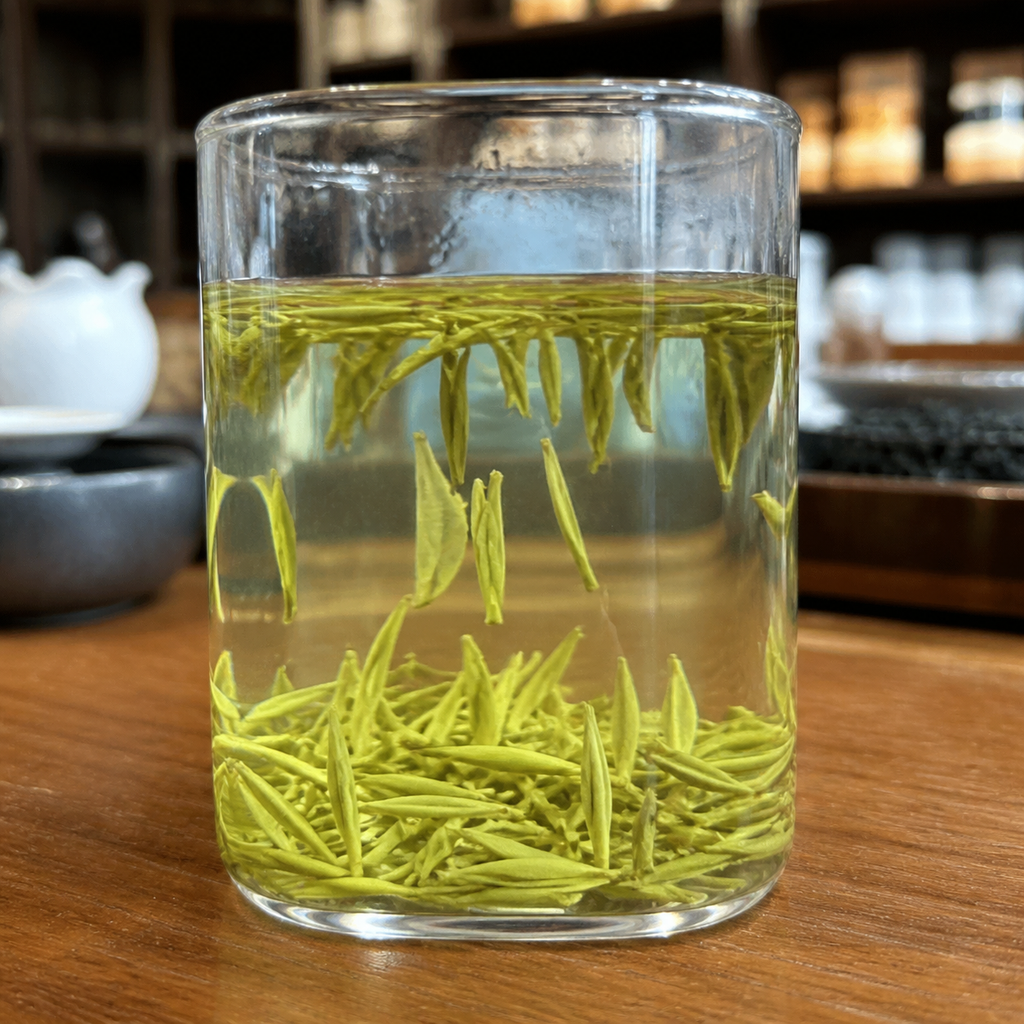
我把冷泡茶喝到后半杯时,水色已经比刚端来时深了一点。杯底的叶片不再像刚入水时那样紧缩,叶脉和卷曲处在透明玻璃里变得可见。我没有去碰杯子里的叶子,只是转动杯身,让靠窗的光从另一个角度照过去。香气仍然很轻,更多是在我把杯子靠近时才显出来,不像热茶那样隔着一段距离就能闻见。它有一种接近青草、嫩叶和清水的感觉,但我不愿把这种感受夸张成某种唯一正确的标准。不同的水、茶量、浸泡时间和个人口味都会改变结果。那天真正重要的是,我终于不再要求一杯饮料立刻给我强烈刺激。
By the second half of the cold brew, the color had become slightly deeper than when it first arrived. The leaves at the bottom no longer looked tightly drawn as they had upon entering the water; veins and curled edges became visible through the clear glass. I did not touch the leaves. I simply rotated the cup so that window light crossed them from another angle. The aroma remained delicate and appeared mainly when I brought the cup close, rather than reaching me from a distance as hot tea often does. It suggested grass, tender leaves, and clean water, but I do not want to exaggerate that sensation into one universal standard. Different water, leaf amounts, steeping times, and personal tastes will all change the result. What mattered that day was that I finally stopped demanding an immediate, forceful stimulus from a drink.
我注意到店里的人处理茶叶时很克制。没有大幅度摇晃容器,也没有为了让颜色更快出来而不断搅动。有人把盖子轻轻放回原处,有人先看一眼叶片状态,再决定要不要挪动杯子。这样的动作让我意识到,冲泡不只是把茶叶放进水里那么简单,它还包括不急着干预。旅行中我也常犯同样的错误:一看到人少就急着往前赶,一发现导航偏了就不断切换路线,一感到无聊就掏出手机填满空白。可有些变化不需要我立刻插手。叶子需要时间沉下,街道需要时间让我读懂,身体也需要时间告诉我今天还能走多远。
I noticed how restrained the people in the shop were when handling the leaves. No one shook the vessel vigorously or stirred it constantly to force color out faster. Someone placed a lid back gently; someone first looked at the condition of the leaves before deciding whether a cup needed to be moved. Those actions made me realize that brewing is not merely putting leaves into water. It also includes not interfering too soon. I often make the same mistake while traveling: rushing ahead the moment a path looks less crowded, repeatedly switching routes when navigation drifts, or taking out my phone to fill every blank moment of boredom. Yet some changes do not need my immediate intervention. Leaves need time to sink, a street needs time for me to understand it, and my body needs time to tell me how far I can still walk that day.
街坊的生活节奏并不统一,这一点在茶店门口看得很清楚。有位老人把脚步放得很稳,提着东西从石板较平的地方走过去;一个年轻人从巷子里快步出来,手上拿着未喝完的饮料,转眼就消失在拐角;还有人停在门边整理袋子里的物品,像是在确认有没有漏带什么。起初我只把这些人当作街景的一部分,后来却感到他们每个人都在进行自己的路线调整。有人为路面放慢,有人为工作加快,有人为手里的东西停下。城市不是一条统一速度的传送带,至少在这条街上,它更像许多不同节拍暂时并列在一起。
The neighborhood's rhythm was not uniform, and this was clear from the tea shop doorway. An older person walked with steady steps, carrying things along a flatter part of the stones. A younger person emerged quickly from a lane with an unfinished drink in hand and disappeared around the corner. Someone else stopped by the door to rearrange items in a bag, as if checking whether anything had been forgotten. At first I treated these people as part of the street scene. Later I felt that each of them was making a route adjustment of their own. One slowed for the pavement, another accelerated for work, and another paused for what was in hand. A city is not a conveyor belt set to one speed. At least on this street, it was more like many different rhythms temporarily existing side by side.
我第二次经过那处岔口时,刻意没有马上低头看导航。我先看石板的走向,再看远处有没有我记得的屋檐和门口,再听一听人流是从哪个方向变密的。这样做并不能替代地图,却让我从被屏幕牵着走,变成主动把屏幕上的信息和眼前的空间对照。确认之后,我才掏出手机,发现自己确实应该沿着更宽的方向继续。这个小动作后来很有用:在陌生街区里,先抬头建立方位感,再看屏幕校正细节,往往比边走边盯着箭头更不容易错过路面、人流和转弯的提示。
The second time I passed that junction, I deliberately did not look down at navigation immediately. I first watched the direction of the stones, then looked for eaves and doorways I remembered in the distance, and listened for the direction in which the flow of people grew denser. This did not replace a map, but it changed me from someone led by a screen into someone actively comparing screen information with the space in front of me. After that check, I took out my phone and found that I really should continue along the wider way. The small habit later proved useful: in an unfamiliar neighborhood, looking up to establish orientation first and using the screen to correct details is often less likely to miss the pavement, crowds, and signals of an upcoming turn than walking while staring at an arrow.
那天的失路并没有造成严重后果,但它让我重新安排了午饭前的距离。我原本还想绕到更远的街区,觉得既然已经出门,就应该把脚力用到最后。后来我把这个念头放下,选择在附近完成一段更短的步行。这个决定不是因为我突然讨厌远处的地方,而是因为我开始区分“还能去”和“去了会不会更好”。脚底发紧、注意力被路面分走、天气仍有潮意,这些都是判断条件。把目的地留给另一个状态更好的上午,并不意味着放弃;它是在承认自己不是只由愿望组成,也由体力、方向感和当下环境组成。
Getting lost that day did not cause a serious problem, but it made me rearrange the distance I would cover before lunch. I had originally wanted to circle toward a farther district, thinking that since I was already out, I should use every bit of walking energy. Later I let that thought go and chose to complete a shorter walk nearby. This was not because I suddenly disliked the distant place. It was because I began to distinguish between “I can still go” and “Would going make the day better?” Tightness in my feet, attention pulled away by the pavement, and lingering dampness in the weather were all conditions for judgment. Saving a destination for another morning when I was in better shape was not giving up. It was recognizing that I am made not only of intentions, but also of stamina, orientation, and the present environment.
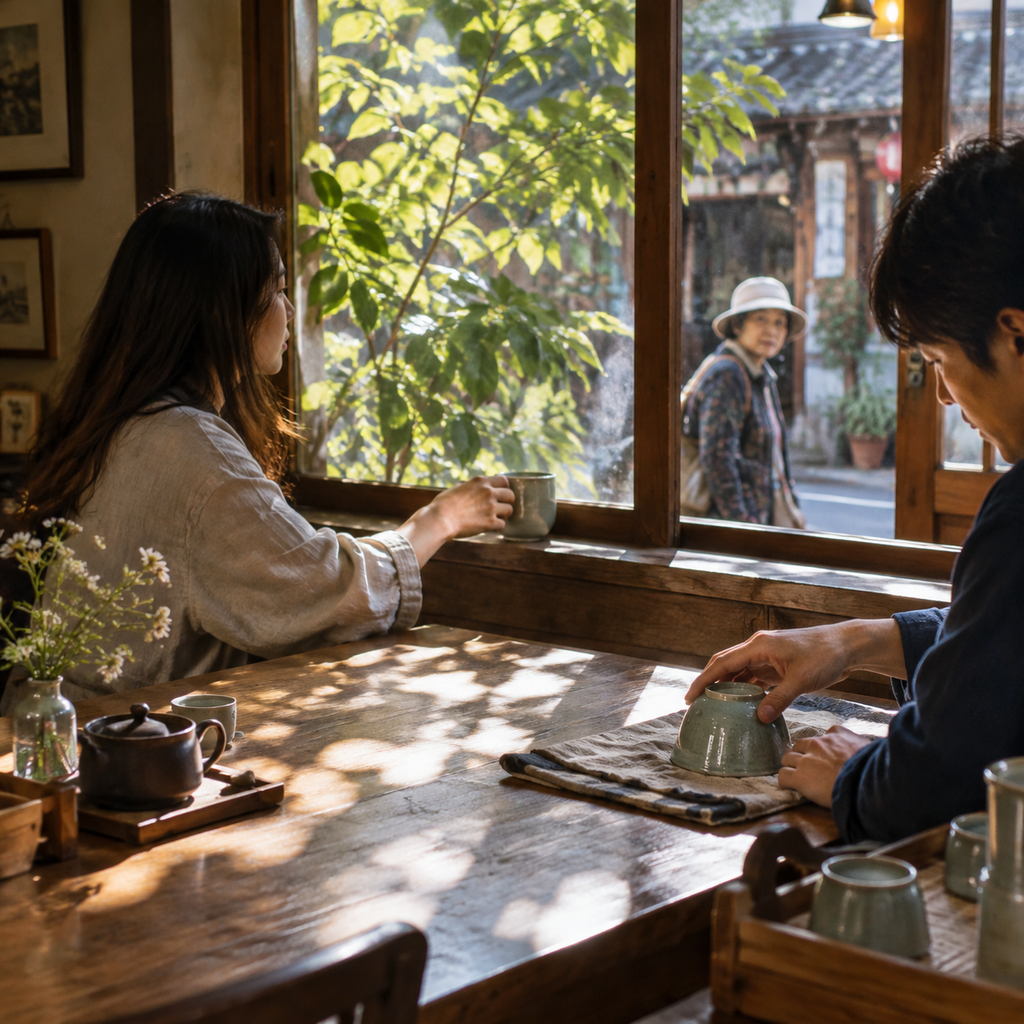
我很喜欢冷泡茶在口中留下的那种慢后劲。它不是喝下去以后忽然冒出一个强烈的味道,而是在我说话、看街、收拾背包的间隙里,仍能感觉到一点清甜和微涩。这个延迟让我愿意把喝茶和走路分开处理:不是站着两口喝完就出发,而是在坐下时好好喝,在出发后让味道自然留一会儿。许多旅行中的体验其实也有类似的延迟。刚看见一条街时,我可能只觉得它窄、湿、难走;离开一段时间后,我才想起光落在杯里的颜色,想起自己为了避开水痕放慢脚的动作。不是所有感受都必须在现场立刻写成结论。
I liked the slow after-effect that cold-brewed tea left in my mouth. It was not a powerful flavor that suddenly appeared after swallowing. Instead, in the gaps while I spoke, watched the street, or packed my bag, I could still feel a little clean sweetness and mild astringency. That delay made me want to treat tea and walking separately: not to finish two quick sips while standing and leave, but to drink properly while seated and let the flavor remain naturally after I set out. Many travel experiences have a similar delay. When I first see a street, I may only think that it is narrow, wet, and difficult to walk. After leaving it for a while, I remember the color of light in a cup and the way I slowed my steps to avoid damp marks. Not every feeling must be turned into a conclusion immediately on the spot.
在茶店坐着时,我把背包里几样东西重新放了一遍。路线纸从最外面挪到容易取的位置,水瓶没有再塞得太紧,外套也搭在椅背上晾一晾潮气。这些动作很普通,却让下一段步行轻松许多。以前我会把整理背包看作出门前一次性完成的工作,仿佛中途停下来重新分配物品说明我准备不足。现在我更愿意把它看成路上的维护。和调整路线一样,整理不是承认失败,而是根据已经发生的事修正身体周围的小秩序。街道不会因为我背包乱了而停下,正因为如此,我更需要在可停的时候把手边的东西放好。
While sitting in the tea shop, I rearranged several things in my backpack. I moved the route sheet from the deepest layer to a place I could reach easily, stopped squeezing the water bottle in too tightly, and placed my jacket over the chair to let some dampness air out. These were ordinary actions, yet they made the next stretch of walking much easier. I once treated organizing a backpack as a task completed once before leaving, as if stopping midway to redistribute things meant I had prepared poorly. Now I prefer to see it as maintenance on the road. Like adjusting a route, organizing is not an admission of failure. It is a way to revise the small order around my body according to what has already happened. The street will not stop because my backpack is disordered; that is exactly why, when I can pause, I need to put what is near me in order.
我没有向任何人询问所谓最标准的冷泡方法,也没有把那一杯的比例、浸泡时长记成可复制的公式。对一个陌生人来说,这样问或许会显得突兀;对我自己来说,那天也不是来做一场严格的品鉴。可我观察到几个很直观的原则:水温较低时,味道出来得慢;叶子需要舒展空间;随着时间推移,颜色和口感都会变化;不必因为第一口淡,就急着否定它。这些观察足够让我在以后遇到冷泡茶时更有耐心,也让我懂得,旅行里的学习不一定总是从一串权威数字开始,有时先把眼睛和舌头放慢就够了。
I did not ask anyone for a supposedly standard cold-brew formula, and I did not record the leaf ratio or steeping time from that cup as a reproducible equation. For a stranger, such a question might have felt abrupt; for me, that day was not a formal tasting session. But I noticed several direct principles: when water is cooler, flavor emerges slowly; leaves need room to open; color and taste both change with time; and a light first sip does not need to be rejected immediately. These observations are enough to make me more patient when I encounter cold-brewed tea again. They also taught me that learning while traveling does not always begin with a string of authoritative numbers. Sometimes slowing the eyes and tongue is enough.
街面开始热闹以后,停顿反而显得更有必要。人多时,石板街的速度不是由我一个人决定的。我必须看前面的人什么时候停下拍照,什么时候有人从门里出来,什么时候有人带着东西占住较窄的一段。若我执意维持手机上预想的步速,就会不断感到被打断;若我接受人流本来会改变步幅,等待就不再像浪费。那杯冷泡茶让我提前练习了这种接受。杯中的叶片不会按照我想要的速度下沉,街上的人也不会按照我想要的速度让开。两者都提醒我,最省力的办法常常不是催促,而是观察后找一个合适的位置接进去。
As the street became busier, a pause felt even more necessary. When there were more people, the speed of the stone street was not decided by me alone. I had to watch when people ahead stopped for photographs, when someone emerged from a doorway, and when a person carrying things occupied a narrow section. If I insisted on maintaining the pace predicted by my phone, I would feel interrupted again and again. If I accepted that the crowd naturally changes a person's stride, waiting no longer felt like waste. The cold brew had prepared me for that acceptance. The leaves in the cup would not sink at the speed I wanted, and people on the street would not make way at the speed I wanted. Both reminded me that the least exhausting response is often not to urge, but to observe and then enter at an appropriate moment.
我还记得一次很小的让路。前方有人从一扇门里搬出东西,通道只剩下一人宽。我原本可以从旁边急着挤过去,但鞋底刚踩到较湿的一块石面,就停住了。对方先把手上的物件稳住,我退到稍宽一点的位置,等通道重新空出来才走。这件事没有什么值得夸大的礼节意义,却让我觉得整条街的关系变得具体:不是“游客”和“本地生活”彼此对立,而是不同的人在有限的空间里轮流使用通道。只要我愿意把十几秒还给别人,自己也不必带着冒险和急躁继续走。
I also remember one very small moment of making way. Someone ahead was carrying things out through a doorway, leaving only enough room for one person. I could have tried to squeeze past, but when my sole reached a wetter stone, I stopped. The other person first steadied what was in hand. I stepped back to a slightly wider spot and walked on only after the passage opened again. There is no grand lesson in this act of courtesy, but it made the relationship on the whole street concrete. It was not “tourists” versus “local life.” It was different people taking turns using a limited passage. By returning ten or fifteen seconds to someone else, I did not need to continue with risk and impatience in my own body.
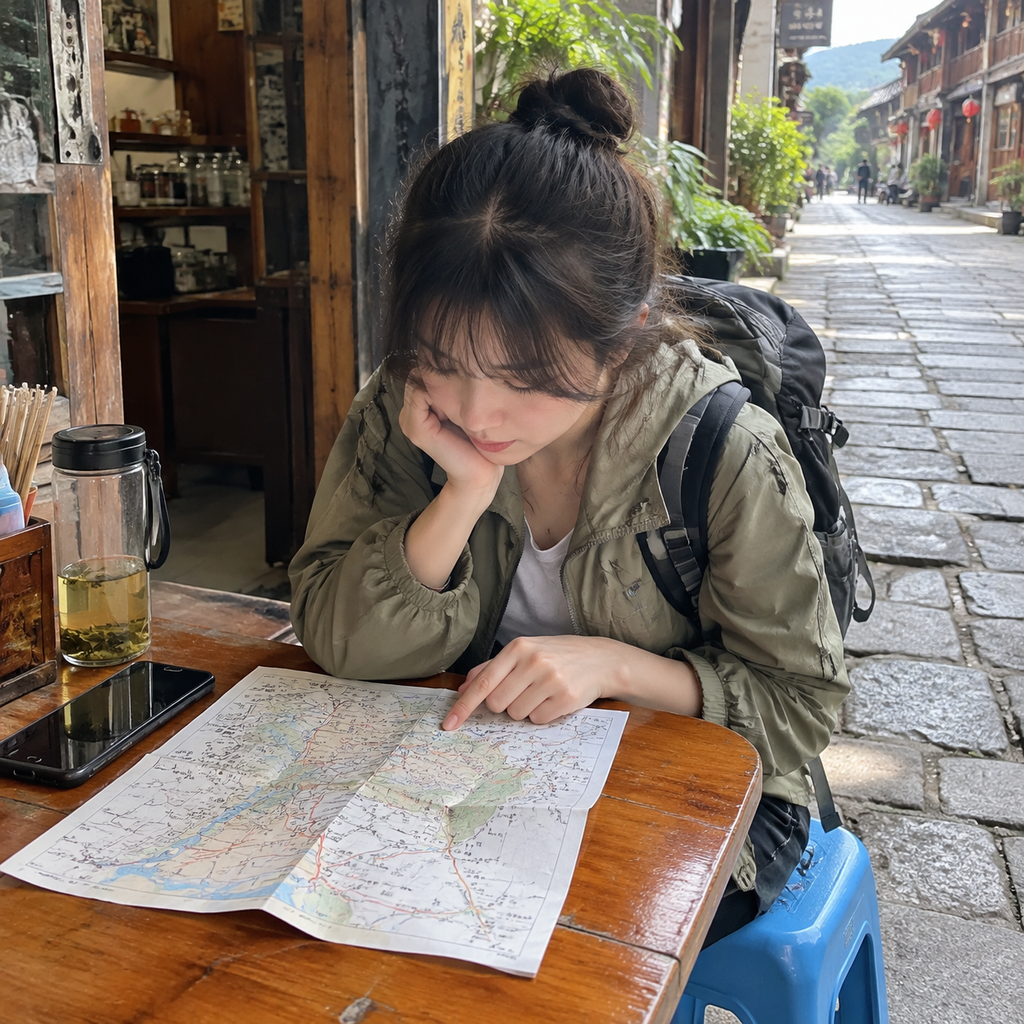
后来我在较开阔的地方重新确认下午安排,发现删去一个远处地点以后,时间并没有变得空洞。相反,我有余裕找一处合适的位置吃饭,也有余裕在天气变化前决定是否继续步行。以前我常把空出来的时间视为必须立刻填补的缺口,结果总会再加一个临时目的地,最后又把自己推回匆忙里。那天我没有这样做。我把空出来的一小段当作缓冲,用来应对迷路、排队、临时休息或只是站在街边看一会儿。这种缓冲在行程表上看不出精彩,却比把每一格塞满更能保护一整天的判断力。
Later, in a more open area, I checked the afternoon plan again and found that removing one distant destination did not make the time feel empty. On the contrary, it gave me room to find a suitable place for lunch and room to decide whether to keep walking before the weather changed. I once treated unfilled time as a gap that had to be immediately occupied, so I would add another temporary destination and eventually push myself back into haste. I did not do that day. I treated the small amount of free time as a buffer for getting lost, queues, an unplanned rest, or simply standing by the street to watch for a while. This buffer may not look exciting on an itinerary, but it protects a day's capacity for judgment better than filling every box.
对我来说,毛尖在那天并不只是一个地方性符号,也不是我可以借来装饰游记的名词。它首先是一杯具体的饮品:透明杯子、凉水、慢慢展开的绿叶、清鲜而不浓重的口感。正因为它足够具体,我才不需要把它扛到过大的意义上。它让我记住的是一套身体里的顺序:先坐下,先喝一口,先看叶片和街面,再决定下一步。这样的顺序看似微小,却和我以前“先完成、再感受”的惯性正好相反。石板街的高低和冷泡茶的缓慢,把这个差别做得非常清楚。
For me, Maojian that day was not merely a local symbol, nor was it a noun I could borrow to decorate a travel essay. It was first a specific drink: a clear glass, cool water, green leaves slowly opening, and a fresh flavor that was not heavy. Because it was so specific, I did not need to carry it into an oversized meaning. What it left me with was an order inside the body: sit down first, take a sip first, look at the leaves and the street, and then decide the next step. That order seems small, but it is the opposite of my old habit of “finish first, feel later.” The rises and falls of the stone street and the slowness of cold brew made the difference very clear.
离开前,我把杯子里剩下的一点茶喝完,没有刻意等到最后一片叶子完全沉稳,也没有试图把上午的一切都拍下来。店外的光已经偏向另一侧,街上的影子拉得更长。有人从我身后经过,鞋跟敲在石板上,声音比早晨干脆。我背起包,确认路线纸和手机都在容易拿的位置,选了一条不那么赶的方向离开。那条路未必是当天最短的,但它让我保留了看路、让路和停下来的余地。石板街尽头那杯冷泡毛尖没有替我安排旅行,它只是在我快要把旅行安排得过满时,让我把脚步放回自己身上。
Before leaving, I finished the small amount of tea remaining in the cup. I did not deliberately wait until the final leaf had settled completely, and I did not try to photograph every part of the morning. Outside, the light had shifted to the other side of the street, and shadows had grown longer. Someone passed behind me, heels striking the stones with a crisper sound than in the morning. I put on my backpack, checked that the route sheet and phone were easy to reach, and left in a direction that felt less rushed. It may not have been the shortest route that day, but it left me room to watch the ground, make way, and stop. The cold-brewed Maojian at the end of the stone street did not arrange the trip for me. It simply returned my footsteps to me when I was close to arranging the trip too full.
走出最后一段石板时,我没有立刻恢复原先那种大步向前的走法。我让脚掌先适应较平的路面,也留意身后巷子里逐渐淡下去的声音。冷泡茶的余味还在,淡得几乎不必刻意分辨,却让我没有急着寻找下一件需要完成的事。我知道第二天依然可能排得很满,也未必每次都能停下来喝茶;但至少从那天起,我会在路线过密时问自己一次:眼前这段路究竟需要赶过去,还是值得好好走过去。这个问题没有固定答案,却能让我在城市不断加速的表面之下,给身体留出一次重新判断的机会。我也因此更安心。
When I stepped off the last stretch of stone, I did not immediately return to my former long, fast stride. I let the soles of my feet adjust to the flatter surface and noticed the sounds in the lane behind me gradually fading. The aftertaste of cold brew remained, so faint that I hardly needed to identify it, yet it kept me from urgently looking for the next thing to complete. I knew that the following day could still be tightly scheduled and that I would not always have time to stop for tea. But from that day on, when a route becomes too dense, I ask myself one question: does the section in front of me need to be hurried through, or is it worth walking through properly? The question has no fixed answer, but it gives my body a chance to judge again beneath the city’s constantly accelerating surface. That made me feel steadier too.
Public Source Notes
- Public tea-brewing guides
- Public cultural information on Chinese tea
- Public city walking maps
- Public pedestrian-safety guidance
- 熟食店玻璃柜前那句“几个人吃”,让我第一次学会在中国别只按克数点菜 | The Question “How Many People Are Eating?” at a Deli Counter Taught Me Not to Order Only by Weight in China
- 学打中国结之后,我终于理解“吉祥”为什么可以握在手里 | After Learning Chinese Knotting, I Finally Understood How Auspicious Meaning Can Be Held in the Hand
- 那张被擦亮的桌子,让我看见沙县小吃如何成为日常 | The Polished Table Showed Me How Shaxian Snacks Became Everyday Food
- 深夜便利店里那几分钟,让我第一次觉得自己也进入了中国城市的夜班节奏 | A Few Minutes in a Late-Night Convenience Store Made Me Feel I Had Entered the Night Rhythm of a Chinese City
- 我在高铁站丢过方向,但没丢掉行程 | I Lost My Direction at a High-Speed Railway Station but Not My Trip
- 中国跨城旅行怎么管钱:预算分桶法实战 | Budget Buckets for China Trips: A Practical Money System
- 五月第一次去北京,我是怎么把暴走行程改成舒适慢线的 | My First Beijing Trip in May: How I Turned an Exhausting Route into a Gentle Slow-Paced Plan
- 在大同的风里看石窟与城墙 | Reading Grottoes and City Walls in Datong's Wind
- 一块豆腐的两千年旅程 | A Block of Tofu's Two-Thousand-Year Journey
- 早上七点,广州人已经喝了两轮茶 | Morning Tea in Guangzhou: A Ritual Before the Rest of China Wakes Up
Comments (0)