
扎染工作坊:我第一次把一块白布慢慢等成风景 | Tie-Dye Workshop: The First Time I Waited for a White Cloth to Become a Landscape
扎染工作坊:我第一次把一块白布慢慢等成风景 | Tie-Dye Workshop: The First Time I Waited for a White Cloth to Become a Landscape
我原本以为,扎染这种体验对游客来说多半只是“做点手工、拍几张照片、带走一块纪念布”。直到我真的坐进一个中国扎染工作坊,桌上摊着白布、棉线、木夹和一盆深蓝色染液时,我才意识到,这门手艺最迷人的地方并不是最后成品有多上镜,而是你必须先学会接受“不立刻知道结果”。对我这个来自法国的人来说,这种节奏很陌生,也很迷人。
I used to think a tie-dye workshop would probably be one of those tourist activities where you make something small, take a few photos, and leave with a souvenir cloth. But when I actually sat down in a Chinese workshop with white fabric, cotton string, wooden clips, and a basin of deep indigo dye in front of me, I realized that the most fascinating part was not how photogenic the final result would be. It was the fact that I had to accept not knowing the outcome immediately. For me, as someone from France, that rhythm felt unfamiliar and deeply attractive.
老师先没有急着让我们染色,而是把一块方布放在手里,一边折,一边讲为什么要先“想象纹样”,再决定怎么捆。她说,扎得紧的地方会留下白,折得密的地方会形成重复的节奏,而每一个结其实都像一个小小的判断。我听着这些解释的时候,忽然觉得这不像单纯的装饰工艺,更像一种把耐心直接留在布里的方法。你不能只想着快点看到答案,你得先和材料合作。
The instructor did not rush us into dyeing. She held up a square of cloth and showed us, fold by fold, why we should first imagine the pattern before deciding how to bind it. She explained that tightly tied areas would remain white, dense folds would create repetition, and every knot was really a small judgment. Listening to her, I suddenly felt that this was not just a decorative craft. It was a way of placing patience directly into cloth. You could not simply rush toward the answer. You had to collaborate with the material first.
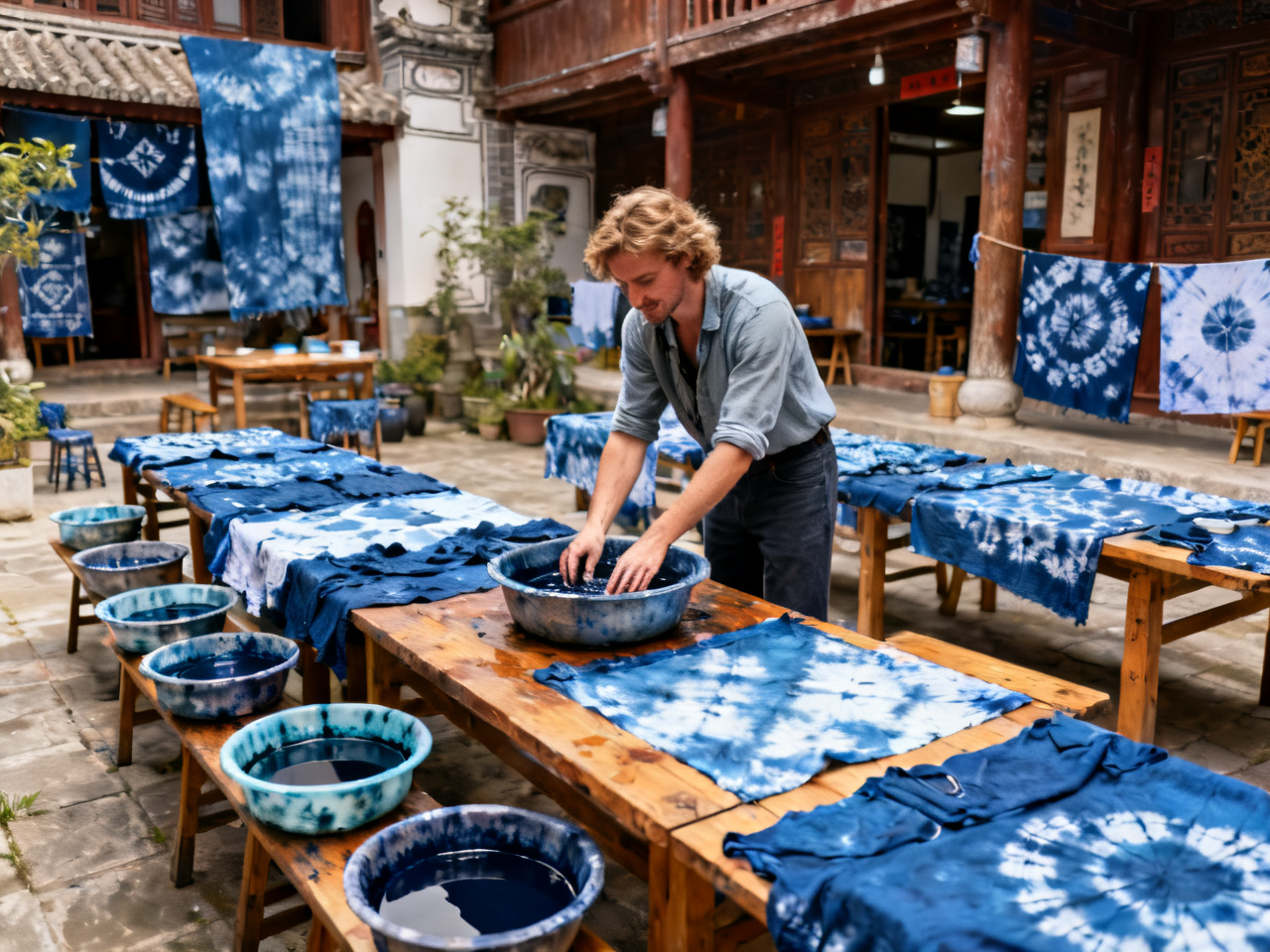
我做的第一个图案其实一点都不雄心勃勃。我怕自己绑得太乱,只选了最基础的折叠和几处捆扎。可真正开始上手之后,我很快发现,哪怕是最简单的动作,也会暴露一个人的性格:有人绑得特别果断,有人每打一个结都反复确认;有人一开始就追求复杂的大图案,有人更愿意让布自然地长出变化。我大概属于第二种,常常停下来想“这里是不是太紧了”“那边会不会留白太多”。这种犹豫在旅行里未必是优点,但在扎染台前,它反而让我慢下来。
My first design was not ambitious at all. I was afraid of making a mess, so I chose only the most basic folds and a few bindings. But once I actually started, I quickly noticed that even simple gestures reveal personality. Some people tied decisively, others checked every knot twice. Some immediately chased complicated patterns, while others preferred to let the cloth develop its own variation. I was probably in the second group, always pausing to think, “Is this too tight?” or “Will that side stay too empty?” In travel, hesitation is not always a strength, but at a tie-dye table, it slowed me down in a good way.
真正让我着迷的是入染那一刻。白布被慢慢压进蓝色染液里,表面起了一层细小的波纹,空气里有一点植物和水混在一起的气味。老师把布提起来时,它看上去几乎只是深蓝的一团,还远远谈不上漂亮。可她一点都不着急,只是说:再等等,颜色还在进去,布也还在记住你刚才做过的动作。我很喜欢这句话。手艺最动人的部分,常常不是“我做了什么”,而是材料如何慢慢把这些动作保存下来。
What truly captivated me was the moment of dyeing. The white cloth was slowly pressed into the blue liquid, tiny ripples formed on the surface, and the air carried a faint smell of plants and water together. When the instructor lifted the cloth out, it looked like nothing more than a dark blue bundle, not beautiful yet at all. But she was completely unhurried. She only said, “Wait a little. The color is still entering, and the cloth is still remembering what you did.” I loved that sentence. The most moving part of craft is often not what I did, but how the material slowly preserves those gestures.
等到拆线的时候,整个工作坊一下子安静了很多。之前大家还会聊天、比较谁绑得更整齐,可一旦到了揭晓纹样的时刻,每个人都本能地低头看自己的布,像在等一个很私人的答案。我把线一圈圈解开,白色的线条和蓝色的底慢慢露出来,那种感觉有点像在雾里看见景物渐渐成形。它不完美,边缘有些地方甚至比我预想的更散,可正因为这样,我反而觉得它像真的“做出来了”,而不是标准化地“生产出来了”。
When it was time to untie the cloth, the whole workshop suddenly became much quieter. Earlier, people had been chatting and comparing whose bindings looked neater. But the moment of revealing the pattern felt private, and everyone instinctively lowered their head toward their own piece. As I loosened the string circle by circle, white lines and blue ground slowly appeared, and the feeling was almost like seeing a landscape emerge through mist. It was not perfect. In some places, the edges were looser than I had expected. But precisely because of that, it felt genuinely made rather than uniformly produced.
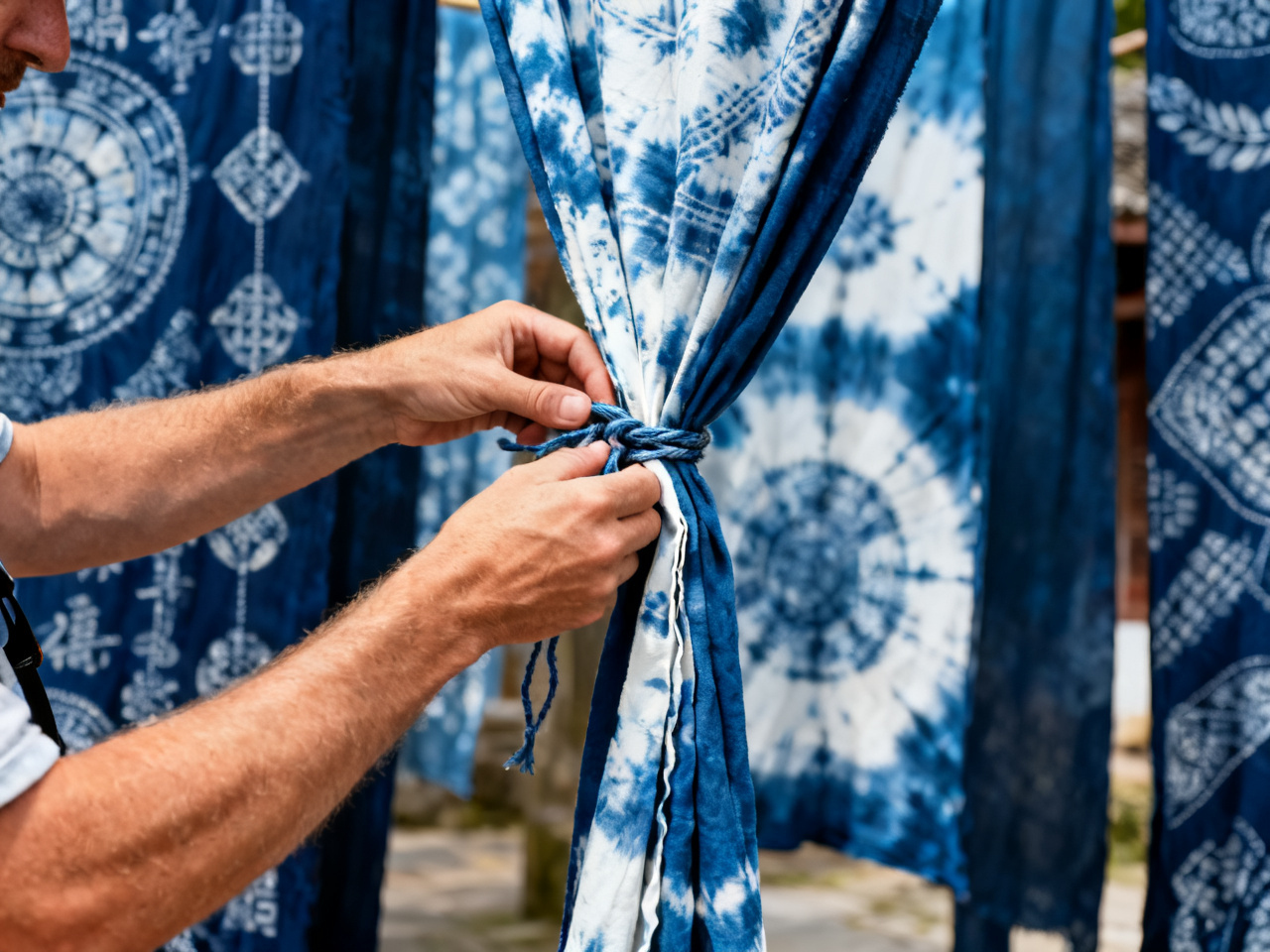
这时我也自然想起法国的一些传统布艺和家居织物经验。在法国,我们当然也有很强的纺织传统,从乡村家用织物到更精致的印染布料,都强调材料、质感和日常审美的结合。但我在中国扎染工作坊里感受到的东西不太一样。法国很多纺织美感更讲究控制、均衡和成品的协调,而中国扎染,至少在这次体验里,更让我意识到“偶然性也可以被欣赏”。那些轻微的不对称、深浅不一的晕染、白线忽宽忽窄的变化,都不是失败,反而是手工存在过的证据。
At that point I naturally thought about traditional textiles and domestic fabrics from France. We certainly have strong textile traditions too, from rural household cloth to more refined printed and dyed fabrics, all shaped by a close relationship between material, texture, and everyday aesthetics. But what I felt in this Chinese tie-dye workshop was different. In France, textile beauty often emphasizes control, balance, and harmony in the finished piece. Chinese tie-dye, at least in this experience, made me appreciate that accident itself can be part of beauty. Slight asymmetry, uneven tonal diffusion, and white lines that widen and narrow unpredictably were not failures. They were evidence that the hand had truly been there.
我后来明白,为什么很多人会说扎染特别适合旅行者体验。因为它不是那种只能远看、很难参与的民艺。你真的可以在短短半天里,用自己的手完成一次从空白到成形的过程。而且这个过程不会假装你已经懂了传统,它只是很诚实地让你摸到一点门槛:你会知道,真正熟练的手艺人为什么能控制节奏,为什么能预判图案,为什么看似简单的蓝白布面其实藏着很多经验。
Later I understood why so many people say tie-dye is especially suitable for travelers. It is not a craft that can only be admired from a distance. You can genuinely complete a process from blankness to form with your own hands in half a day. At the same time, the experience does not pretend that you suddenly understand the whole tradition. It simply lets you touch the threshold honestly. You begin to see why skilled artisans can control rhythm, anticipate patterns, and make a blue-and-white cloth that looks simple but actually contains a great deal of experience.
如果有外国朋友问我,中国民艺里哪一种最容易让人立刻产生参与感,我现在大概会先提扎染。不是因为它最华丽,而是因为它把“等待”“判断”和“接受不完美”都变成了很具体的身体经验。你离开工作坊时手上拿着的,不只是一块布,也是一段你亲手制造出来的时间。对我来说,这正是旅行纪念里最珍贵的部分:它不是买来的,而是你在那个地方慢慢等出来的。
If foreign friends ask me which Chinese folk craft gives the quickest sense of real participation, I would probably mention tie-dye first. Not because it is the most ornate, but because it turns waiting, judgment, and acceptance of imperfection into physical experience. When you leave the workshop, what you carry is not only a piece of cloth, but also a stretch of time you made with your own hands. For me, that is the most valuable kind of travel memory. It is not something purchased. It is something you waited into existence in that place.
- 黄山山脚那家白灯小馆,让我在上山前先把胃和心都放平了 | A White-Lit Eatery at the Foot of Huangshan Settled Both My Stomach and My Mind Before the Climb
- 脸谱绘制体验:我第一次明白一张脸为什么可以先于台词说话 | Opera Face-Painting Workshop: My First Time Understanding How a Face Can Speak Before the Lines
- 中秋赏月最美地点推荐 | Best Places to Enjoy the Mid-Autumn Moon
- 中国社交礼仪速成:称呼、送礼与餐桌文化 | Chinese Social Etiquette: Greetings, Gifts & Dining
- 大运河边读一座城市 | Reading a City Along the Grand Canal
- 一个普通工作日的公交站,让我学会了中国排队不是只看队形 | On an Ordinary Weekday Bus Stop, I Learned That Queueing in China Is Not Just About the Shape of the Line
- 成都最会让国外镜头停久一点的,往往不是熊猫,而是人坐下来以后那股松弛 | What Most Often Makes Foreign Cameras Linger in Chengdu Is Not the Pandas but the Ease That Begins Once People Sit Down
- 丝绸之路探险之旅 | The Silk Road Adventure
- 和妈妈在福州三坊七巷躲五月阵雨时,我们终于把很多不好意思问出口的话说出来了 | Sheltering from a May Shower in Fuzhou, My Mother and I Finally Said Things We Had Long Left Unspoken
- 第一次在中国药店买感冒药,我学会先说症状再看品牌 | The First Time I Bought Cold Medicine in a Chinese Pharmacy, I Learned to Describe Symptoms Before Looking at Brands
Comments (0)