
退潮后的石滩,比准点的海景更懂钦州 | The Stone Flats After Low Tide Taught Me More Than a Timed Sea View in Qinzhou
退潮后的石滩,比准点的海景更懂钦州 | The Stone Flats After Low Tide Taught Me More Than a Timed Sea View in Qinzhou
我到钦州时,原本给自己排了一张很像样的行程表:上午看海,午后去另一个点,傍晚再回到岸边等光线软下来。表格里的箭头清楚,地图上的距离也不长,仿佛只要按时上车、按时下车,海边就会依照预约出现。可沿海的路从来不完全听从这种安排。车在城与岸之间绕过村落、堤坝和零散的养殖水面,窗外的颜色一点点从楼房的灰白变成泥滩的褐、植被的绿和海水不稳定的蓝。我没有急着确认自己会不会迟到,只在每次转弯时看一眼远处的堤线。它像一条被潮水反复擦拭过的边界,提醒我:来到这里,先要接受时间不是唯一的尺度。
When I arrived in Qinzhou, I had drawn up a neat timetable: sea in the morning, another stop after lunch, then back to the shore for softer evening light. The arrows on my map looked convincing, and the distances appeared short. But the road between the city and the coast wound past villages, dikes, and scattered aquaculture ponds. Outside the window, building gray gave way to mudflat brown, vegetation green, and an unsettled blue sea. Instead of checking whether I was behind schedule, I watched the distant line of the embankment. It looked repeatedly polished by water and made one point clear: here, clock time is not the only measure.
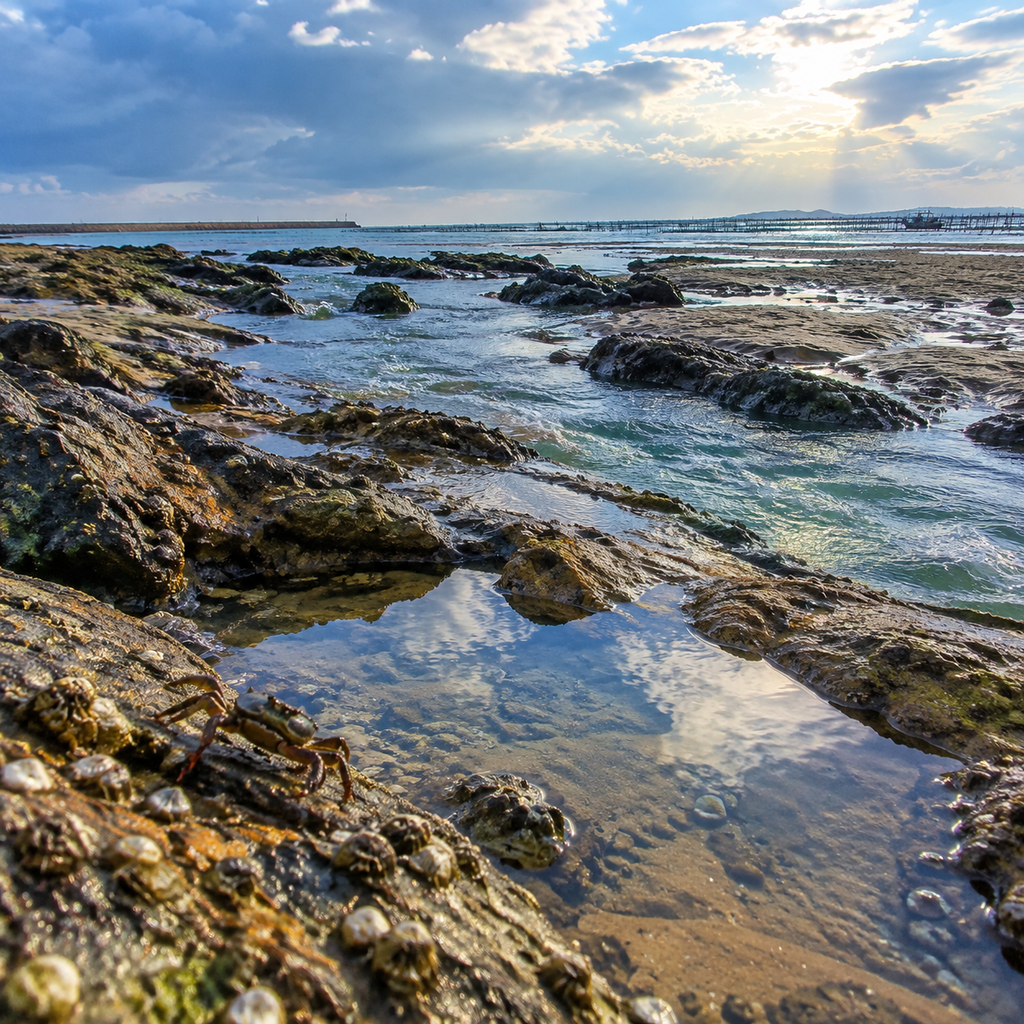
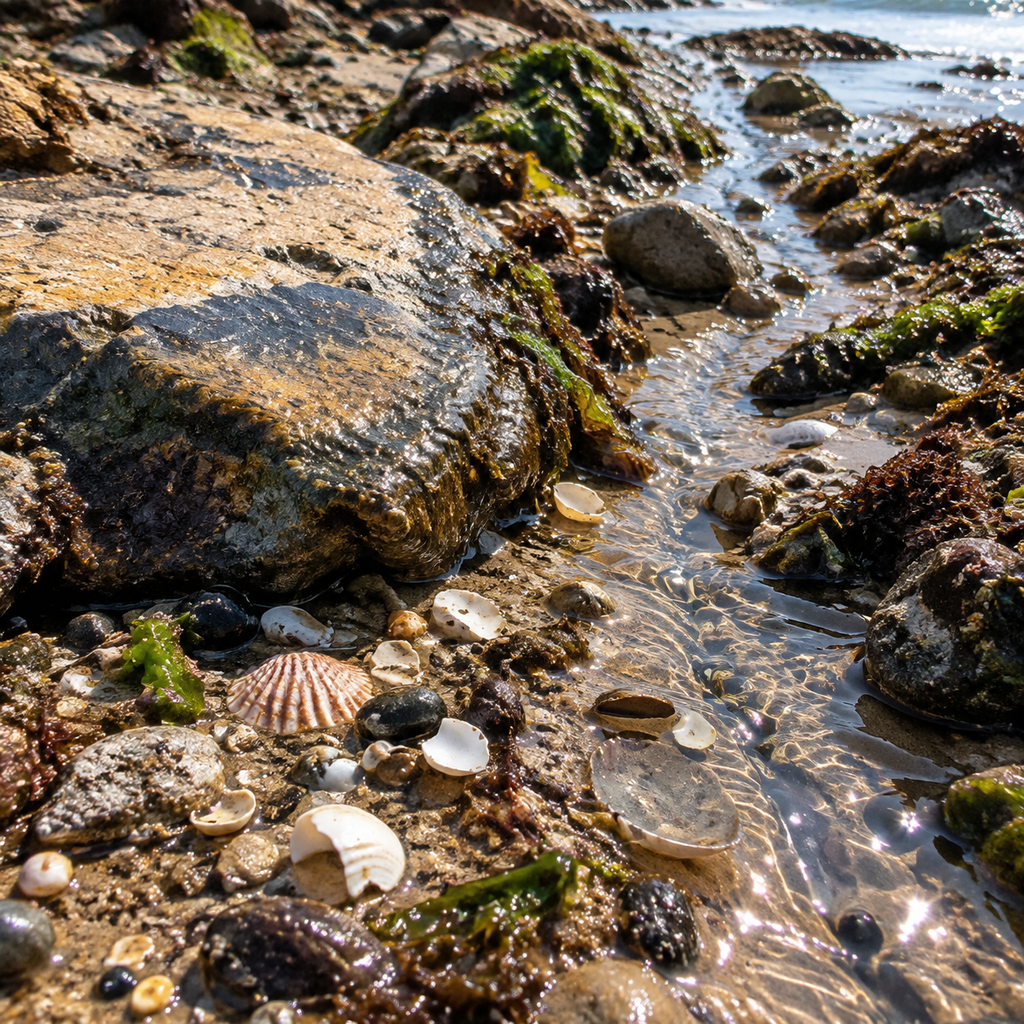
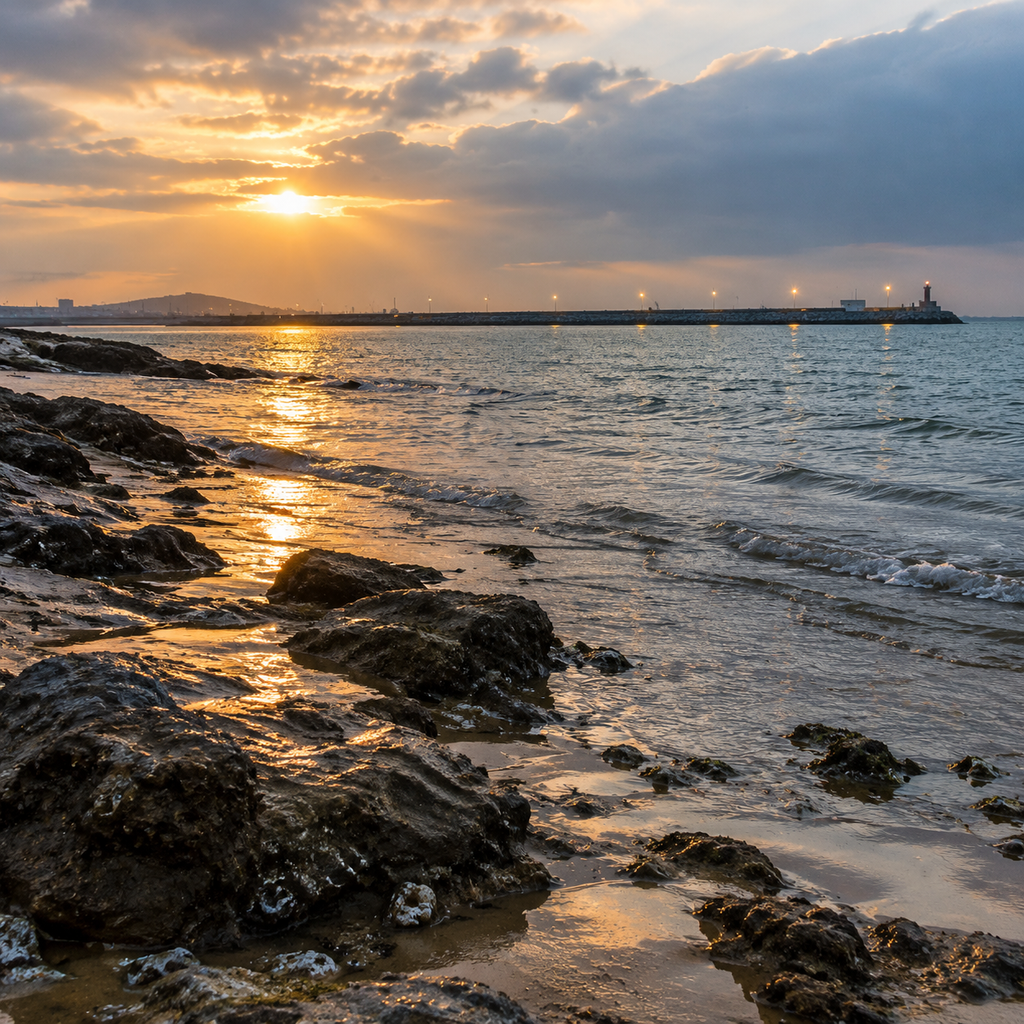
我把石滩作为一个“顺路看看”的地点,后来才发现这正是误判。退潮后的岸边并不只是涨潮海景退去后留下的背景,而是一片需要慢慢阅读的地面。水离开以后,原先平整的海面被拆成许多层:浅水在凹处留成小镜子,较深的沟槽仍有流动,石头、贝壳、海藻和泥沙各自露出颜色。远看时它们像一幅安静的纹理,走近后却不断改变脚下的判断。某块石面在阳光里显得干爽,边缘却覆着薄薄的水膜;一段看似可以直穿的滩地,中间也许藏着被海水掏松的泥。我的路线从“走到尽头拍照”改成“先看十分钟再迈第一步”,这不是谨慎的姿态,而是身体在陌生地形前应有的顺序。
I first treated the stone flats as a quick stop on the way elsewhere. That was a mistake. After the tide withdrew, the shore was not merely the backdrop left behind by a missing sea view. It became a surface that had to be read. Pools sat in hollows like small mirrors, deeper channels still moved, and stones, shells, algae, and silt showed their own colors. From far away they formed a quiet texture; close up they continually changed what a safe step meant. A sunlit rock could still carry a slick film, and an apparently direct route could conceal softened mud. My plan changed from “walk to the end for a photo” to “watch for ten minutes before taking a first step.”
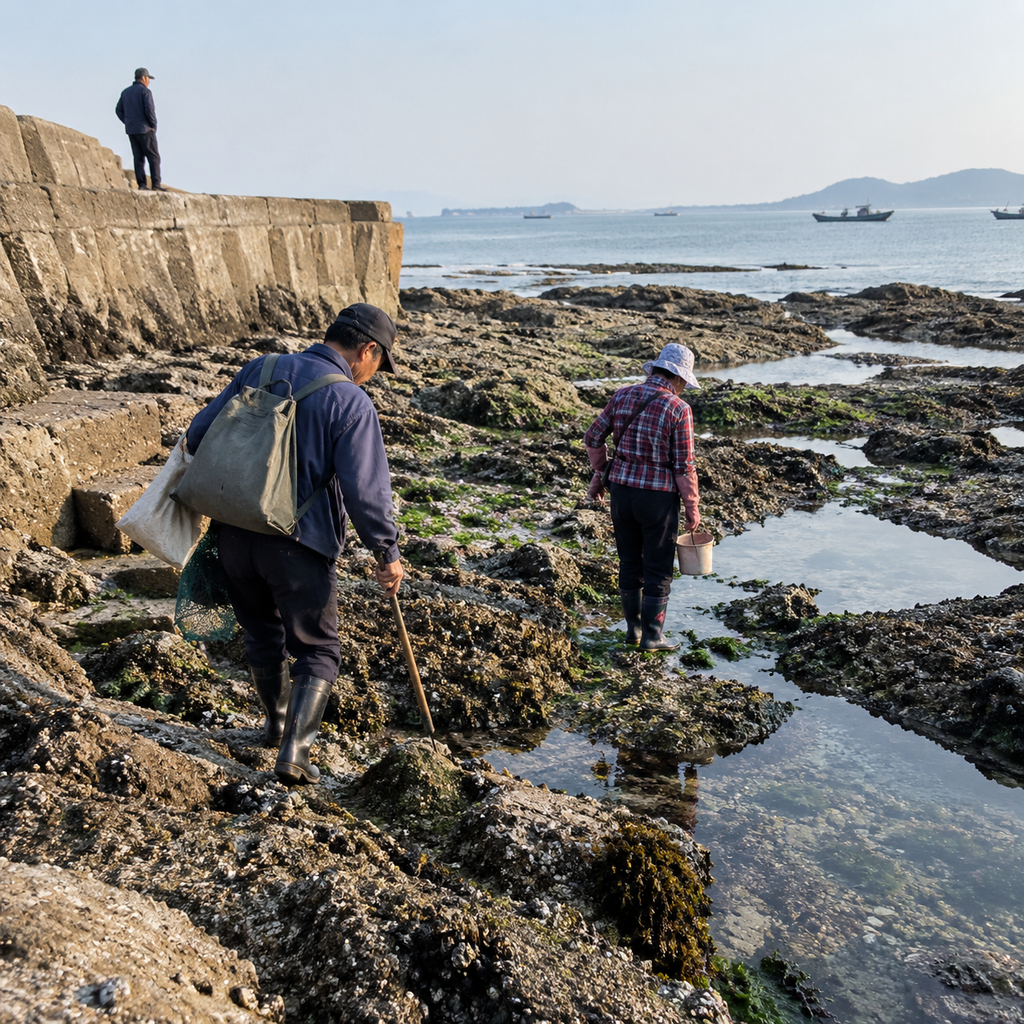
岸上没有一块牌子能替我完成全部判断。有人在堤边停下来看水,也有人背着工具往低处走;他们对脚下的路熟悉,却并不意味着我可以照着他们的轨迹贸然跟进。我注意到他们走得不快,落脚却很确定,会避开发亮的石面,也会在沟槽前停一下,看水位和底部的质地。他们的动作没有戏剧性,反而因为平常而值得看。旅行者常把当地人的存在当作画面里的点缀,或把他们当成即时导航;我更愿意把那种熟练理解为提醒。对他们来说,这是日常往返的岸;对我来说,这是第一次需要用鞋底、眼睛和耐心认识的地方。两者之间不该被一张照片抹平。
No signboard on the shore could make every decision for me. Some people paused near the dike to watch the water, while others carried tools toward the lower ground. Their familiarity did not mean I should blindly copy their path. I noticed that they did not move fast, but each step was certain. They avoided gleaming rock and sometimes stopped before a channel to inspect the water and the ground beneath it. The ordinary nature of these movements made them more useful than any dramatic gesture. I did not treat local residents as scenery or as instant guides. Their ease was a reminder that this was their everyday shore, while it was my first encounter with a terrain I needed to learn through my eyes, soles, and patience.
我在较高处整理背包,把相机和手机收好,只带着能腾出双手的东西往下走。这个决定很小,却比后来拍到什么重要。湿滑石面最麻烦的地方不在于它看起来危险,而在于它常常看起来普通:海藻薄薄贴着石头,颜色和阴影混在一起;贝壳碎片在泥里扎脚;海水从裂隙退去,留下一层不容易辨认的亮。每一步我都先把脚掌放实,再把重量移过去,尽量让身体保持低而稳定。遇到无法确认的地方,我宁可绕远或折返。旅行叙事喜欢把犹豫写成错过,但在这样的岸边,放弃一块更远的石头,恰恰是把下一步留给自己。
I repacked at higher ground, put away my camera and phone, and took down only what allowed both hands to stay free. It was a small choice, but more important than any picture I might take. Slick rock is difficult because it often looks ordinary. Thin algae merge with shadow, shell fragments press through mud, and retreating water leaves a shine that is hard to read. I placed each foot fully before shifting weight, keeping my body low and steady. When I could not judge a patch of ground, I went around it or turned back. Travel stories often frame hesitation as loss. On this shore, giving up one farther rock meant preserving the next safe step.
退潮并不是一个静止的“景观状态”。我最初站在岸上时,以为海已经退得差不多,后来才从水线和沟槽里的流向意识到,变化仍在继续。水并非整齐地从一条线后撤,而是在石缝、浅坑和低洼处留下不同速度的痕迹。有些地方露得更快,有些地方仍像被海攥在手里。风把水面吹出细碎的纹路,也让远处的边界看起来比实际更近。即使没有掌握具体潮汐表,我也能看出不应把“现在露出来了”理解为“接下来仍然安全”。我会不时回头看堤岸的位置,记住自己是从哪里下来的,并把返回的路当作路线的一部分,而非离开时才临时处理的事情。
Low tide is not a frozen scenic condition. When I first stood above the shore, I assumed the sea had nearly finished receding. Watching the waterline and the flow in channels showed that the change was still underway. Water did not retreat neatly behind one line; it lingered at different speeds in cracks, basins, and depressions. Some ground emerged quickly while other parts remained held by the sea. Wind textured the water and made distant boundaries seem closer than they were. Even without relying on a precise tide table, I knew that exposed ground was not a promise of lasting safety. I kept looking back toward the dike, remembered my descent point, and treated the return route as part of the route itself.
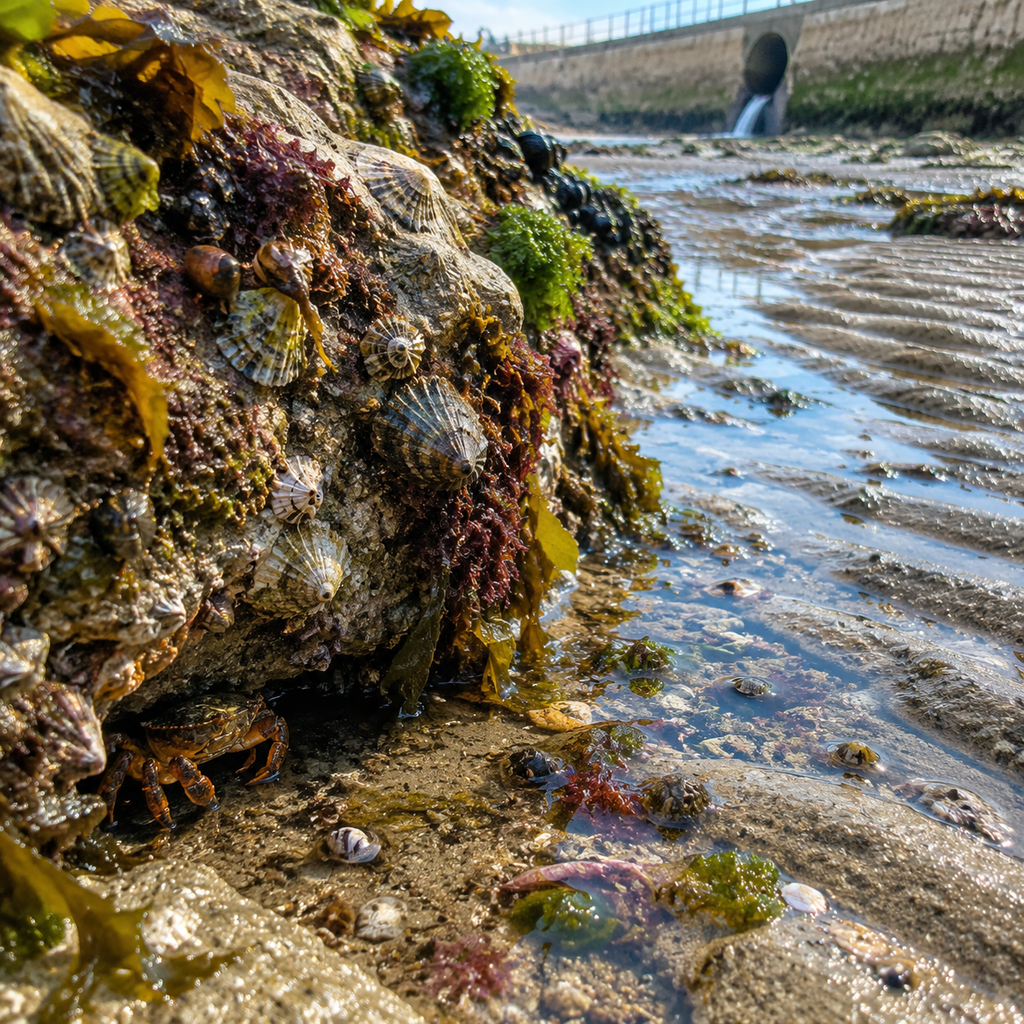
石滩上的细节不断把我的注意力从远景拉回近处。一只小蟹从石边闪进阴影,几条浅水沟里有微小的活动,附着在石头上的壳类和海藻让颜色变得复杂。它们并不需要被我一一命名,重要的是它们说明这片地面不是空出来供人行走的广场。潮水每天反复覆盖和露出它,岸边的生物与劳作都在这个节奏里安排。我曾经为了赶一个所谓更“完整”的海景,习惯把低头的时间压缩到最短;这一次却发现,真正让我停留的不是海平线,而是脚边一米内那些被退水暂时交出来的东西。它们不壮观,也不适合被迅速消费,却让钦州的海岸有了触感和重量。
Details on the flats kept drawing my attention from the horizon back to the ground. A small crab slipped into shade beside a rock, faint movement appeared in shallow channels, and shells and algae made the surface visually complex. I did not need to name everything. What mattered was that these details showed the shore was not an empty plaza made for walking. Tides cover and uncover it repeatedly, and both life and work at the coast are organized around that rhythm. I used to shorten the time spent looking down in order to chase a supposedly more complete sea view. Here, what held me was not the horizon but the things temporarily handed over by the receding water within a meter of my feet.
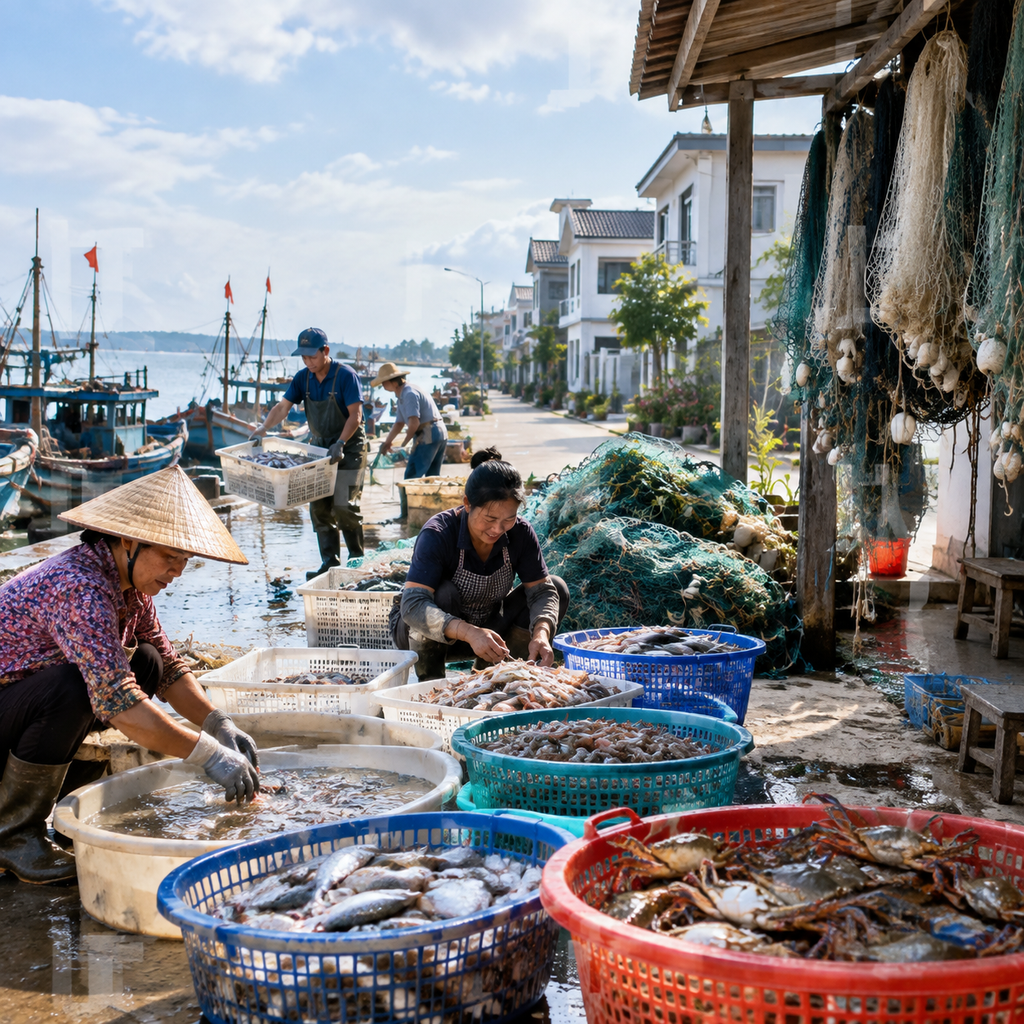
岸边的渔民和居民让我意识到,海的边界也连接着吃饭这件很具体的事。靠近村落和市场的地方,我看到从海上、滩地或养殖区回来的物件被搬运、清洗、分类,空气里混着潮湿、盐分和烹饪的气味。我没有试图追问每一种收获来自哪里,也没有把路边的操作浪漫化成固定的“渔家生活”。但当我后来在沿海餐馆点海鲜时,石滩的画面一直在场:食物不再只是菜单上一个抽象的品类,而与水位、季节、运输、处理和厨师手里的火候有关。最合适的选择未必是点得最多,而是看当日供应、询问做法、按同行人数适量安排,也接受有些想吃的东西未必正好遇得上。
The fishermen and shore residents made the coast feel connected to the practical matter of eating. Near villages and markets, I saw items returning from the sea, flats, or aquaculture areas being carried, rinsed, and sorted. The air mixed dampness, salt, and cooking smells. I did not pretend to know the source of every catch or romanticize roadside work into a fixed image of coastal life. Later, when I ordered seafood at a coastal restaurant, the stone flats remained in my mind. Food was no longer an abstract menu category; it was tied to water levels, seasons, transport, handling, and the cook’s heat. The sensible choice was not to order the most, but to check what was available that day, ask how it was prepared, and order for the group.
午饭没有让我重新回到严格的计划里,反而把计划彻底松开了。原定的下一处景点需要在一个我已无法保证的时间抵达,地图还提示我需要转车或等待。以前我会把这看成当天的失败:既然做了攻略,就应该把标记逐个完成。可当我从餐馆出来,看见岸边的光线已经变化,鞋底还带着石滩的泥沙,我忽然不想为了证明效率而匆忙离开。我选择留在附近,沿着较安全的堤路慢慢走,找一处可以看水而不必踩进湿地的地方。少去一个点并没有让这一天变得空白;它让前面那段观察有机会沉下来,而不是立刻被下一个打卡任务覆盖。
Lunch did not pull me back into a strict plan. It loosened the plan further. The next attraction required arrival at a time I could no longer guarantee, and the map suggested transfers or waiting. I used to call that a failed day: once an itinerary was made, every pin should be completed. But leaving the restaurant, with the shore light already changed and mud from the flats still on my shoes, I did not want to rush away simply to prove efficiency. I stayed nearby, walked slowly along the safer dike road, and found a place to watch the water without stepping into wet ground. Missing one stop did not make the day empty; it allowed the earlier observation to settle.
路线的不确定性不是值得炫耀的随性,而是沿海出行中需要预留的现实。公共交通、步行距离、天气、潮位、临时施工和身体状态都会改变抵达方式。对我而言,更实用的做法是把目的地分成“必须完成”和“可以替换”两类,并在出发前留出回程余量。石滩尤其不适合被塞进过紧的时间缝隙:为了赶车而加快脚步,往往正好和湿滑地面需要的节奏相冲突。当天我没有用任何精确时间来证明自己判断正确,只是根据眼前的水、脚下的路和回去的条件不断调整。这样的调整并不浪漫,却能避免把旅行变成对屏幕上时间数字的追逐。
Uncertainty in a coastal route is not carefree spontaneity; it is a condition that requires room in the schedule. Public transport, walking distance, weather, tide, temporary construction, and one’s physical condition can all change how a place is reached. I find it practical to divide destinations into essential and replaceable stops, while preserving margin for the return. Stone flats are especially unsuitable for a narrow gap between appointments. Hurrying to catch a vehicle conflicts directly with the pace demanded by slick ground. I did not use any exact time to declare my judgment correct. I adjusted repeatedly according to the water in front of me, the ground beneath me, and the conditions for getting back.
我也开始重新理解“看海”这个词。很多人抵达海边,是为了等一个开阔、干净、海水占满视野的瞬间;这种期待没有问题,但它容易让人忽略海岸本身的复杂性。钦州的岸边在我面前并不总是蓝得均匀,也不总能被概括成一条适合留影的弧线。它有堤坝、滩涂、石面、沟槽、作业痕迹、村落道路和被风吹乱的水色。退潮把这些平时被水遮住的层次摊开,也把“海景”从一个远看的对象变成一组需要保持距离、认真辨认的关系。我最终没有得到计划中那种准点抵达的画面,但我看见了水离开之后,岸为什么仍然是海的一部分。
I began to rethink the phrase “seeing the sea.” Many people come to the coast for an open, clean moment when water fills the view. That expectation is valid, but it can hide the complexity of the shore. What I saw in Qinzhou was not always uniformly blue or reducible to a photogenic curve. There were dikes, tidal flats, stone surfaces, channels, signs of work, village roads, and water colors broken by wind. Low tide spread out layers usually concealed by water. It turned the sea view from a distant object into a set of relationships that required distance and attention. I did not get the scheduled image, but I understood why the shore remains part of the sea after water leaves it.
安全判断在这里也包含知道何时不再继续。走到一处石面较开阔的位置后,我曾想再往前一点,因为前方看起来更接近水线,照片的层次可能更好。但我停下来观察,发现两边的石头颜色变深,间隙里有持续的水,回头的路径也不如刚下滩时清楚。我没有把这种不确定性解释成挑战,而是把它当作返回的理由。海边事故往往不是因为人完全不了解危险,而是因为已经走出一段后,不愿承认继续前进的收益很小。转身时我没有遗憾,反而觉得这条没有走完的路让景色保持了应有的边界。旅行不是征服地面,尤其不该拿陌生的潮间带来证明胆量。
Safety here also meant knowing when to stop. At a broader stretch of rock, I considered moving farther out because the waterline seemed closer and the image might gain more layers. Then I watched: rocks on both sides had darkened, water continued through their gaps, and the route back looked less clear than it had at the start. I did not frame that uncertainty as a challenge. I took it as a reason to return. Coastal accidents are not always caused by total ignorance of danger; often people have already gone some distance and resist admitting that the reward of continuing is small. Turning around did not feel disappointing. The unfinished route kept the landscape’s necessary boundary intact.
回到较干的路面后,我先处理鞋底和裤脚上的泥沙,再重新拿出相机。这个顺序看似琐碎,却影响之后的移动和乘车:湿泥会让鞋在光滑地面上继续打滑,海水和砂砾也不适合被随手带进车厢或餐馆。沿海步行并不需要复杂装备,但合脚、防滑、可以弄脏的鞋,比为了照片好看的鞋更合适;饮水、防晒或遮雨用品、基本的通信电量,以及不把包塞得过满的习惯,都能减轻临场压力。若带着儿童、行动不便者或不熟悉水边环境的同行者,更应把可站在堤上观察当成完整体验,而不是把下到石滩当作唯一目标。能够安全返回,才有余裕谈论风景。
Back on drier ground, I cleaned mud and sand from my soles and trouser hems before taking out the camera again. That sequence matters for later walking and transport: wet mud can keep shoes slippery on smooth surfaces, and saltwater and grit should not be casually carried into vehicles or restaurants. Coastal walking does not require elaborate gear, but shoes that fit, grip, and can get dirty are more useful than footwear chosen for photos. Water, sun or rain protection, basic phone charge, and a lightly packed bag reduce pressure on site. With children, people with limited mobility, or companions unfamiliar with water edges, observing from the dike should count as a complete experience rather than a lesser substitute.
傍晚前,我没有再强行去赶原计划里的热门点。远处可能仍有更标准的取景角度、更完整的设施和更容易说明的照片,但我不觉得当天必须补齐它们。沿着岸边回去时,我把注意力放在已经经历过的变化上:早些时候露出的石面,此时的光泽和颜色已不同;水线的位置也提醒我,它并不为任何人的日程停留。这样的回看让我明白,旅行中的取舍不是把“少看”包装成高尚,而是诚实地承认精力、天气和环境都有边界。把时间留给一段值得仔细走完的路,往往比在多个地点留下仓促的证据更有意义。
Before evening, I did not force myself to chase the popular stop on my original list. Somewhere farther away there might have been a more standard viewpoint, fuller facilities, and easier photographs. I did not feel compelled to make them up that day. Walking back along the shore, I watched the changes I had already experienced: rocks exposed earlier now carried different sheen and color, and the waterline reminded me that it would not pause for anyone’s schedule. This was not a way to make “seeing less” sound noble. It was an honest recognition that energy, weather, and terrain have limits. Giving time to one route that deserves to be walked carefully can matter more than leaving hurried proof from several places.
钦州这段石滩给我的最终印象,不是一处必须在某个时刻抵达的景点,而是一堂关于节奏的现场课。它要求我在下滩前看,在行走时看,在想继续时再看一次;也要求我接受海鲜餐桌上的供应、交通的衔接和天气的空档,不会完全服从预先写好的清单。第一人称的旅行记录很容易把所有变化都写成个人发现,但我更愿意保留一点谦逊:潮水本来就在涨落,岸边的人本来就在生活,石头也不会因为我来访而更有意义。改变的是我的看法。我从急着抵达一个名词,变成愿意停在一个正在变化的地方。
The lasting impression of these Qinzhou stone flats is not of an attraction that must be reached at one appointed moment, but of a lesson in rhythm. They asked me to look before stepping down, while walking, and once more when I wanted to continue. They also asked me to accept that seafood availability, transport connections, and gaps in the weather would not fully obey a written list. First-person travel writing can too easily turn every change into a personal discovery. I prefer some humility: the tide was already rising and falling, shore residents were already living their lives, and the stones did not become meaningful because I visited. What changed was my view. I stopped rushing toward a destination name and became willing to remain in a place that was changing.
如果再去沿海地区,我仍会查交通、天气和公开的潮汐信息,也会为想看的地点做好准备;准备并不等于把一切钉死在日程里。对石滩而言,最值得带走的不是某一张照片,而是一套朴素的判断:不确定就不冒进,先想回程再往前走,尊重作业和居住空间,不随意采集或踩踏看不懂的区域,吃饭时珍惜当日食材但不过度点单。它们听起来不像旅行攻略里的亮点,却决定了一天是否能从容收尾。那天我错过了一个准点的海景,却在退潮后不规则的石面上,得到了一种更贴近钦州海岸的观看方式。
If I return to a coastal area, I will still check transport, weather, and publicly available tide information, and I will still prepare for places I hope to see. Preparation does not mean pinning every moment to a schedule. What I carry from the stone flats is not one photograph but a set of plain judgments: do not press on when unsure; think about the return before moving farther out; respect working and residential space; do not casually collect or trample areas you do not understand; appreciate the day’s ingredients without over-ordering. These may not sound like highlights in a travel guide, but they determine whether a day can end calmly. I missed a precisely timed sea view and found a more grounded way to look at Qinzhou’s coast.
我后来把那天的起点重新回想了一遍,才发现真正影响路线的不是某一个突然出现的意外,而是一连串很普通的小延迟。出门时多看了一会儿天气,路上为了确认下车位置多问了一次,走到岸边又因为没有立刻下滩而停留更久。每一件事单独看都不值得写进日程,可它们累积起来,便让原本严丝合缝的安排失去余地。过去我会责怪这些细节破坏效率,现在却觉得它们是路线正在接触现实的证据。海边不是把城市里的时间表搬过去就能顺利运行的场所。真正有用的计划,应当允许人因为看见了需要看的东西而慢下来,也允许人因为没把握而放弃一段路。
When I later reconsidered the beginning of that day, I realized that the route had not been changed by one dramatic problem, but by a chain of ordinary small delays. I spent a little longer checking the weather, asked once more about where to get off, and paused at the shore instead of immediately descending. None of these moments seemed important on its own, yet together they removed the slack from a tightly arranged schedule. I used to blame such details for reducing efficiency. Now I see them as evidence that a route is meeting reality. A coast is not a place where an urban timetable can simply be transferred intact. A useful plan must allow someone to slow down after seeing what needs attention and to abandon a section of road when confidence is lacking.
在靠近石滩之前,我也会先分辨岸边可通行的部分和不应随便进入的部分。堤路、硬化步道、村道与作业区域的边界并不总是用醒目的栏杆划出,有时只是一扇门、一条车辙、一段堆放物或一块改变了颜色的地面。陌生访客很容易把没有写着禁止的地方理解为可以自由穿行,但沿岸空间往往同时承担通行、防护、生产和居住功能。我宁可绕开看不懂的入口,也不把镜头和好奇心当成越界的理由。这个选择并没有减少观察的内容,反而让我更认真地看道路如何连接堤坝、房屋、滩地和水面。看懂边界,不是为了把旅行变得拘束,而是为了让自己的出现不增加别人的麻烦。
Before getting close to the flats, I tried to distinguish between parts of the shore meant for passage and parts that should not be entered casually. The boundaries among dike roads, paved paths, village lanes, and working areas are not always marked by prominent railings. They may be indicated only by a gate, tire tracks, stacked materials, or a change in ground color. An unfamiliar visitor can mistake the absence of a prohibition sign for permission to roam. Coastal space often serves circulation, protection, work, and residence at the same time. I would rather avoid an entrance I do not understand than use curiosity or a camera as a reason to cross it. That choice did not reduce what I could observe; it made me pay closer attention to how roads connect dikes, homes, flats, and water.
潮水变化带来的还有声音的变化。站在高处时,最先听到的是风和远处车辆的响动;走近低处,水在石缝里进退的细小声响才慢慢清楚。没有巨浪时,海也不会因此沉默。水擦过碎石、碰到壳片、从一条浅沟转进另一条浅沟,都有不同的节奏。这样的声音不能替代安全判断,却能帮助我保持注意力:如果只顾看取景框,很容易忘记环境始终在移动。我偶尔会关掉相机,站着听一会儿,再看水线有没有变化。那不是为了制造所谓治愈感,而是避免把海边理解成一张静态背景图。听见变化,才更容易承认自己并没有完全掌握它。
Tide changes also altered the soundscape. From higher ground, I first heard wind and distant vehicles. Closer to the lower shore, the smaller sounds of water moving through rock cracks became distinct. A sea without large waves is not silent. Water brushed gravel, touched shell fragments, and turned from one shallow channel into another at different rhythms. Sound cannot replace safety judgment, but it helped keep my attention active. If I focused only on a viewfinder, I could forget that the surroundings were always moving. At times I put the camera away, listened for a while, and then checked whether the waterline had changed. This was not about manufacturing a calming mood. It was about refusing to treat the coast as a static backdrop.
我没有把石滩的湿滑只归因于“下雨后”或“有海水”这样简单的说法。实际走起来,风险来自多种表面同时出现:平整的岩面可能薄滑,粗糙的石头也可能松动,泥地可能吸住鞋底,贝壳和藻类会让落脚点变得难以预测。光线还会影响判断,逆光时水膜特别显眼,阴影里却可能完全看不出来。因此我尽量不跨大步,不从高一点的石头直接跳向低一点的石头,也不为了绕开泥地而贴近水沟边缘。看上去慢,其实是在把意外发生后无法控制的动作,拆成每一步都能及时收回的选择。对于没有经验的人来说,最可靠的技巧不是模仿别人走得多远,而是把自己限制在始终能稳定退出的范围内。
I did not reduce slipperiness on the flats to simple labels such as rain or seawater. In practice, risk came from several surfaces appearing together. Smooth rock could carry a thin slick layer; rough stones could still shift; mud could hold a shoe sole; shells and algae made footholds unpredictable. Light also changed perception. Backlight could reveal a film of water, while shadow could hide it completely. I avoided large steps, avoided jumping down from a higher rock to a lower one, and avoided edging close to channels just to bypass mud. Moving slowly meant breaking potentially uncontrollable actions into choices I could still reverse. For someone without experience, the most dependable technique is not copying how far others go, but staying within a range from which one can leave steadily.
在岸边看见有人作业时,我会把距离留得更宽一些。工具、筐子、车辆和临时堆放的物品,都说明这里不是为了观光而布置的舞台。即便不清楚对方具体在做什么,也能理解他们需要连续的通道、清楚的视线和不被打断的节奏。我没有凑近拍摄,也没有因为想了解而要求对方停下来解释。沿岸劳动有它自己的时间,可能受潮水、天气和当日收获影响,不应被访客的好奇切成碎片。隔着适当距离观察,我仍然能感到一种与旅游景点不同的秩序:人们并不是在“展示海边”,而是在安排一日里必须完成的事。这样的认识,让我吃海鲜和走过岸边时都少了一点理所当然。
When I saw people working along the shore, I left more space. Tools, baskets, vehicles, and temporarily stored items all showed that this was not a stage arranged for visitors. Even without knowing exactly what someone was doing, I could understand the need for clear passage, uninterrupted sightlines, and a working rhythm. I did not move closer for photographs or ask anyone to pause and explain. Coastal labor has its own timing, shaped by tide, weather, and the day’s yield; it should not be broken into pieces by a visitor’s curiosity. From an appropriate distance, I could still sense an order different from that of a tourist attraction. People were not presenting the coast. They were getting through the tasks that had to be done that day.
午餐时我没有追求一张“本地人必吃清单”,而是先看菜单上能否说明食材和做法,再结合当时人数选择几样适合分享的菜。沿海饮食的好处在于可以尝到鲜味,但鲜味不等于一定要用复杂的烹调或点很多种类来证明。清蒸、白灼、煮汤、快炒,各有适合的食材和口味;我更看重店家当日能够稳定提供什么,也会明确自己的忌口或过敏情况。对于不熟悉的贝类、蟹类或其他海产,确认是否适合食用、是否充分加热,比拍照发问更实际。饭桌上留下的不是一份权威推荐,而是一个朴素的感受:当我刚从潮间带回来,食物与海之间的距离似乎被拉近了,但这份靠近也提醒我尊重供应和处理的复杂性。
At lunch, I did not chase a list of supposedly essential local dishes. I first looked for what the menu could say about ingredients and preparation, then chose a few shareable dishes according to the group. Coastal food can offer freshness, but freshness does not require complicated cooking or a long order to prove itself. Steaming, blanching, soup, and quick stir-frying suit different ingredients and tastes. I cared more about what the restaurant could provide reliably that day, and I stated dietary restrictions or allergies clearly. With unfamiliar shellfish, crabs, or other seafood, checking whether it was appropriate to eat and properly cooked mattered more than asking questions for a photograph. The meal left me with a simple sense that food and sea had moved closer, while their handling remained complex.
我还注意到,石滩并不适合用“离市区多远”“能玩多久”这样的单一问题来概括。即使从地图上看距离不大,最后一段道路是否好走、是否需要绕行、能否找到合适的观察位置、手机信号和补给是否方便,都会改变体验。比起把时间估算得过于精确,我更愿意在出发前保存离线地图、确认大方向的交通条件,并让同行的人知道大致返回安排。抵达以后,若发现道路状况、天气或潮水与预期不同,就把原先的目标缩小到安全可行的范围。把“到达某块石头”换成“在岸边完成一段稳妥的观察”,并不是降低标准,而是让目标与现场条件一致。
I also noticed that stone flats cannot be summarized by a single question such as how far they are from town or how long they take to visit. Even when a map shows a short distance, the final road conditions, possible detours, access to a suitable observation point, phone signal, and nearby supplies can all change the experience. Rather than estimate time too precisely, I prefer to save an offline map, confirm the broad transport situation, and let companions know the general return arrangement. Once there, if road conditions, weather, or tide differ from expectations, I reduce the original goal to a safe and workable scale. Replacing “reach that particular rock” with “complete a steady observation from the shore” is not lowering a standard. It is matching the goal to conditions on site.
天气在沿海也不只是决定照片明暗的变量。云层压低时,石头和海水的颜色会显得更接近,远处的地形不容易辨认;太阳突然出来时,反光又可能让眼睛疲劳。风大时,站在空旷堤岸上要留意帽子、伞和轻便物品,避免它们被吹走后促使人往不该去的方向追赶。下雨或雷电临近时,湿滑、能见度和避险条件都会变化,最合理的路线往往是回到有遮蔽、有人流或交通更方便的区域。我不把等待天气好转当成浪费,也不会因为已经花了路上的时间就强迫自己完成下滩。旅行的成本不是只有车票和路程,还包括判断失误可能带来的后果。
Weather on the coast is not merely a variable that determines photographic brightness. Under low cloud, stone and water colors can merge and distant terrain becomes harder to read. When the sun suddenly appears, glare can tire the eyes. In strong wind on an open dike, hats, umbrellas, and light belongings need attention, so that a blown item does not tempt someone to chase it toward unsafe ground. When rain or lightning approaches, slipperiness, visibility, and options for shelter all change. The sensible route is often back toward an area with cover, people, or easier transport. I do not consider waiting for weather to improve a waste, and I do not force a descent simply because I have already spent time getting there.
我在堤上遇到几位停下来休息或望向水面的居民时,没有把短暂的并处变成采访。我们也许只是共享同一段风、一片正在变化的水面和一条返回的路。旅行者总想从当地人那里得到一句能放进文章里的总结,仿佛一句话便能代替长期生活带来的知识;但我知道自己没有足够的背景去要求这种交付。比起索取答案,我选择用礼貌的距离经过,在需要让路时让路,在不确定方向时只询问最必要的信息。没有精确引语,并不妨碍我记住那种岸边的日常感:有人等待,有人搬运,有人回家,而我只是短暂地从中穿过。
When I encountered residents resting or looking toward the water from the dike, I did not turn our brief coexistence into an interview. We may simply have shared the same wind, a changing stretch of water, and a route back. Visitors often want a local person to offer one quotable summary, as if a sentence could replace knowledge built through long residence. I did not have the context to demand that. Instead of extracting answers, I passed with polite distance, gave way when necessary, and asked only essential questions when uncertain about direction. The absence of a precise quote does not prevent me from remembering the ordinary quality of the shore: some people waited, some carried things, some went home, and I only passed through for a short time.
回程的选择也让我放慢了判断。与其等到体力下降、天色改变或交通临近结束时再决定怎么走,我在离开石滩不久便开始确认下一段路。手机上的地图只能提供参考,真正影响行程的是脚下能否稳定行走、路口是否容易识别、有没有合适的位置等候,以及当天是否适合继续停留。我给自己留出空档,不把每一次等待都视为损失。坐在相对干燥安全的位置时,我可以整理衣物、补水、检查物品,也可以重新看一眼岸边。那段看似没有“内容”的空档,让此前紧绷的注意力缓下来,也减少了为了赶时间而做出仓促选择的可能。
The return choice also slowed my judgment. Rather than wait until my energy fell, light changed, or transport was nearly finished before deciding how to leave, I began confirming the next section soon after leaving the flats. A phone map provides only reference. What actually affects the journey is whether the ground can be walked steadily, whether intersections are recognizable, whether there is a suitable place to wait, and whether the day still suits staying longer. I left myself empty time and did not treat every wait as a loss. In a relatively dry and safe place, I could clean up, drink water, check my belongings, and look once more toward the shore. That apparently contentless pause reduced the pressure to make hurried choices.
有时旅行写作把临时改线描述成一种灵光乍现,好像只要偏离计划就必然获得更真实的体验。我不这样看。改线也可能带来迷路、疲惫、错过交通和增加对周边居民的打扰,因此它应当建立在基本信息和持续判断上。那天我留下来,不是因为“随意走走”本身更高级,而是因为替代路线在当时看起来更稳妥:我能看见回去的方向,能保持在较安全的道路上,也不需要进入陌生的作业区。若这些条件不存在,按原路离开同样是正确的选择。自由并不等于拒绝规划,而是能在计划失效时作出不夸张、可承担的调整。
Travel writing sometimes presents an improvised detour as a flash of insight, as though leaving a plan automatically produces a more authentic experience. I do not see it that way. A changed route can also bring disorientation, fatigue, missed transport, and disturbance to residents. It should rest on basic information and continuous judgment. I stayed that day not because wandering was inherently superior, but because the alternative route seemed steadier at that moment. I could see the direction back, remain on safer paths, and avoid entering unfamiliar work areas. If those conditions had not existed, leaving by the original route would have been equally sound. Freedom is not the refusal of planning; it is the ability to make modest, bearable adjustments when a plan stops fitting.
退潮后的石面让我特别清楚地感到尺度的变化。站在堤上,海岸是一片可以被概览的平面;站到石头之间,十几步的距离会被沟槽、泥地和水膜拆得很长。地图上的直线在现场失去意义,取而代之的是一个个需要确认的落脚点。这种尺度变化也改变了我拍照的方式。我不再急着把自己放进辽阔背景里,而是拍一些不依赖冒险位置的局部:水留在石缝里的线条、远处堤岸与滩地的关系、从安全道路看出去的层次。照片不必证明我走得多远,它们只需要诚实保留我所站的位置和当时看见的变化。
The stone surface after low tide made changes of scale especially clear. From the dike, the coast looked like a flat area that could be surveyed at a glance. Among the rocks, a distance of a dozen steps was stretched by channels, mud, and films of water. Straight lines on a map lost their meaning on site, replaced by individual footholds that had to be checked. This also changed the way I photographed. I stopped trying to place myself in a vast background and made a few local images that did not require risky positions: water lines in rock cracks, the relation between distant dike and flats, and layers seen from a safe road. The photographs did not need to prove how far I had gone. They only needed to retain honestly where I stood and what was changing.
我对沿海饮食的期待也在这一天变得更克制。海鲜的名称、做法和供应会因季节、天气、运输和店家采购而不同,访客不必把某一种食材当成抵达某地的考试题。比起执着于“必须吃到”,我更愿意接受当日可得的选择,听取店家关于做法的说明,并避免因为不熟悉而点下数量过多或处理方式不适合自己的食物。用餐结束时适量不浪费,也是一种对这条海岸链条的尊重。看到过滩地后,我很难再把一盘菜想成凭空出现的地方标签;它背后有自然条件和许多人的劳动,而这些并不需要被夸张成传奇才值得珍惜。
My expectations of coastal food also became more restrained that day. Seafood names, preparations, and availability can vary with season, weather, transport, and a restaurant’s purchasing. A visitor does not need to treat one ingredient as an exam question for arriving somewhere. Rather than insist that I must eat a specific item, I accept what is available that day, listen to a restaurant’s explanation of preparation, and avoid ordering too much food or food unsuitable for me simply because it is unfamiliar. Finishing an appropriate amount without waste is also a form of respect for the coastal chain behind a meal. Having seen the flats, I could no longer imagine a plate as a place label appearing from nowhere. Natural conditions and many people’s work stand behind it.
离开之前,我最后一次回头看石滩,没有试图判断它到底“值不值得专程来”。这种问题太依赖单一标准:若只以照片、设施或可复制的行程衡量,它可能显得不够便利;若愿意把它视作观察潮间带、理解岸边生活节奏的机会,它又会延展出许多不适合压缩的内容。对我来说,答案取决于当天条件和自己的准备,而不是一句万能推荐。有人适合站在堤上看一会儿就离开,有人可能因为熟悉环境而有更明确的目的;无论哪一种,都不需要把更远、更险或更慢当成唯一正确的旅行方式。
Before leaving, I looked back at the stone flats one last time without trying to decide whether they were worth a special trip. The question depends too heavily on one standard. Measured only by photographs, facilities, or a reproducible itinerary, the place may seem inconvenient. Treated as an opportunity to observe an intertidal zone and the rhythm of shore life, it opens into material that cannot be compressed easily. For me, the answer depends on conditions that day and on personal preparation, not on a universal recommendation. Some people may be best served by watching from the dike briefly and leaving; others familiar with the environment may have clearer purposes. Neither needs to make farther, riskier, or slower travel the only correct way.
我把原本未完成的景点保留在地图上,没有删掉,也没有急着给它补一个“下次一定”。它只是提醒我,路线可以有余白,旅行也可以不以完成率作为结论。钦州的这段海岸没有替我解决所有关于出行效率的问题,却让我在一个具体下午练习了更实际的优先级:先确认安全,再尊重环境和他人,然后才考虑画面与清单。等我回到更熟悉的路面,海已经不是早晨那个被期待准点观看的远景。它经由石滩、潮沟、食物、风和返回的道路,变成了一连串持续变化的条件。我带走的不是对它的占有感,而是对下一次靠近海岸时该如何停步、如何转身的一点判断。
I left the unfinished attraction on my map. I did not delete it, nor did I rush to promise that I would certainly return. It simply reminded me that routes can have blank space and that travel need not end with a completion rate. This stretch of Qinzhou coast did not solve every question about efficient movement, but one particular afternoon let me practice a more practical order of priorities: confirm safety first, respect the environment and other people next, then consider images and lists. By the time I reached more familiar ground, the sea was no longer the distant view I had expected to see on time that morning. Through flats, channels, food, wind, and the road back, it had become a sequence of changing conditions. I took away not a sense of possession, but a little better judgment about when to pause and when to turn around near a coast.
我在车上把当天的路线写成几行很短的记录:从哪里下车,在哪一段堤路停过,什么时候决定不再向前,以及哪一顿饭让自己重新想起退潮后的水线。这样做不是为了把经历整理成一套可复制的标准答案,而是为了保存判断发生的顺序。许多旅行记忆会留下色彩,却忘记当时为什么绕路;会留下食物,却忘记那之前如何在潮湿石面上确认脚下。对我而言,顺序本身就是海岸给出的信息。它让我知道,下一次面对类似的路线时,应先为未知留出空间,再为想象中的风景安排位置。
On the vehicle back, I reduced the day’s route to a few short notes: where I got off, which section of the dike I stopped at, when I decided not to go farther, and which dish brought the receding waterline back to mind. I was not trying to turn the experience into a repeatable set of correct answers. I wanted to preserve the order in which judgment happened. Travel memories often retain color but forget why a detour was made; they retain food but forget how each foot was checked on wet stone beforehand. For me, sequence itself was information from the coast. It told me to leave room for the unknown before assigning a place to an imagined view.
我在石滩边停留得越久,越能看出“退潮”并不是把海水从岸上擦掉那么简单。水退之后,原来被水面遮住的高低差逐渐显现,石块之间的缝隙变成细小的排水通道,低处存着一层并不透明的水,稍高的位置则留着湿润的盐痕。远处看,整片滩地似乎已经可以通行;近处看,每隔几步就有一个需要重新判断的界面。我的眼睛不再只寻找一条最短的路,而是观察水从哪里来、往哪里去,哪些地方仍有流动,哪些地方只是反光。这样的观察不能给出一个永远有效的结论,却能让我明白脚下的景观仍在变化。
The longer I stayed beside the flats, the clearer it became that low tide did not simply wipe seawater from the shore. As the surface withdrew, hidden differences in height appeared. Gaps between rocks became small drainage channels, lower hollows held opaque water, and higher places retained damp salt marks. From a distance, the flats seemed broadly walkable; up close, every few steps presented another boundary to assess. I stopped searching only for the shortest line and watched where water came from, where it moved, and whether a shine represented flow or a film left behind. Observation could not produce a permanent guarantee, but it made the continuing change of the ground impossible to ignore.
潮水变化也改变了我对“到达”的理解。以前抵达一个景点,通常意味着走到入口、拍下标志,再按照地图前往下一处;在退潮石滩,真正的到达可能只是站在合适的高处,看清水线和石面,确认自己有足够条件返回。若为了证明已经深入而踩过不确定的区域,抵达就变成一种对环境的过度索取。对岸边居民来说,某段石滩也许只是通往作业位置的日常路径;对临时来访的人来说,它完全可能是陌生且容易误判的地形。把两种经验区别开,能避免把别人熟悉的动作当作自己的安全许可。
Tide movement changed my definition of arrival. In many attractions, arrival means reaching an entrance, photographing a sign, and following the map to the next stop. On a stone flat after the tide has gone out, arrival may simply mean standing at a suitable higher point, understanding the waterline and surface, and confirming that returning remains possible. If I crossed uncertain ground merely to prove that I had gone farther, arrival would become an excessive demand on the environment. A stretch of shore may be an ordinary route to a resident’s work area, while remaining unfamiliar and easy to misread for a temporary visitor. Keeping those experiences separate prevents another person’s confidence from becoming my permission to take risks.
我还留意到,石滩上的颜色会随着湿度和光线不断变换。黑褐色不一定代表深水,发亮也不一定意味着整块石头都湿;浅灰色的粗糙表面可能很稳,颜色相近的细泥却会让鞋底突然下陷。判断不能只靠一条经验口诀,而要把视觉、脚感和周围水流放在一起。没有把握时,我会先用鞋尖轻触边缘,而不是把全身重量压上去;如果地面出现摇晃、吸附或水从缝隙持续涌动的感觉,就立刻退回原处。即便这样做看起来谨慎过头,也比把一次错误踩踏变成需要别人救援的麻烦更值得。
Colors on the flats kept changing with moisture and light. Dark brown did not necessarily mean deep water, and a bright surface did not mean the whole rock was wet. A rough pale patch might be firm, while nearby mud of a similar color could suddenly hold a shoe. No single visual rule was enough; I had to combine sight, the feel underfoot, and the movement of nearby water. When uncertain, I touched an edge lightly with the toe rather than transferring my full weight. If the ground rocked, held the sole, or showed continuing water movement through a crack, I returned at once. It might have looked excessively cautious, but it was preferable to turning one misjudged step into a problem for other people to solve.
岸边居民的生活节奏让我想到,游客看到的只是海岸功能中的一小部分。清晨可能有人处理工具,中午有人往返搬运,天气变化时还要重新安排晾晒、停放或出海相关的事务;我无法仅凭一次经过推断这里每天的规律,也不应该因为某个瞬间安静,就把它当成无人使用的空地。拍摄时我会先确认自己没有挡住通道,也避免把住宅、院落和作业细节当成可随意收集的素材。若需要询问方向,问题越具体越好;问清大致往哪边走,比要求对方为陌生访客讲完整的地方故事更合适。尊重不是附加礼节,而是进入生活空间时最基本的路线条件。
The rhythm of shore residents’ lives reminded me that a visitor sees only a small part of the coast’s functions. In the morning, tools may be handled; around midday, items may be carried back and forth; when weather shifts, drying, parking, or work related to going out on the water may need to be rearranged. I could not infer a daily pattern from one visit, and I should not treat a quiet moment as proof that a space was unused. When taking photographs, I checked that I was not blocking passage and avoided collecting houses, yards, or work details as if they were ownerless material. If I needed directions, a specific question about the general way was more appropriate than asking someone to narrate the place for a stranger.
我在沿海吃饭时,也更愿意把“鲜”理解为一种需要条件配合的状态,而不是一个可以随口保证的形容词。食材从水面、滩地或养殖水域到餐桌,中间有分拣、保存、清洗、运输和烹调,每一步都会影响口感与安全。菜单上出现某种海产,并不说明当天一定有同样品质;看见别人点了某道菜,也不代表它适合所有人的体质。点餐前说明过敏和忌口,询问是否充分加热,控制分量并认真吃完,比追问一个夸张的“最地道”答案更实际。退潮石滩让我意识到,餐桌与海岸相连,却绝不是一条可以被游客随意简化的直线。
When eating near the coast, I preferred to understand “fresh” as a condition that depends on many steps, not as a casual guarantee. Between water, flats, or aquaculture areas and a dining table come sorting, storage, rinsing, transport, and cooking, each affecting taste and safety. A seafood item on a menu does not promise identical quality on every day, and another diner’s choice may not suit everyone’s body. Stating allergies and restrictions, asking whether food will be thoroughly cooked, ordering a reasonable amount, and finishing it carefully were more useful than chasing an exaggerated claim of authenticity. The flats made the connection between shore and table visible without pretending that it was a simple line.
路线准备还应该包括对“无法确认”的容忍。地图可能把一条小路画得很清楚,却没有告诉我路面何时积水、哪一段正在使用、哪处转弯缺少照明。导航的蓝点也只能说明设备判断的位置,不能替我判断石头是否承重、堤边是否适合停留。出发前我会把主要道路、可撤退的位置和大致回程方向记在心里,并让同行者知道不要各自分散太远。到现场后,若手机电量下降、天气转差或视线变得模糊,就把观察范围收窄。与其把所有不确定都塞进一个“应该没问题”,不如承认信息不足本身就是需要改变路线的信息。
Route preparation should include tolerance for what cannot be confirmed. A map may draw a small road clearly without showing where water gathers, which section is in use, or which turn lacks lighting. A navigation dot only describes a device’s estimated position; it cannot decide whether a rock will bear weight or whether a dike edge is suitable for standing. Before leaving, I noted the main road, possible retreat points, and the broad direction back, and I told companions not to spread too far apart. Once there, if phone charge fell, weather worsened, or visibility weakened, I narrowed the observation area. Instead of forcing every uncertainty into “it should be fine,” I treated missing information itself as a reason to change course.
我没有把准点景观完全否定。若有人专门为了观测、摄影或与交通衔接而安排时间,公开潮汐信息和天气预报当然有参考价值;问题在于,参考资料不是现场许可,计划时间也不是自然现象的承诺。潮位预测存在适用范围,岸边实际水面还会受到风、地形和当天状况影响,普通游客没有必要凭一个数字做出过度精细的冒险判断。更稳妥的做法是把“想看什么”与“必须走到哪里”分开:可以期待退潮后的纹理,却不必为了接近某个角度而踏入看不清的沟槽。这样既保留期待,也给现实留下修正空间。
I did not reject scheduled sea views altogether. For observation, photography, or transport connections, publicly available tide information and weather forecasts can be useful references. The problem is treating a reference as permission, or a planned time as a promise made by nature. Tide predictions have limits, and actual shore conditions may also reflect wind, terrain, and the day’s circumstances. An ordinary visitor does not need to turn one number into an excessively precise risk calculation. It is more useful to separate what I hope to see from how far I must walk: I can look forward to textures exposed by low tide without entering a channel whose depth I cannot read. Expectation remains, but reality retains room to revise it.
在滩地附近停留时,我也会注意垃圾、废弃线绳和尖锐物。它们未必集中在显眼位置,潮水带来的碎片可能卡在石缝里,作业相关物品也可能与自然材料混在一起。看见不熟悉的东西,我不会随手捡起、翻动或带走,更不会为了拍摄把它们重新摆成所谓自然构图。鞋底的保护固然重要,手也同样需要避免直接触碰;若发现受伤动物、疑似污染或明显危险物,更适合保持距离并向有管理职责的人员反馈,而不是靠个人好奇心处理。尊重海岸,既包括不踩踏生物,也包括不把自己的整理欲强加给一片并不属于自己的地方。
While staying near the flats, I also watched for rubbish, discarded line, and sharp objects. They were not always concentrated in obvious places. Tide-borne fragments could lodge in cracks, and work-related materials could blend with natural debris. When I saw something unfamiliar, I did not pick it up, turn it over, or take it away, and I did not rearrange it into a supposedly natural composition for a photograph. Foot protection mattered, but so did avoiding direct contact with the hands. If I encountered an injured animal, suspected pollution, or an obvious hazard, keeping distance and reporting it to the relevant staff was more appropriate than handling it out of curiosity. Respect included leaving an unfamiliar shore in the condition in which I found it.
那天最难放下的并不是一处没有走到的远端,而是对“效率”的旧习惯。只要看见地图上还有一个标记,我就会本能地把它当成待完成任务;只要照片里还缺一张宽阔海面,就会觉得停留不够完整。可是退潮石滩把注意力拆成许多细小动作:观察、等待、绕行、回头、擦干鞋面、确认方向。它们不能在行程表上组成漂亮的勾选,却共同决定我是否真正理解了当天的岸边。少走一段不是自动正确,多走一段也不是自动深入;值得保留的判断,往往发生在没有观众、没有掌声、也没有明确结果的那一刻。
The hardest habit to release was my old idea of efficiency, not a distant section of shore I had left unexplored. When a map still showed another pin, I instinctively treated it as a task. When a photograph lacked a broad expanse of sea, I felt the visit was incomplete. The flats broke attention into small actions: observe, wait, go around, look back, dry the shoes, and confirm direction. These actions did not form attractive checkmarks on an itinerary, yet together they determined whether I understood that day’s coast. Walking less was not automatically right, and walking farther was not automatically deeper. The most valuable judgment often occurred without an audience, applause, or clear result.
若同行者对下滩很感兴趣,我会先和他们约定集合点、返回信号和不分散的范围,而不是到了现场才争论谁应该继续。老人、孩子以及不熟悉海边的人,并不需要通过踩过最湿的石面来证明自己参与了旅行;在堤路、较高岸线或安全的观察处看水,同样可以讨论潮沟、鸟类、渔具和食物之间的联系。照顾同行者也意味着不把个人拍摄目标变成全队的压力。有人想多停留,有人想先回去吃饭或等车,合理的办法是保留选择,而不是用“难得来一次”迫使所有人接受同一种节奏。
If companions were interested in walking down to the flats, I would agree beforehand on a meeting point, a signal for returning, and a range within which no one should spread out. Older people, children, and anyone unfamiliar with shore terrain did not need to cross the wettest rock to prove that they had taken part. Watching from a dike, higher shoreline, or stable viewpoint could still open discussion about channels, birds, tools, and food. Caring for companions also meant not turning one person’s photography goal into pressure on the whole group. Someone might want to stay longer while another preferred food or transport. The sensible arrangement preserved options instead of using the rarity of a visit to impose one pace.
我把这次经历写下来时,尽量不替钦州的海岸下一个过大的结论。不同岸段的地形、管理方式和居民活动可能并不相同,同一个地方在不同天气和水况下也会呈现不同面貌。能够确认的,是我亲自看到的水线、石面、返回道路和餐桌上的选择;不能确认的,就不凭想象补成地方传说。第一人称不应该成为夸大可信度的工具。它只能说明我从一个有限位置观察到什么,也提醒读者把文章里的感受和出发前需要查证的交通、天气、安全信息分开。真实的旅行记录允许留下空白,空白比虚构的确定更诚实。
When writing about the visit, I tried not to make an oversized claim about Qinzhou’s coast. Terrain, management, and residents’ activities may differ from one shore section to another, and the same place can look different under changing weather and water conditions. What I could confirm was limited to the waterline, rock surfaces, return route, and dining choices I personally observed. I did not turn what I could not confirm into local legend. First-person writing should not be used to inflate credibility. It can state what was seen from one limited position and remind readers to verify transport, weather, and safety information before setting out. A truthful travel account can leave blanks; blanks are more honest than invented certainty.
回到住处后,我先检查鞋底是否有残留的小石子和硬壳,再整理照片。相册里有些画面并不“出片”:水面被风打碎,石头颜色偏暗,远景没有想象中的开阔。但它们保留了当时为什么停步、为什么绕行,以及光线如何影响判断。照片的价值不只在于向别人展示一个地点,也在于帮助自己回看当天是否曾经忽略某个细节。若下一次再遇到类似岸线,我或许会更早准备防滑鞋、更少携带需要频繁拿取的设备,并把回程安排放在计划的前半段考虑。这些具体改动,比一句笼统的“下次注意安全”更有用。
Back at my accommodation, I checked small stones and hard shell fragments from the soles before sorting the photographs. Some images were not conventionally impressive: wind broke the water surface, the rocks looked dark, and the view lacked the imagined openness. Yet they preserved why I stopped, why I went around, and how light affected judgment. A photograph can help someone see a place, but it can also help the photographer review whether a detail was overlooked. If I met a similar shoreline again, I might prepare grippier shoes earlier, carry fewer items that required handling, and consider the return arrangement in the first half of the plan. Such specific changes are more useful than a general promise to be careful next time.
钦州退潮石滩留给我的,不是一套可以复制到所有海岸的口诀,而是一种愿意不断校正的态度。看水时不急于把它归类,看人时不把日常劳动变成背景,看食物时不把供应简化成标签,看路线时不把地图直线当成真实地面,看景观时也不要求它在我规定的时刻完成展示。准点的海景当然有它的魅力,可当潮水让石滩露出沟槽、藻痕、泥沙和生活痕迹时,慢下来并不是错过主景,而是承认主景原本就不只在远处。安全返回、没有打扰岸边的人、适量吃完一餐,再带着对不确定性的尊重离开,已经足以构成一次完整的沿海观看。
What Qinzhou’s stone flats after low tide left with me was not a formula transferable to every coast, but a willingness to keep correcting my judgment. I tried not to classify water too quickly, turn daily labor into scenery, reduce food to a label, mistake a straight map line for actual ground, or demand that a landscape perform at my chosen moment. A precisely timed sea view has its appeal. Yet when the tide exposed channels, algae marks, silt, and signs of ordinary life, slowing down did not mean missing the main scene. It meant recognizing that the scene had never existed only in the distance. Returning safely, disturbing no one along the shore, finishing a sensible meal, and leaving with respect for uncertainty were enough to make the coastal visit complete.
进一步走近潮沟时,我发现最容易让人误判的不是明显的水,而是水离开后留下的假象。沟槽边缘有时像一条普通的暗线,实际上可能比周围石面低得多;泥沙表面看起来已经结实,鞋尖一碰却会向下陷。为了看清楚,我会先站在较高处沿着沟的方向观察,再寻找已经存在的稳固落脚点,而不是临时踩出一条新路。若必须跨越,我也会先判断对岸是否真的有继续前进的必要,以及失败后能否保持身体平衡。很多所谓“只差一步”的位置,恰恰不值得用一次失足去交换。退潮带来的可见范围扩大了,但人的行动范围并没有因此自动扩大。
Moving closer to a channel, I found that the most misleading feature was not visible water but the false firmness left after water withdrew. A channel edge could look like an ordinary dark line while sitting much lower than the surrounding rock. Mud might appear set, then give way under a toe. To read the ground, I watched the channel’s direction from higher ground and looked for firm footholds already present rather than creating a new path. Before crossing anything, I asked whether the far side offered a necessary benefit and whether I could stay balanced if the attempt failed. A place that seemed only one step away was often not worth exchanging for a fall. Exposed ground expanded what could be seen, but it did not automatically expand where a person should go.
我也把“停留”从被动等待变成主动安排。停在堤上时,我会选择不会妨碍车辆、行人和作业的位置;停在石滩较高处时,则把背包放在不容易被水流或风带走的地方,并记住离开时需要带齐所有物品。短暂休息不是把注意力从安全上撤走,反而是重新检查身体状态的机会。脚底发酸、衣物闷湿、口渴或注意力下降,都会让本来清楚的石面变得难以判断。沿海行程常被照片里的辽阔感掩盖,但体力是实际路线的一部分。承认自己需要休息,不意味着失去探索资格,而是让观察能够在清醒状态下继续。
I also turned staying in place into an active part of the plan rather than passive waiting. On the dike, I chose a position that did not obstruct vehicles, pedestrians, or work. On higher ground near the flats, I placed my bag where wind or water was unlikely to move it and remembered to collect everything before leaving. A short rest was also a chance to check my condition. Sore soles, damp clothing, thirst, or reduced attention could make a previously clear rock surface difficult to judge. Coastal routes are often presented through expansive photographs, but physical energy is part of the actual route. Admitting the need for rest did not remove my right to explore; it allowed observation to continue with a clearer mind.
在附近购买或品尝沿海食物时,我不把“靠海”理解成所有东西都必然来自眼前这片水。沿海城市的餐饮供应有自己的采购网络,食材可能来自不同水域,也可能因为季节和运输条件发生变化。这样的现实并不削弱一顿饭的地方感,反而提醒我不要用未经核实的来源替餐馆或居民作判断。若想了解一道菜,我会问做法、口味和是否适合自己,而不是要求一个能够代表整座城市的答案。吃饭时观察的是食物如何被处理、分享和吃完,旅行者能做的尊重也很具体:不催促,不浪费,不把不认识的食材当作拍照道具。
When buying or tasting coastal food nearby, I did not assume that being close to the sea meant everything came from the water directly in front of me. Coastal restaurants have their own supply networks, and ingredients vary with season and transport. That reality does not weaken a meal’s sense of place. It reminds me not to replace evidence with an unverified claim about origin. If I wanted to understand a dish, I asked about preparation, flavor, and suitability for me instead of demanding an answer that represented an entire city. I watched how food was handled, shared, and finished. Respect from a visitor was concrete: do not rush staff, waste food, or treat unfamiliar ingredients as props.
路线的替代方案也不一定要寻找一个更热门的地点。有时最好的替代,是沿着可辨认的道路回到有补给的区域,或者在视野开阔的地方多看一会儿已经来到的岸线。旅行者容易把“换点”理解成必须继续增加新内容,仿佛原定目标失败后,只有另一个打卡点才能挽救一天。实际上,减少移动可以让同伴保持在一起,也能降低在陌生路口反复确认的压力。我会优先选择能够随时结束、方向容易辨认、不会穿过作业区的安排。景观不会因为少换一次地方就失去价值,人的注意力反而可能从寻找新鲜感回到理解眼前。
A route alternative does not have to be another popular attraction. Sometimes the best alternative is following a recognizable road back toward supplies, or watching the shore longer from an open viewpoint already reached. Travelers can mistake changing stops for an obligation to keep adding new material, as if only another check-in could rescue a disrupted day. Reducing movement can keep companions together and lower the pressure of repeatedly confirming unfamiliar junctions. I preferred an arrangement that could end at any time, had a readable direction, and did not pass through working areas. A landscape does not lose value because one transfer is omitted. Attention may return from novelty seeking to understanding what is already in front of us.
我最后想保留的,是在没有标准答案时仍然能够负责地行动。看不懂潮沟,就站远一点;不确定石面,就绕开;不知道某件物品是否属于作业,就不触碰;不清楚餐食是否适合自己,就先询问;赶不上下一处景观,就重新安排返程。这样的选择没有戏剧性的转折,却把人与海岸之间的距离调整到合适的位置。钦州退潮石滩的价值不必依赖一个人人都能复述的故事,它可以只是让来访者在一片具体、潮湿、正在变化的地面前,放弃几次轻率的判断。等水线再次移动,最重要的也许不是我看见了多少,而是我是否知道什么时候应该停下。
What I want to retain is the ability to act responsibly when there is no standard answer. If I could not read a channel, I stayed farther away. If a rock surface was uncertain, I went around it. If I did not know whether an object belonged to work, I did not touch it. If I was unsure whether food suited me, I asked first. If I could not reach the next view, I rearranged the return. None of these choices was dramatic, but together they placed a suitable distance between a visitor and the coast. Qinzhou’s stone flats do not need a story everyone can repeat. They can simply make someone abandon several careless judgments before a specific, wet, changing surface. When the waterline moves again, the important question may be not how much I saw, but whether I knew when to stop.
我愿意把这份余白带回日常,而不是只在旅行当天谈安全。回看路线时,我会把“没有继续”也记在记录里,因为它和抵达一样构成经验;整理餐桌照片时,我会记得食材有供应边界,不用一张菜单替代事实;再次看见海岸照片时,我也会注意画面之外的道路、居民和退潮留下的湿地。对钦州石滩的理解,正是在这些不显眼的选择中慢慢变得具体。它没有要求我给出一个绝对答案,只要求我在每次靠近水边时,先承认现场比想象复杂,再决定自己能够承担怎样的靠近。
I wanted to carry this margin into ordinary life instead of speaking about safety only on a travel day. When reviewing the route, I recorded “did not continue” as part of the experience, because it mattered as much as arrival. When sorting dining photographs, I remembered that ingredients have limits of supply and that a menu cannot replace evidence. When looking at shore photographs again, I noticed the roads, residents, and wet ground beyond the frame. My understanding of Qinzhou’s flats became concrete through these quiet choices. The place did not demand an absolute answer. It asked me to admit that the shore was more complex than my imagination before deciding how close I could responsibly come.
Public Source Notes
- 官方旅游与目的地信息
- 气象部门公开预报与预警信息
- 海事、潮汐及海岸安全公开提示
- 本地交通运营方公开线路与时刻信息
- 市场监管、食品安全与餐饮消费公开信息
- 自然保护、海岸湿地与文明旅游公开指引
- 把翻译地图付款放在手机首页,让我少在街头慌张 | Putting Translation, Maps, and Payment on My Phone Home Screen Made Street Travel Calmer
- 我在清晨的老街,跟着一碗热汤慢下来 | In the old street at dawn, I slowed down by following a bowl of hot soup
- 秦淮河灯影之外,我在夫子庙听见一堂夜课 | Beyond Qinhuai's Lantern Reflections, I Found a Night Lesson at Fuzimiao
- 中国西部丝绸之路探险 | Silk Road Adventures in Western China
- 贵阳夜市里的一张塑料凳,让我放下了游客的架子 | A Plastic Stool in a Guiyang Night Market Made Me Drop My Tourist Distance
- 七月避暑:中国最凉快的地方在哪里 | July Cool Escapes: Where to Beat the Heat in China
- 支付宝微信支付境外使用教程 | Alipay & WeChat Pay Guide for Foreign Visitors
- 海南环岛自驾7天:三亚万宁博鳌 | 7-Day Hainan Island Drive: Sanya, Wanning & Boao
- 黄山山脚那家白灯小馆,让我在上山前先把胃和心都放平了 | A White-Lit Eatery at the Foot of Huangshan Settled Both My Stomach and My Mind Before the Climb
- 雨后的绍兴黄酒馆里,老板一句话让我重新理解“慢” | In a Shaoxing Yellow Wine Tavern After Rain, One Sentence Changed How I Understood Slowness
Comments (0)