
骑楼雨幕后的纸包鸡香,把我留在梧州 | The Aroma of Paper-Wrapped Chicken Kept Me in Wuzhou After the Rain
骑楼雨幕后的纸包鸡香,把我留在梧州 | The Aroma of Paper-Wrapped Chicken Kept Me in Wuzhou After the Rain
八月的一天下午,我从梧州一段临江道路转进骑楼街时,天色还只是发灰。雨没有预告,先是几滴砸在伞面上,接着整排檐口同时垂下水线。我把相机带从肩上取下来,折进外套里面,又把鞋尖贴着骑楼内侧的干地往前挪。一个穿浅色雨衣的送菜女人抱着塑料筐从我身边经过,她把筐往怀里抬了抬,避开门前横出来的雨水。我跟着她走了十几步,停在一处能看见灶台热气的门口。那时我原定去看几处街巷,再沿江走到下一个停留点;雨把这个顺序打散,而骑楼给了我一个可以暂时不决定的地方。
One August afternoon, I turned from a riverside road into an arcade street in Wuzhou while the sky was only beginning to turn gray. The rain gave no warning: a few drops struck my umbrella, then water began falling in continuous lines from the whole row of eaves. I took the camera strap off my shoulder and tucked it inside my jacket, then moved forward with my shoes close to the dry inner edge of the arcade. A woman in a pale raincoat passed carrying a plastic basket of vegetables. She lifted it against her chest to avoid the water running across the doorway. I followed her for a dozen steps and stopped near an entrance where steam from a stove was visible. My original plan was to inspect several lanes and then walk toward another riverside stop. The rain broke that order, while the arcade gave me somewhere I could postpone making a decision.
门内的人没有把避雨者往里赶。靠墙的位置有几把椅子,门边立着几把湿伞,伞尖不时碰到地砖,发出轻轻的嗒声。厨房里的纸张发出干燥的摩擦声,像有人连续翻动厚一点的信封;随后,油脂、葱姜和烘热后的纸味一起钻到门外。我站得太久,里面一位正在整理餐具的女人抬眼看了看我,又朝桌面上的纸包扬了扬下巴。她没有报出店名,也没有把菜说成某种传奇,只是用动作告诉我,刚出锅的东西需要先放稳。我点了点头,把湿伞靠到不挡人的一侧,坐到最外边的位置。
No one inside pushed the people sheltering from the rain back outside. A few chairs stood along the wall, and several wet umbrellas leaned near the entrance. Their tips occasionally touched the tiles with a soft tapping sound. In the kitchen, paper made a dry rubbing noise, as if someone were turning thicker envelopes one after another. Then the smell of fat, scallion, ginger, and warmed paper drifted toward the doorway. I stood there too long. A woman arranging tableware looked up, then nodded toward the paper parcels on a table. She did not give me a restaurant name or present the dish as a legend. Her gesture simply indicated that something just out of the pot needed to be set down carefully. I nodded, placed my wet umbrella where it would not obstruct anyone, and sat at the outermost place.
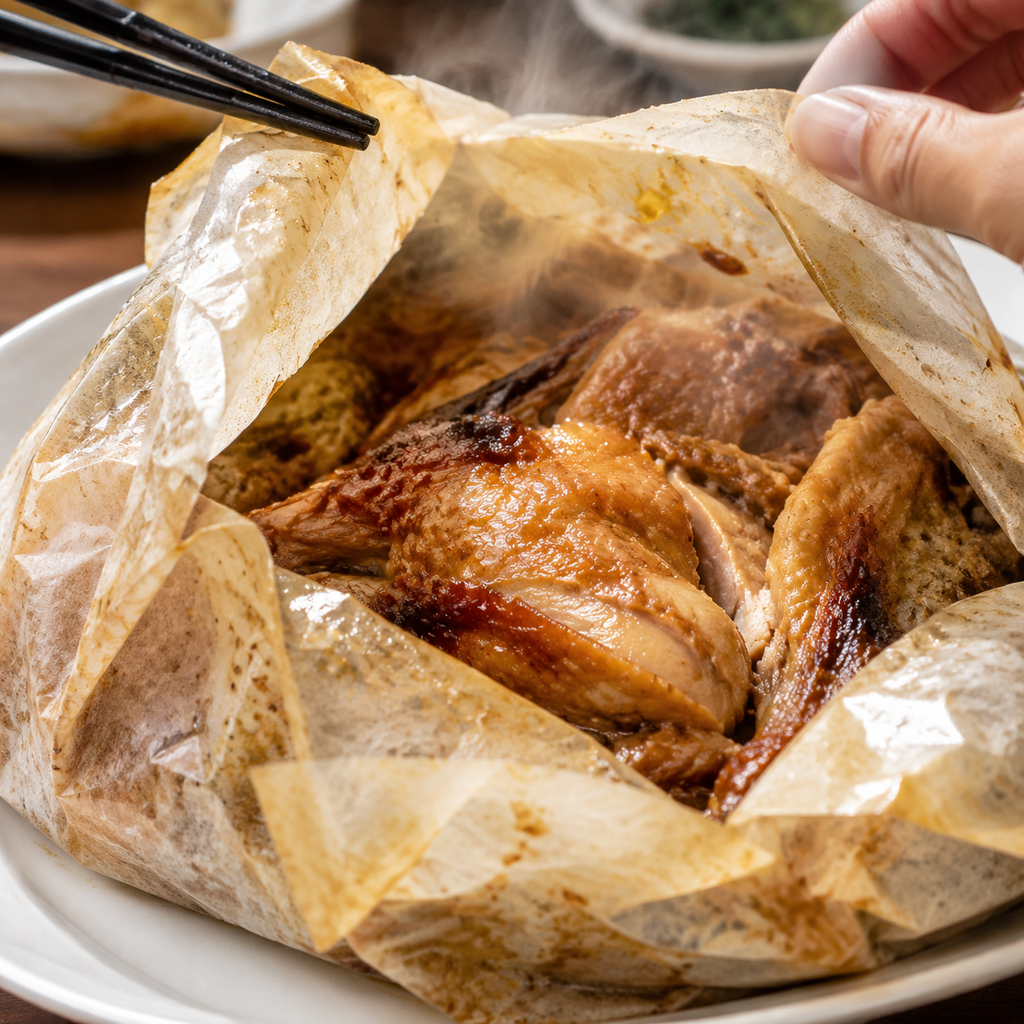
纸包鸡被端出来时,外层并不是一只平整漂亮的方盒,而是几层纸折叠、压住、再收紧的包裹。纸边有轻微的油印,折角因受热而变得柔软,靠近封口的位置却还保持着干硬的纹路。端菜的人先把包放在一只盘子里,再用手背碰了一下盘沿,确认没有滑动,最后才把盘子推到我面前。这个次序很重要:纸包不是拿来直接用手撕着走的装饰物,它要在盘子里停住,等桌面、手和热气都准备好。我先拍了一张没有打开的纸包,随即把手机放下,免得镜头挡住旁边的人取筷子。
When the paper-wrapped chicken arrived, the outer layer was not a perfectly neat square box. It was a parcel made of several sheets folded, pressed, and tightened together. Light oil marks showed along the paper, the corners had softened from heat, while the area near the closure still held its dry, firm creases. The server placed the parcel on a plate, touched the rim of the plate with the back of a hand to make sure it was stable, and only then slid it toward me. The order mattered. The wrapper was not a decorative object meant to be torn open by hand while walking; it needed to rest on a plate while the table, hands, and steam were ready. I took one photograph of the unopened parcel and put my phone down so the camera would not block someone beside me from reaching for chopsticks.
我原本以为拆纸只是一个开端,真正重要的是里面的鸡肉;坐在桌边后才发现,拆开的动作本身就改变了吃饭的速度。桌旁的人没有替我抢着动手。我先用筷子尖挑开最外层折边,发现纸面吸住了一点油,便改用两根筷子夹住纸角,沿着已经松开的纹路慢慢掀起。纸层一层叠着一层,热气从缝隙里冒出来,手指不能直接按在中央。我把盘子往自己这一侧拉了半寸,给蒸汽留出上升的空间。纸打开到一半时,里面的气味已经比视觉先抵达鼻子:鸡皮的油香、调味料的咸鲜、葱姜的暖意,混着纸被热透后的朴素气息。
I had assumed that opening the wrapper was merely a prelude and that the chicken inside was the important part. At the table, I realized that opening it changed the pace of eating. No one beside me reached over to do it for me. I used the tips of my chopsticks to lift the outer fold, then noticed that a little oil had made the paper cling to itself. I switched to gripping a corner with both chopsticks and opened it slowly along the loosened crease. The layers overlapped. Steam came through the gaps, and the center was too hot to press with my fingers. I pulled the plate half an inch toward myself to give the steam room to rise. When the paper was half open, the smell reached my nose before the view did: the rich scent of chicken skin, savory seasoning, warm scallion and ginger, and the plain fragrance of paper heated through.
我没有马上把纸全部扯掉。靠门坐着的一位中年男人看了看我的动作,用手掌在半空轻轻往外扇了两下,又指了指盘边。他的意思不需要完整的句子就能明白:先散热,再夹取。我照做,把最上面的纸折到外侧,让热气不再闷在包裹里。那层纸的内面呈现出一片不规则的亮色,油没有完全流下,而是停在纤维之间,随着角度变化闪一下。鸡肉露出来后,表面颜色偏深,边缘带着收紧的纹理,下面的汁水没有漫到盘底。这个观察让我放弃了“打开就翻动”的习惯,先让食物从封闭状态过渡到可入口的温度。
I did not tear the wrapper completely away. A middle-aged man sitting near the door watched my hands, gently fanned the air twice with his palm, and pointed to the edge of the plate. His meaning needed no full sentence: let it release heat before taking a piece. I followed him and folded the top layer outward so steam would no longer remain trapped. The inside of the paper held irregular patches of shine. The oil had not all run down; it remained among the fibers and flashed as the angle changed. Once the chicken was visible, its surface was darkened, with tightened edges, while the juices had not spread across the bottom of the plate. I abandoned my habit of turning food over immediately and let it move from a sealed parcel to an edible temperature first.
第一筷子我夹的是靠近边缘的一小块,不是为了判断整道菜,只是想知道纸包之后的肉会怎样回应牙齿。筷子碰到外皮时,表面有一点弹,夹紧后并没有马上碎开;我把它送到嘴边,先碰到的是温度,随后才是调味和肉的纤维。那一口没有让我只能用“香”字结束判断:香气在鼻腔里停得久,咸味在舌面上慢慢展开,鸡肉需要轻轻咀嚼,不能像汤粉那样用筷子搅动几下就吞下去。我把骨头和较硬的边缘放到盘子一角,把能单独咬开的部分分成小块,吃一块,再抬头看一眼雨势。
For my first bite, I chose a small piece near the edge, not to judge the whole dish but to see how the meat responded after being enclosed in paper. The surface had a little spring under the chopsticks; when I gripped it, it did not immediately fall apart. At my lips, temperature came first, followed by seasoning and the texture of the meat. I could not finish the judgment with the single word “fragrant.” The aroma lingered in the nose, salt unfolded gradually across the tongue, and the chicken needed gentle chewing. It could not be swallowed after a few casual stirs, as noodles might be. I set bones and firmer edges in one corner of the plate, divided the pieces that could be bitten separately, and looked out at the rain after each bite.
雨势最密的时候,骑楼外的路像铺了一层会移动的玻璃。水从檐口落下,先在地砖上炸开细小的白点,再沿着低处汇成窄流。骑电动车的人在外侧减慢速度,行人则贴着柱脚通过;柱子把一段长街切成一个个短镜头,有人站在这一根柱子后收伞,有人跨过下一根柱子前的积水。坐在门口吃东西的人不必把街景全部让给雨,他们仍然能看见谁在赶路、谁在找地方停下。我吃到一半时,一名拎着文件袋的年轻人把袋子夹在腋下,腾出手接过门内递出的打包纸袋,接着退回檐下,而不是冒雨冲向街口。
At the heaviest part of the shower, the road outside the arcade looked like a sheet of moving glass. Water fell from the eaves, burst into tiny white specks on the tiles, and gathered into narrow streams at the lower points. People on electric scooters slowed near the outer edge, while pedestrians passed close to the column bases. The columns divided the long street into short scenes: someone closed an umbrella behind one column, another person stepped over a puddle before the next. Diners near the entrance did not have to surrender the whole street view to the rain. They could still see who was hurrying and who was looking for somewhere to pause. Halfway through my meal, a young man carrying a document folder tucked it under his arm, freed one hand to receive a wrapped takeaway bag from inside, and stepped back beneath the eaves instead of rushing into the rain.
我开始注意到,骑楼不仅改变了“走哪一条路”,还改变了“什么时候决定吃饭”。没有连续的室外暴露,人可以在几家相邻的门口之间移动;先看雨有没有减弱,再看桌边是否有空处,接着闻到某种食物,才决定停下。晴天时,餐饮选择常常跟着目标走:到了某个地方,才寻找一顿饭。雨后的骑楼把顺序倒过来,路上的遮蔽先制造了停留,停留又让气味和动作参与选择。我原来准备把晚餐推迟到更远的区域,纸包鸡却让我把“就近吃、等雨小、再决定下一段”排在了前面。
I began to notice that the arcade changed not only which route people took, but also when they decided to eat. Because there was no long stretch of open exposure, people could move between neighboring entrances. They watched whether the rain had eased, checked for a place at a table, noticed a smell, and only then decided to stay. In dry weather, meal choices often follow a destination: reach a place first, then look for food. After rain, the arcade reversed that order. Shelter created a pause, and the pause allowed smell and movement to participate in the choice. I had planned to postpone dinner until a farther area, but the paper-wrapped chicken made “eat nearby, wait for the rain to soften, then decide the next stretch” the more sensible sequence.
纸包的余温也在提醒我,外带和堂食并不是两个完全分开的动作。有人把包好的食物放进袋子,袋口没有立刻扎死,而是留出一点缝;有人拿到手后先换到不烫的那一侧,再把袋子贴近身体。门口的工作人员把几个纸包错开放在托盘上,避免热气全挤在一起。我看见一个小男孩伸手去碰袋角,旁边的大人把他的手腕轻轻带开,改为指给他看纸上的油印。孩子没有哭闹,只把手缩回去,踮脚看了一会儿,再跟着大人往柱子内侧站。食物的包装在这里承担了温度、携带和等候三件事,手的动作也随之变得有先后。
The lingering warmth of the wrapper also reminded me that takeaway and dining in were not completely separate activities. One person placed a wrapped parcel in a bag without tying the opening shut, leaving a small gap. Another shifted the bag to its cooler side before holding it close to the body. A worker at the entrance spaced several parcels across a tray so the heat would not be trapped together. I saw a small boy reach toward a corner of a bag. The adult beside him gently guided his wrist away and pointed instead to the oil mark on the paper. The boy did not fuss. He pulled his hand back, stood on tiptoe to look for a while, and then followed the adult toward the inner side of the column. The packaging carried heat, allowed transport, and marked a waiting period, so the hands handling it also acquired an order.
我吃第二轮时,换了一个更慢的方式。先用筷子把肉与纸面分开,再把一块带皮的肉放到盘子中央,用筷子轻轻压住,沿着纤维方向撕开。纸上留下的油光让我看见肉汁停留的位置,也让我明白为什么不能用力拖拽:一旦纸屑黏在肉上,入口时会破坏原本干净的口感。我把纸包折成一个低矮的边框,让骨头、葱姜和已经冷下来的小块各有位置。邻桌的人把自己的纸包打开得很利落,动作是先压住封口、再向两边拉;我照着看了一遍,却没有急着模仿,直到我确认手不会碰到蒸汽,才把剩下的纸层拆开。
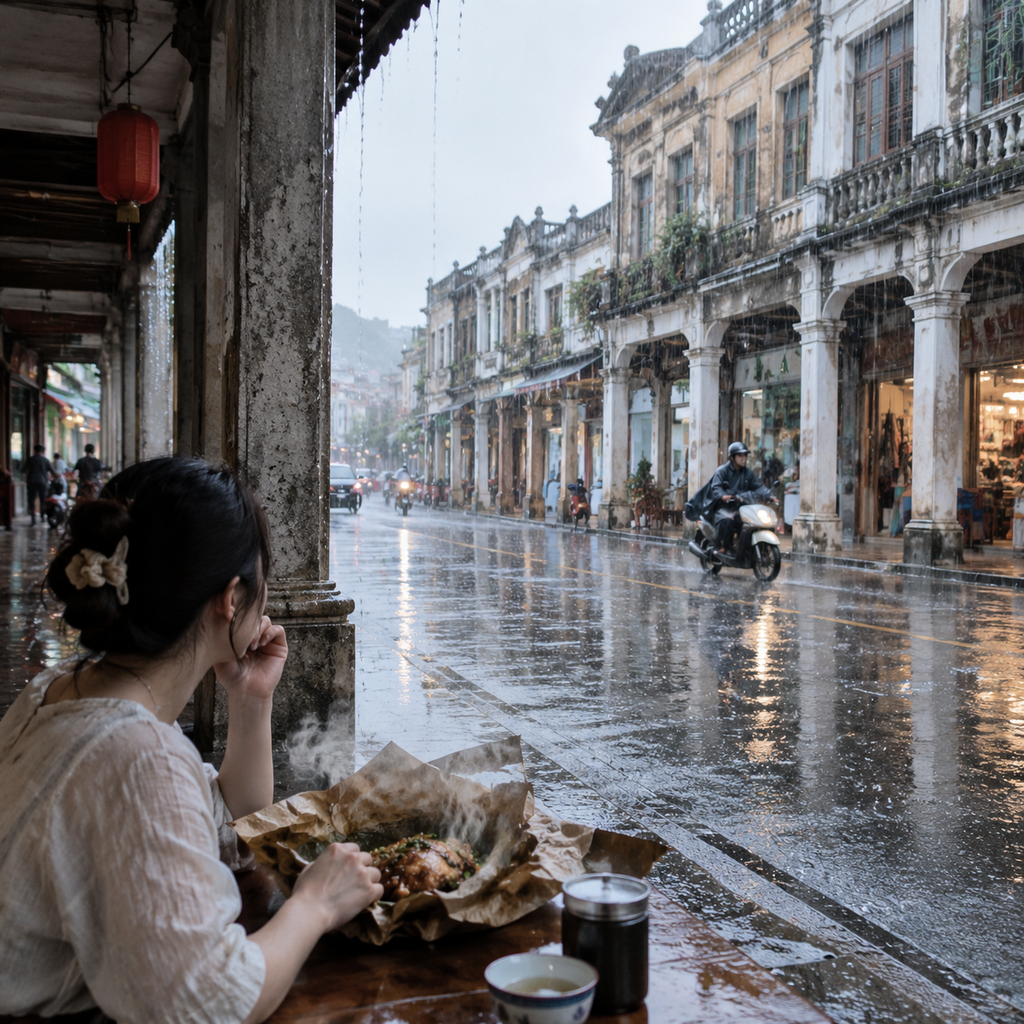
For the second round, I slowed down further. I separated the meat from the paper with my chopsticks, placed a skin-on piece at the center of the plate, held it gently, and pulled it apart along the grain. The sheen left on the wrapper showed where the juices had rested and explained why the paper should not be dragged forcefully: a scrap clinging to the meat would disturb the clean texture at the mouth. I folded the wrapper into a low rim so bones, scallion and ginger, and cooler pieces each had their own place. Someone at the next table opened a parcel efficiently by holding down the closure and pulling both sides outward. I watched once, but did not copy in a hurry. Only after I was sure my hands would avoid the steam did I remove the remaining layers.
雨小下来以后,街面上的人没有立刻全部离开。有人站在柱子外沿收起伞,有人把伞面抖了两下再靠到墙边;骑车人先用鞋底试路,确认没有连续的水流后才拧动车把。一个戴眼镜的街坊把椅子往里收,让从门口经过的老人不必侧身太多。他做完这件事,又回头看了一眼桌上的纸包,拿筷子把一块掉到盘边的肉夹回自己碗里。这里的交流很少靠完整的介绍,更多时候是让出半步、指一下热气、挪一张椅子、把食物往桌中央推。这些细小动作把陌生人、熟客和过路人放在同一条可协商的线上。
When the rain eased, people did not all leave at once. Some stood at the outer edge of the columns to close their umbrellas; others shook their umbrellas twice before leaning them against the wall. Cyclists tested the road with a shoe before turning the handlebar once the water was no longer running continuously. A bespectacled neighbor pulled a chair inward so an elderly person passing the entrance would not have to turn sideways so much. After doing that, he glanced back at the paper parcel on his table and used chopsticks to move a piece that had slipped to the plate’s edge back into his bowl. Few of these exchanges required complete explanations. They happened through half a step given up, a gesture toward hot steam, a chair moved aside, or food pushed toward the middle. Such small actions placed strangers, regulars, and passersby on the same negotiable line.
我后来走出门,又折回来拿伞时,发现自己已经把路线重新画了一遍。原计划里的几个室外停留点被放到次日,眼下只保留骑楼内可以连续走到的段落;沿江的长距离步行也改成先找能随时进门的方向。这个调整不是因为雨把一天彻底毁掉,恰恰是因为遮蔽空间让行动没有中断。只要我不把每一个路口都当成必须通过的关卡,雨就能把赶路改成观察:柱脚是否积水,檐下是否有人搬货,哪扇门前的气味适合停留,哪张桌子周围需要先让别人通过。行程表从一串目的地,变成了可以随时折返的范围。
When I stepped outside and then returned for my umbrella, I realized I had redrawn the route in my head. Several outdoor stops from the original plan moved to the following day. For now, I kept only the sections that could be walked continuously beneath the arcades, and changed the long riverside walk into a direction where I could enter a doorway at any moment. The adjustment did not mean the rain had ruined the day. It happened because the sheltered space prevented the day from stopping. Once I stopped treating every intersection as a checkpoint that had to be passed, the rain became an invitation to observe: where water gathered at column bases, where goods were moved under the eaves, which doorway held a smell worth pausing for, and which table needed to be cleared so others could pass. My itinerary changed from a chain of destinations into a range from which I could turn back.
纸包鸡冷下来后,气味从浓烈变得更贴近纸面。我夹起一小块已经不再冒热气的肉,发现入口前的香气少了一层冲劲,咸鲜却更清楚,皮的韧感也变得明显。旁边桌有人把剩下的部分重新包好,先将纸边压平,再把没有沾到汤汁的外层折进去,最后把包裹放进袋中。我没有把这件事写成某种固定规矩,因为我没有看见每个人都如此处理;但那个动作让我懂得,纸包不是吃完就该丢开的废料,而是记录过温度、油脂和等待的表面。它能告诉人食物从哪里打开,哪一边较热,剩下的部分还能不能平稳带走。
After the chicken cooled, its smell moved from being forceful to sitting closer to the paper. I picked up a small piece that no longer released steam. One layer of intensity had disappeared before it reached my mouth, but the savory taste was clearer and the skin had a more noticeable chew. At the next table, someone rewrapped the remaining pieces by flattening the paper edge, folding in an outer section that had not touched the juices, and finally placing the parcel in a bag. I did not turn this into a universal rule, because I had not seen everyone handle it that way. Still, the movement made me understand that the wrapper was not simply waste to be discarded after eating. It had recorded heat, fat, and waiting. It could show where the food had been opened, which side was warmer, and whether the remainder could be carried without falling apart.
我在门口又遇到那位穿雨衣的送菜女人。她的筐已经空了,只剩几片水洗过的叶子贴在底部。她站在檐下抖掉袖口的水,向里面的人摆了摆手,然后把空筐倒扣在自己的脚边。刚才她走得很快,现在却没有马上离开;她先看街上水流的位置,再把车推到一根柱子后面,等一辆电动车过去,才从椅子旁绕出。她的动作让我重新看骑楼:这里不是把所有人平均安排在一个“避雨区”,而是让每个人依据货物、鞋底、伞面和目的地,在同一段屋檐下找自己的站位。对于旅行者来说,最基本的礼貌就是别把入口堵成自己的观景台。
At the entrance I met the woman in the raincoat again. Her basket was empty except for a few washed leaves stuck to the bottom. She stood beneath the eaves, shook water from her cuffs, waved to someone inside, and turned the empty basket upside down near her feet. She did not leave immediately this time. She first examined where the water was flowing, then pushed her cart behind a column and waited for an electric scooter to pass before moving around the chairs. Her movements changed the way I saw the arcade. It did not place everyone equally inside one “rain shelter.” It allowed each person to find a position according to their goods, soles, umbrella, and destination. For a traveler, the most basic courtesy is not to turn an entrance into a private viewing platform.
天快黑时,檐口还在滴水,雨后的光从湿地砖上反射到柱面,亮一块,暗一块。店里有人把桌上的纸屑扫到掌心,有人把椅子往回推,给下一拨进门的人腾出位置。工作人员把没有吃完的纸包放在袋子里,提醒拿袋的人握住底部;对方先点头,再把袋子换到另一只手。那顿饭没有一个戏剧性的结尾,只有包装被重新折好、伞被挪开、椅子被归位、脚步重新经过门槛。我站在这几个连续的小动作旁边,才确定自己不会马上去下一个地方。雨已经给了我足够的理由留下,而纸包鸡的香气让这个留下不显得像等待。
As evening approached, water was still dripping from the eaves. After the rain, light reflected from the wet tiles onto the columns, bright in one patch and dim in the next. Someone swept scraps from a table into a palm; someone else pushed a chair back so the next group entering would have room. A worker placed an unfinished paper parcel into a bag and reminded its holder to support the bottom. The person nodded first, then shifted the bag to the other hand. The meal had no dramatic ending. There were only small actions: the wrapper folded again, umbrellas moved aside, chairs returned, and footsteps crossing the threshold. Beside this sequence, I knew I would not go immediately to the next place. The rain had given me enough reason to stay, while the aroma of the paper-wrapped chicken made the staying feel like more than waiting.
梧州的雨后骑楼让我记住的,不是一条必须照着走的路线,而是一种根据空间重新安排一天的方法。先找到可以避雨又不妨碍别人出入的位置,再观察食物如何被包、如何被加热、如何在纸里保持温度;打开时不抢速度,闻到香味后也不急着把判断说满;吃东西时给桌面、过道和门口留下余地,离开前看一眼地砖和檐口,决定下一段是继续走还是再次停下。纸包鸡把我留在梧州,并非因为它替我完成了某个景点,而是因为它把一顿饭的热度、骑楼的宽度和雨势的变化放进了同一个时间里。
What I remember from Wuzhou’s arcades after rain is not a route that must be followed, but a way of rearranging a day according to space. First find a place sheltered from rain without obstructing anyone’s entrance or exit. Then observe how the food is wrapped, heated, and kept warm inside the paper. When opening it, do not chase speed; after smelling it, do not rush to complete the judgment. While eating, leave room for the table, passage, and doorway. Before leaving, look once at the tiles and the eaves, and decide whether the next stretch should be walked or paused again. The paper-wrapped chicken kept me in Wuzhou not because it completed a sightseeing stop for me, but because it placed the warmth of a meal, the width of an arcade, and the changing rain into one shared span of time.
我第二次把纸包打开时,特意先观察了桌子的高度。骑楼里的桌面并不都一样,有的靠墙,有的贴近门口,有的旁边正好是通行的窄口。若把盘子放在最外侧,经过的人容易碰到;若把纸包摊得太开,又会占住旁边的碗筷位置。我把盘子向墙边移了移,纸边只在自己的桌面范围内展开,再将筷子横放在盘子上方。一个端着汤碗的阿姨从桌角经过时,手肘没有碰到任何东西。她停了一下,把自己手里的碗往里收,我也跟着把纸包再折窄一点。那不是谁在教谁,而是两个人用桌面完成了一次没有声音的协商。
The second time I opened the parcel, I paid attention to the height and position of the table. Arcade tables were not all arranged alike: some stood against a wall, some close to the entrance, and some beside a narrow passage. If I spread the plate at the outer edge, passersby might knock it; if I opened the paper too widely, it would take the space needed by bowls and chopsticks. I moved the plate toward the wall, kept the wrapper within my own area, and laid the chopsticks across the top of the plate. When a woman carrying a bowl passed the table corner, her elbow did not touch anything. She paused, drew her bowl inward, and I folded the parcel a little narrower too. No one was formally teaching the other; the tabletop became a quiet negotiation.
我还留意到纸包的声音会随着温度变化。刚开始掀开时,纸层分离得很慢,手指只要用力过猛,就会把已经吸油的纤维扯出毛边。过了一会儿,热气散掉,纸边变得更容易折叠,轻轻一压便贴回盘面。坐在里面的老人把自己那份纸包先摊开一条细缝,等了片刻才继续。他没有拿手机记录,也没有向旁人解释,只把纸角压住,低头看肉块的位置。这个动作让我意识到,加热并不是一道看不见的后台工序;热度直接决定了包装该怎么碰、食物该如何分开、吃饭的人要不要再等一会儿。
I also noticed that the wrapper sounded different as it cooled. At first, the layers separated slowly; too much force would pull oily fibers into a rough edge. After a while, the steam escaped and the paper became easier to fold, settling back against the plate with a light press. An older man nearby opened his parcel only into a narrow gap and waited before continuing. He did not record it on a phone or explain the procedure to anyone. He simply held down the corner and looked at where the pieces lay. That movement made me realize that heating was not an invisible backstage process. Temperature directly determined how the wrapper should be touched, how the food should be separated, and whether diners should wait a little longer.
门外的雨水也在改变气味的走向。雨刚下大时,潮湿的石材和伞布味道占了上风,纸包鸡的香气只在门内停留;雨势变缓后,檐下的空气开始流动,油香沿着柱廊向两侧散开。一个本来只是经过的男人走到门口,先看了看里面的座位,再低头闻了一下自己的衣袖,像是在确认身上没有被雨水带来的泥味。他没有马上坐下,而是把湿鞋挪到门外较空的位置,才向里面的人比了一个询问的手势。气味让他停下,但地面的湿度决定了他怎样停下。对我来说,这种先后关系比“这里很香”的形容更有用。
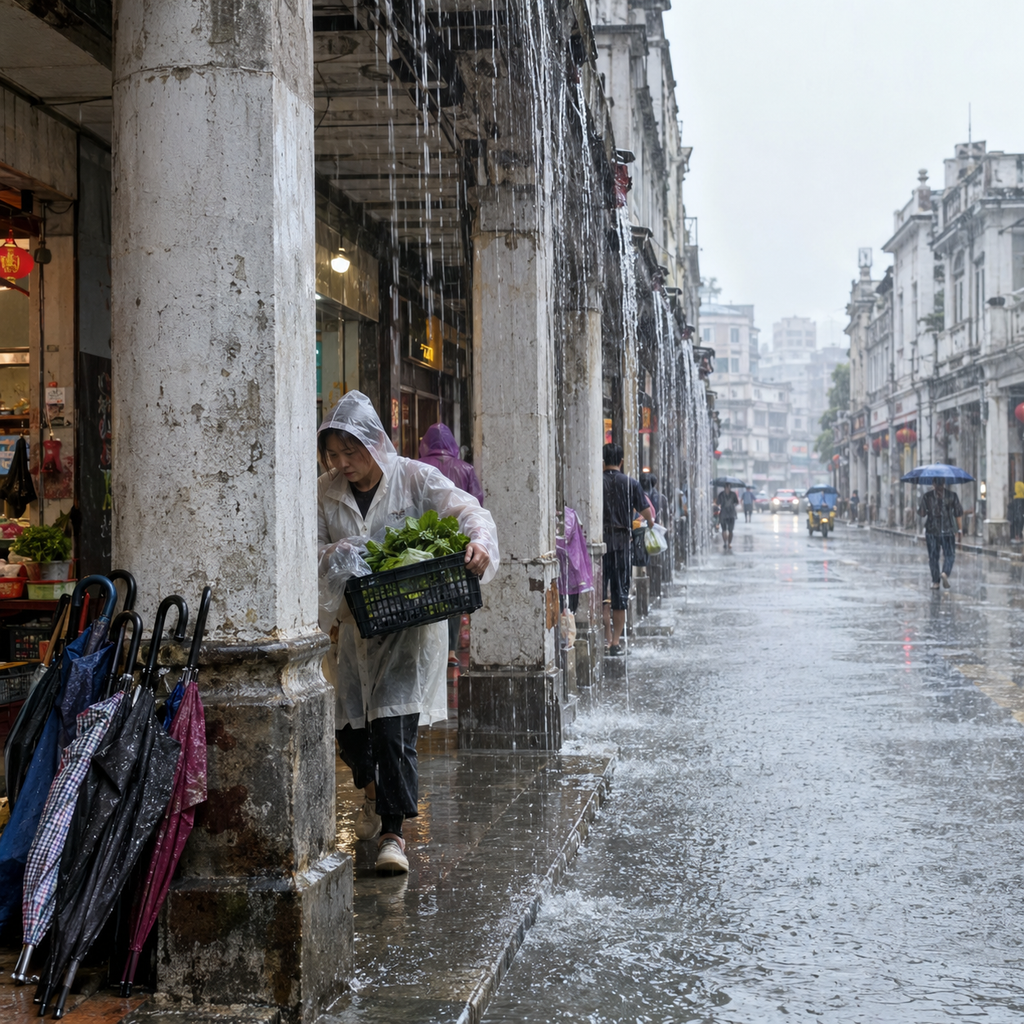
Rainwater outside also changed the direction of the smells. When the shower was strongest, damp stone and wet umbrella fabric dominated, and the chicken’s aroma remained inside. As the rain weakened, air moved beneath the eaves and the savory smell traveled along the columns in both directions. A man who had only been passing came to the entrance, checked the available seats, and looked down at his sleeve as if making sure it had not picked up the muddy smell from the street. He did not sit immediately. He moved his wet shoes to a clearer spot outside, then made an asking gesture toward the people inside. The smell made him pause, but the wet floor determined how he paused. For me, that sequence was more useful than simply saying that the place smelled good.
我把这顿饭拆成了几个小段:打开纸包,等热气散开,先吃边缘,再处理带皮的部分,最后才碰中间较厚的肉。每一段之间,我都会抬眼看看门口是否有人进来。这样做并不是为了把吃饭弄得仪式化,而是因为纸包的形状在不断变化,盘子的重心也会跟着移动。纸层刚打开时,中央的热气最集中;纸边压低后,汁水和油光会向较低处聚拢;肉块被夹走几次,盘面就会空出一条方便落筷的路径。我用筷子把骨头拨到那条路径旁边,避免下一次夹取时碰到。食用动作由包装推动,包装又被人的手逐步改造成临时餐具。
I divided the meal into several small stages: opening the parcel, letting the steam escape, eating the edge pieces first, handling the skin-on sections, and only then reaching the thicker meat in the center. Between stages, I looked toward the entrance to see whether someone was coming in. This was not an attempt to make eating ceremonial. The shape of the wrapper kept changing, and the plate’s balance changed with it. At first the steam was concentrated in the center. Once the paper edges were pressed down, juices and oil gathered in the lower areas. After several pieces were removed, a clear path for the chopsticks appeared on the plate. I moved the bones beside that path so they would not interfere with the next bite. The wrapper guided the eating movements, and the hands gradually turned it into temporary tableware.
坐在骑楼里,人的视线也不再只有前方。墙面、柱子、桌面和门槛构成了几层不同高度的观察面。我低头时能看到纸上的折痕,抬头时能看见檐外一串串水珠,再往远处看,才能分辨雨幕里经过的是步行者还是骑车人。一个小伙子从外面跑进来,先把帽子摘下甩水,再把手机从裤袋里取出检查。他站在柱子后面接了一个电话,声音压得很低,接完后没有立刻走,而是蹲下来擦鞋底。等鞋底不再滴水,他才走到靠里的空位。骑楼把一个匆忙的人拆成几个动作,让他有机会把外部天气留在门槛之外。
Inside the arcade, sight was no longer limited to the direction ahead. Walls, columns, tabletops, and thresholds formed several viewing surfaces at different heights. Looking down, I saw creases in the paper. Looking up, I saw strings of drops beyond the eaves. Farther away, I could distinguish pedestrians from cyclists through the curtain of rain. A young man ran in from outside, removed his cap, shook off the water, and checked his phone. He took a call behind a column in a lowered voice. Afterward, he did not leave at once; he crouched to wipe the soles of his shoes. Only when they stopped dripping did he move to an inner seat. The arcade broke his hurry into several actions and gave him a chance to leave the weather outside the threshold.
我在吃饭时没有询问具体店名、价格或营业时段,因为那些信息并没有从眼前的动作中自然出现,也不应当靠猜测补齐。相反,我把能确认的事情记在心里:纸张在热气中变软,封口需要沿折痕处理,开包后要给蒸汽留出口,食用时要把骨头和纸边分开,打包时要托住袋底;雨势、路面和桌边人流会影响我是否继续往前走。这些都是一次现场观察能够承担的内容。旅行写作若只追求一串细节,容易把没有验证过的内容也写得像事实;我宁愿让文章停在能看见、能听见、能用动作确认的范围里。
While eating, I did not ask for or invent a specific shop name, price, or opening schedule. Such details did not naturally emerge from the actions in front of me and should not be filled in by guesswork. Instead, I kept track of what could actually be confirmed: paper softened in steam, the closure needed to be handled along its creases, the parcel needed an opening for heat to escape, bones and wrapper edges had to be separated during eating, and a takeaway bag needed support underneath. Rain, pavement, and traffic beside the table all influenced whether I would continue walking. These were observations that the moment could support. Travel writing that chases a string of details can make unverified information sound factual; I would rather remain within what could be seen, heard, or confirmed through an action.
骑楼里的餐饮选择还受到“可退出性”的影响。坐下之前,我先看门口到桌边有几步,桌椅是否挡住进出,自己的伞能不能放在不滴到别人鞋面的地方。吃到一半,如果雨突然加密,我可以把纸包往里收,等候一阵;如果雨停,拿起伞就能沿着同一排檐口继续走。这个选择与坐在完全封闭的房间里不同,也与露天摊位不同。骑楼允许我保持对街道的注意,却不必把身体暴露在雨里。于是我不再执着于一次性决定“要不要吃”,而是把它拆成“先坐下、先打开、先尝一块,再判断是否继续停留”。
Arcade dining was also shaped by how easily one could leave. Before sitting, I checked how many steps led from the entrance to the table, whether the chairs obstructed the passage, and whether my umbrella could be placed without dripping onto someone’s shoes. If the rain intensified halfway through the meal, I could pull the parcel inward and wait. If it stopped, I could pick up the umbrella and continue beneath the same row of eaves. This differed from sitting in a completely enclosed room and from eating at an open-air stall. The arcade allowed me to remain attentive to the street without exposing my body to the rain. I therefore stopped insisting on a single yes-or-no decision about eating. I could sit first, open the parcel, taste one piece, and then decide whether to stay.
雨后的街坊交流有一种很实际的节奏。有人问候,并不是为了拉长谈话,而是为了确认桌子够不够用;有人把打包袋递过去,也会顺手提醒袋底有热气;有人看见陌生人把纸包拆得太急,就用眼神或手势让他慢一点。那位中年男人后来起身时,把自己的椅子推回墙边,还顺手把门口一把横放的伞往里靠了靠。他没有看我,也没有等待感谢,做完便走到檐下。我跟着把自己的椅子摆正,发现这样做以后,入口处多出了一条可通行的空隙。骑楼的秩序不是写在告示上的抽象规则,而是在一次次挪椅子、收伞、让路和递碗中被维持。
Neighborhood exchanges after rain had a practical rhythm. A greeting was often meant to check whether a table could be shared, not to extend a conversation. Someone handing over a takeaway bag might also mention that the bottom was still hot. When a stranger opened a parcel too quickly, another person could use a glance or gesture to ask for more care. When the middle-aged man eventually stood, he pushed his chair against the wall and moved an umbrella lying across the entrance closer to the side. He did not look at me or wait for thanks; he simply walked beneath the eaves. I straightened my own chair and found that a clear passage had opened near the entrance. The arcade’s order was not an abstract rule posted on a notice. It was maintained through repeated acts of moving chairs, gathering umbrellas, giving way, and passing bowls.
我也重新理解了“被一顿饭留住”这句话。它不一定意味着食物好吃到让人取消所有计划,也不意味着旅行者必须把偶遇写成命运。那天下午,真正发生的是几个小决定连续叠加:雨大了,我没有冲出去;门内有座位,我先坐下;纸包很烫,我等热气散开;香气出现,我改变了吃饭地点;路面仍滑,我缩短了下一段步行;檐下还有人交流,我把离开的时间往后挪。每个决定都很普通,但它们共同改变了下午的方向。纸包鸡不是孤立的味道,它与雨、屋檐、桌面和人的动作一起形成了一条可追踪的因果线。
I came to understand “being kept by a meal” differently. It did not mean the food was so extraordinary that every plan had to be canceled, nor that an encounter had to be turned into destiny. What actually happened that afternoon was a chain of small decisions. The rain grew heavy, so I did not rush outside. There was a seat inside, so I sat down. The parcel was hot, so I waited for the steam to settle. The aroma appeared, so I changed where I would eat. The pavement remained slippery, so I shortened the next walk. People were still exchanging small gestures beneath the eaves, so I delayed leaving. Each decision was ordinary, but together they redirected the afternoon. The chicken was not an isolated flavor; it formed a traceable line of cause and effect with rain, roof, tabletop, and human movement.
离开前,我用纸巾把盘边沾到的一点油擦掉,又把纸包折回原来的大致形状。折叠不可能恢复到未打开时那么紧,但至少不会让纸角伸到过道。我的伞面还在滴水,便先站到门外较空的位置,让水落完一阵,再沿着柱廊往前。走出几十步后,我回头看见那家门口又进来两个人,他们先收伞,再抬头确认座位,随后才把目光放到桌面上的纸包。街上还没有完全干,檐下却已经恢复了走路、搬货、吃饭和说话的交错节奏。我原来的行程被雨打乱,最后留下的是一条更适合梧州天气的路线:给遮蔽留位置,给食物留温度,也给临时停步留出不必解释的时间。
Before leaving, I wiped a little oil from the edge of the plate and folded the wrapper back into roughly its original shape. It could not return to its tightly sealed form, but at least no corner extended into the passage. My umbrella was still dripping, so I stood in a clearer spot outside and let the water fall for a while before walking beneath the columns. After several dozen steps, I looked back and saw two more people enter. They closed their umbrellas, checked the seats, and only then turned their attention to the paper parcels on the tables. The street was not fully dry, but the arcade had already returned to its overlapping rhythm of walking, moving goods, eating, and talking. Rain had disrupted my original itinerary, but it left me with a route better suited to Wuzhou weather: leave room for shelter, give food time to hold its heat, and allow a temporary pause that needs no explanation.
我还观察了同一张桌子在不同人的手里怎样变成不同的用餐空间。靠门的一位年轻母亲把孩子的碗放在里面,自己把纸包放在外侧;她每夹走一块鸡肉,都会先把筷子停在盘上方,看孩子是否要喝水。孩子伸手指向纸边,她没有立刻把纸拿走,而是让孩子隔着一点距离看油印,再把纸角向内折。另一边的老伯吃得很快,先把骨头挑出,随后把纸包卷成窄筒放到盘旁,空出的地方用来摆勺子。两个人面对的是同一种包装,却根据同桌人的身高、手势和吃饭速度安排位置。骑楼的开放性让这些安排能够被看见,也让我理解到餐饮空间并不是装修完成后就固定不变的东西。
I also watched how the same table became different dining spaces in different hands. A young mother near the entrance placed her child’s bowl on the inner side and kept the parcel toward the outside. Each time she picked up a piece of chicken, she paused above the plate to see whether the child wanted water. When the child pointed at the paper, she did not remove it immediately. She let him look at the oil mark from a safe distance, then folded the corner inward. An older man on the other side ate quickly, separating the bones first and rolling the wrapper into a narrow tube beside the plate so he could place his spoon in the cleared space. Both used the same kind of packaging, yet arranged it around height, gestures, and eating speed. The openness of the arcade made these arrangements visible and helped me understand that a dining space is not fixed once its decoration is finished.
我把剩下的鸡肉分给同行人时,也遇到了一个很小的麻烦。盘里有一块肉黏在纸面上,若直接夹,纸会跟着一起卷起;若用力拉,肉的外层又容易散。我先用另一双筷子压住纸,同行人把盘子往里挪,门口一位正在收拾桌面的女人看见后,拿来一把干净的小勺,示意从肉与纸的接缝处慢慢分开。我们没有把这件事说成复杂技巧,只是顺着她的动作试了一遍。肉被完整托起,纸面留下一个浅浅的印子。这个插曲让我记住,食用动作不只是个人口味,也包含桌边共同解决问题的过程;当空间允许人互相看见,陌生人的一个示范就能减少浪费和慌乱。
I ran into a small problem when sharing the remaining chicken with a travel companion. One piece had stuck to the paper. If we lifted it directly, the wrapper curled with it; if we pulled harder, the outer layer of meat began to separate. I held the paper down with a second pair of chopsticks while my companion moved the plate inward. A woman clearing tables near the entrance noticed and brought a clean spoon, indicating that we should work slowly at the join between meat and paper. We tried once according to her movement. The piece came away intact, leaving only a faint mark on the wrapper. The incident taught me that eating is not only a matter of personal taste. It also includes solving small problems together at the edge of a table. When a space lets people see one another, a stranger’s demonstration can prevent waste and confusion.
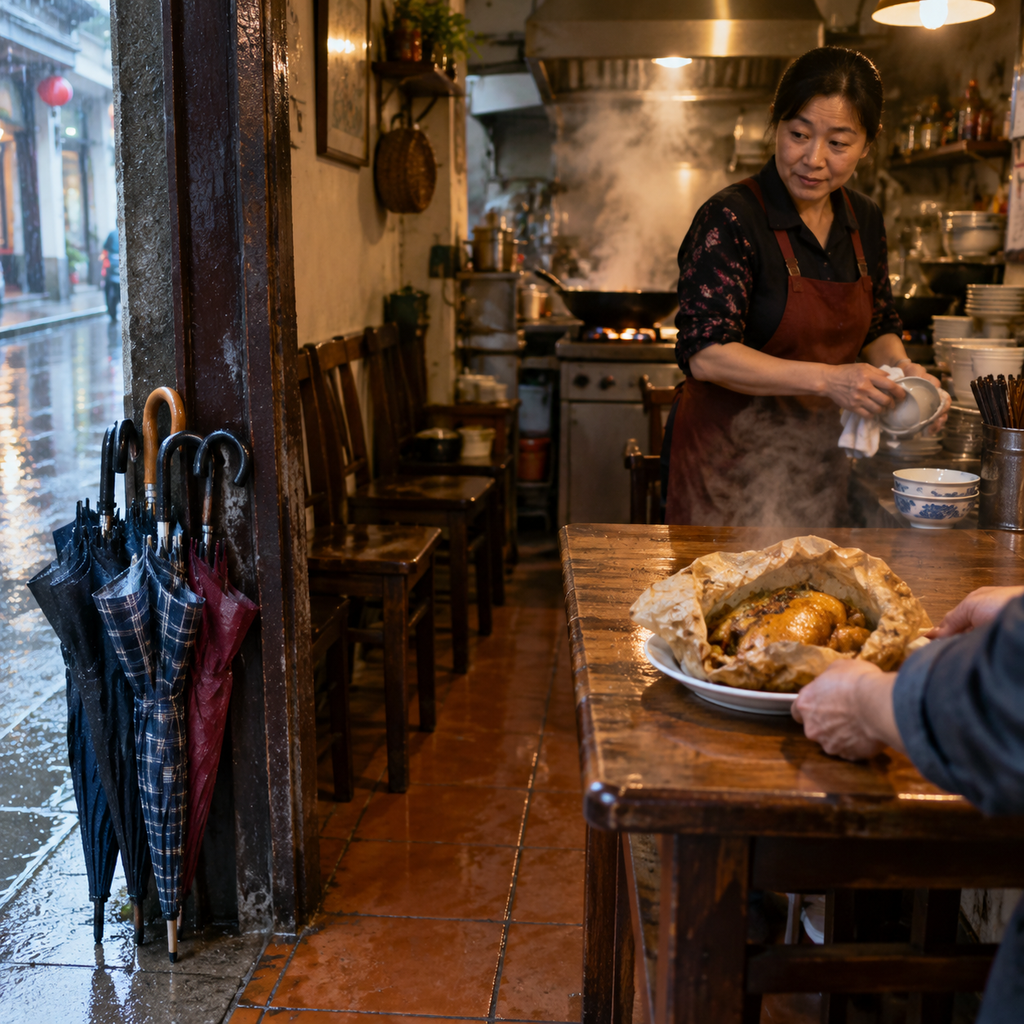
雨后的行程调整还影响了我对“附近”的判断。地图上相隔不远的两个路口,实际走起来可能要经过一段没有连续遮蔽的路;地图上看似绕远的一排骑楼,反而能让人沿檐下慢慢移动,遇到门口拥挤时还可以退回上一根柱子旁。吃完以后,我没有只看直线距离,而是看屋檐是否连续、柱脚有没有积水、门口的桌椅是否给人留下转身空间。一个推着婴儿车的年轻父亲从前方过来,发现某处水流横过地砖,便先把车头抬起一点,再从柱子内侧绕行。他回头向同行的人摆手,提醒对方不要走外沿。我也跟着改道。原来短的路未必更适合雨后,能让身体少做几次应急动作的路,才是当天真正走得下去的路。
The itinerary after rain also changed how I judged the meaning of “nearby.” Two intersections that looked close on a map might require a stretch without continuous shelter. A row of arcades that appeared to be a detour could allow a slow walk under the eaves, with the option to retreat to the previous column when an entrance became crowded. After eating, I stopped looking only at straight-line distance. I checked whether the roofline was continuous, whether water gathered at the column bases, and whether tables left room to turn around. A young father pushing a stroller approached from ahead. When he saw water running across the tiles, he lifted the front slightly and guided the stroller around the inner side of a column. He turned and waved to his companion not to use the outer edge. I changed direction too. The shortest road was not necessarily the best after rain; the road that required fewer emergency movements was the one I could genuinely continue walking.
我最后没有去原先计划中的远处停留点,而是在骑楼相对安静的一段又走了一遍。第一次经过时,我只看见水帘、招牌和躲雨的人;第二次经过,我开始看见每个入口怎样安排货物,哪一段柱廊适合两个人并行,哪些桌子会在饭点前收进屋里,哪些门槛因为湿滑需要绕开。一个年轻店员把空纸箱立起来靠在墙边,发现挡住了通道,又弯腰把箱子压扁;另一位街坊把伞尖朝下放到墙角,避免水流向人行的一侧。我没有把这些动作拍成景点证明,它们本来就是生活的一部分,却比整齐的街景更能说明骑楼如何承受一场雨:让货物有地方放,让人有地方转身,让热食和湿鞋各自找到不冲突的位置。
In the end, I did not go to the distant stop on my original plan. I walked through a quieter section of the arcade once more. The first time, I had seen only the curtain of water, signs, and people sheltering. On the second pass, I noticed how each entrance arranged its goods, which sections allowed two people to walk side by side, which tables would be moved inside before a busy meal period, and which thresholds were slippery enough to avoid. A young worker stood empty cardboard boxes against a wall, then crouched to flatten them when he realized they blocked the passage. Another neighbor placed an umbrella tip-down in a corner so water would not run toward the walking side. I did not photograph these actions as proof of a sight. They were ordinary parts of life, yet they explained better than a tidy street view how the arcade handled rain: giving goods a place, giving people room to turn, and allowing hot food and wet shoes to occupy spaces without conflict.
雨停后的骑楼并不等于路面已经恢复成干燥状态。檐口的水线会在雨势变小后继续落一阵,柱脚附近的积水也会因为砖面高低不同而分成几股细流。我从店门口往街心走时,先把脚放在颜色较浅、没有连续反光的砖面上,再绕开被屋檐集中冲刷的凹处。骑楼的柱网看似把通道拉直,真正行走时却要不停读取这些小变化:哪一段被送货车占去,哪一根柱子后面有人收伞,哪一处地面刚被拖过仍然发滑。雨后逛街不能只盯着远处的牌匾,脚下的湿度决定了速度,速度又决定我会不会看见一间临时打开的餐馆。
An arcade does not mean that the pavement is dry as soon as the rain stops. Water can keep falling from the eaves after the shower has weakened, while puddles near the column bases split into thin streams because the tiles are not perfectly level. When I walked from the doorway toward the street, I placed my feet first on lighter tiles without a continuous reflection, then went around hollows washed by concentrated runoff. The columns seemed to make the passage straight, but walking there required constant small readings: which section was occupied by a delivery cart, which column hid someone closing an umbrella, and which patch had just been mopped and was still slippery. After rain, a visitor cannot watch only the signs ahead. Moisture underfoot controls pace, and pace determines whether an open eatery is noticed at all.
骑楼的遮蔽让餐饮选择出现一种很实际的层次。第一层是能不能在不挡住通道的地方停下来,第二层是桌面和座位是否已经被雨水、湿伞或搬货动作占满,第三层才是想吃什么。我站在一间门口时,先看见靠外的两张桌子旁留有通行缝隙,随后才闻到纸包鸡的油香;如果座椅已经横在柱间,即使气味再明显,我也不会把那里当作合适的停留点。骑楼把店铺、过道和街面放在同一条连续的边界上,吃饭的人既是顾客,也是过路秩序的一部分。选择一家店,实际包含了对别人的脚步、湿伞滴水和自己停留时长的判断。
The shelter of the arcade creates a practical hierarchy for choosing food. First comes the question of whether one can stop without blocking the passage. Next comes the condition of the tables and seats, which may be occupied by rainwater, wet umbrellas, or moving goods. Only then does the question of what to eat arise. At one doorway, I first noticed a narrow gap beside two outer tables and only afterward smelled the rich scent of paper-wrapped chicken. If chairs had stretched across the space between columns, I would not have treated the place as suitable, no matter how appealing the smell. The arcade places shopfronts, passage, and street along one continuous edge. Diners are also participants in pedestrian order, so choosing a restaurant includes judging other people’s footsteps, dripping umbrellas, and the length of one’s own pause.
纸张在这道菜里不是简单的外壳,它把加热留下的痕迹保存得很清楚。刚端来的包裹拿在盘中时,纸面有些地方紧贴肉汁,有些折层仍然干燥;靠近热源的一侧颜色更深,边缘则因反复折压显出细小的毛边。我用筷子打开时,先松开最外层,再让内层向两边倒下,避免把纸屑带到鸡肉上。纸的纤维吸收了一部分油,却没有把所有汁水都变成湿透的软塌状态,这种不均匀正好告诉我哪里曾经受热、哪里只是包裹时被压住。看纸面不是为了挑出“好看”的包装,而是为了决定接下来该等多久、从哪一块开始夹。
The paper is not merely an outer shell; it preserves the marks left by heating with unusual clarity. When the parcel arrived on its plate, some areas of the paper clung to the juices while other folds remained dry. The side closer to the heat was darker, and the edges showed tiny fibers from repeated folding and pressing. I opened it by loosening the outer layer first and letting the inner layers fall outward, keeping scraps away from the chicken. The fibers had absorbed some fat without turning every layer into a collapsed, soaked mass. That unevenness indicated where heat had reached and where the paper had only been compressed during wrapping. I was not examining the wrapper for decoration. Its condition helped me decide how long to wait and which piece to pick first.
加热后的纸味也有一个变化过程。包裹刚打开时,气味混在蒸汽里,靠近鼻子会显得集中;放在桌面几分钟后,热气变薄,葱姜的味道从纸的暖味中分离出来,鸡皮的油香则停在盘边。那几分钟不能被当作空等,因为它给了我一个观察入口的机会:如果纸包底部已经被汁水浸软,移动盘子时就要托住底部;如果纸边仍然挺立,打开剩余折层时可以少用一点力。食物的香气不只负责引起食欲,也在提示温度和包装状态。真正入口前,我会先看纸包是否稳,再用筷子确认肉块有没有黏住纸面。
The smell of heated paper also changes over time. Just after opening, it is concentrated within the steam near the nose. After several minutes on the table, the steam thins, the scallion and ginger separate from the warm paper scent, and the aroma of chicken skin lingers around the plate. Those minutes are not empty waiting. They offer time to inspect the opening: if the bottom has softened from juices, the plate should be supported underneath; if the edges remain firm, the remaining folds can be opened with less force. Aroma does more than create appetite. It also hints at temperature and the condition of the wrapping. Before eating, I check whether the parcel is stable, then use chopsticks to see whether the meat is adhering to the paper.
吃纸包鸡时,手和筷子之间有一套不显眼的分工。筷子适合探入折层、夹开肉块、把骨头移到盘边;手可以扶住盘子、推开已经冷却的纸角,却不该直接去按住中央的热包。我先把纸向外翻成低边,避免它重新盖住食物,再用筷子把一块带皮的肉分成容易入口的大小。咬下去时,牙齿先感到外层的收紧,随后才是肉的纤维和汁水。若一口太大,既不方便咀嚼,也容易让人下意识端碗遮挡邻座取菜。我因此宁愿分两次夹取,把注意力留给温度、骨头和桌面空间,而不是追求一次把包装全部拆完。
Eating paper-wrapped chicken involves a quiet division of labor between hands and chopsticks. Chopsticks are suited to probing the folds, separating pieces, and moving bones to the edge of the plate. A hand can steady the plate or push away a cooled corner of paper, but it should not press the center of a hot parcel. I fold the paper outward into a low rim, preventing it from covering the food again, and use chopsticks to divide a skin-on piece into manageable bites. The teeth first meet the tightened outer layer, followed by the grain and juices of the meat. A bite that is too large makes chewing awkward and may cause the diner to lift a bowl and block a neighbor’s reach. I prefer two smaller movements, keeping room for temperature, bones, and the shared table rather than trying to remove every fold at once.
骑楼里的街坊交流常常从食物的边缘开始,而不是从正式认识开始。有人经过时会把肩膀收窄,让端盘的人先出门;有人看见新客人对着纸包犹豫,就用手指点一下盘底或把自己的打开方式做一遍。这样的提示没有必要变成完整采访,也不能擅自补成一句漂亮的原话。对我来说,更可靠的是观察提示之后发生了什么:我把盘子往里推,给端菜的人让出直线;旁边的人把伞尖转向墙侧,滴水便不再落到鞋面;一个熟客把椅子斜放,过道马上宽了一点。交流通过空间变化被看见,食物只是让陌生人拥有共同注意点的起点。
Neighborhood exchanges in the arcade often begin at the edge of a meal rather than with formal introductions. Someone narrows a shoulder to let a person carrying a plate pass first. Someone notices a newcomer hesitating over a parcel and points to the underside of the plate or demonstrates an opening method with their own food. Such guidance does not need to become a staged interview, and I should not turn it into a polished quotation that was never spoken. What can be observed with confidence is what happens afterward: I push my plate inward to create a straight line for the server; a neighbor turns an umbrella tip toward the wall so water no longer lands on a shoe; a regular angles a chair and widens the passage. Space makes the exchange visible, while the meal simply gives strangers a shared point of attention.
雨后的沿江湿气会改变人对食物保存的判断,但它不能被压缩成一个适用于所有情况的固定答案。靠江一侧的空气明显更潮,纸袋外壁容易变软,桌面上残留的水汽也不容易立刻散去。堂食时,我会把吃剩的部分从湿伞和门口水流旁移开,先看汁水是否已经浸透纸层,再决定是否适合短距离带走。纸包如果底部发软、封口处沾满汤汁,就不适合继续叠压;若只是外层受潮而内层仍有支撑,也要把袋口留出通气位置,并尽快处理。这里的判断重点不是“能放多久”,因为没有一个脱离食物状态、环境和路程的准确数字,而是热、湿、油和携带时间是否同时增加风险。
Humid air along the river changes how food storage should be judged, but it cannot be reduced to one fixed rule for every parcel. On the riverside side of the arcade, the air feels damper, paper bags soften more easily, and moisture on a table takes longer to disappear. When dining in, I move leftovers away from wet umbrellas and runoff near the entrance. I check whether juices have soaked through the paper before deciding whether the food is suitable for a short carry. If the bottom has become soft and the closure is coated with liquid, the parcel should not be compressed further. If only the outer layer is damp and the inner layer still supports the food, I leave an opening for air and handle it promptly. The useful question is not “how long will it last,” since no exact number works independently of food, surroundings, and distance. It is whether heat, moisture, fat, and carrying time are rising together.
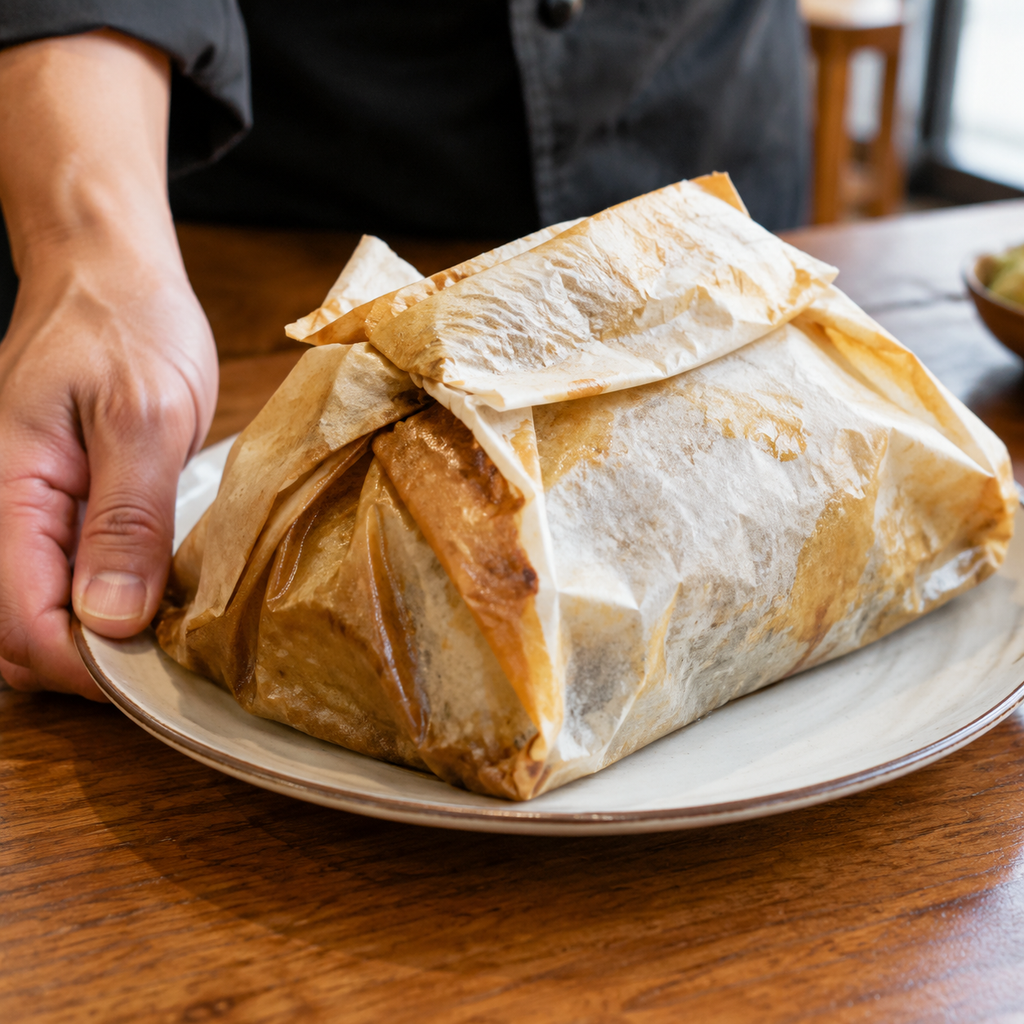
沿江湿气还会影响味道的判断方式。刚从纸里打开的鸡肉,香气被热度推到鼻腔前方;走过一段潮湿的檐下通道后,人的衣袖、纸袋和头发都带着水汽,嗅觉会把环境味与食物味混在一起。于是我不急着在门口判断一份外带食物是否仍然理想,而是先找一个不被雨水直接打到、又不贴近闷热灶台的位置。打开袋口时,我看纸面是否出现新的渗油,闻气味有没有从熟食的咸香变成不清楚的酸闷,再用眼睛确认颜色和表面状态。气味、外观和触感若彼此不一致,就不勉强继续;旅行中少吃一口,通常比把不确定性吞下去更稳妥。
River humidity also affects how flavor should be assessed. Chicken freshly opened from paper sends its aroma forward on the heat. After walking beneath a damp stretch of eaves, however, sleeves, bags, and hair all carry moisture, and the nose can mix environmental smells with those of the food. I therefore do not judge a takeaway parcel at the doorway. I first find a place protected from direct rain but not pressed against a hot, enclosed stove. When I open the bag, I check whether new oil has seeped through the paper, whether the smell remains savory and cooked or has become unclear and sour, and whether the color and surface still look consistent. When smell, appearance, and touch disagree, I do not force the decision. On a trip, leaving one bite uneaten is usually wiser than swallowing uncertainty.
骑楼对行程的影响还体现在“可撤回”这件事上。沿江道路若完全暴露在雨里,走出去以后往往要一路承担鞋袜变湿、相机受潮和临时找车的成本;骑楼则把许多节点连成可退可进的短距离。我从餐馆出来时,没有马上朝远处的江岸拐去,而是沿柱子内侧走了一小段,确认下一处屋檐仍然连续,才决定继续。遇到人流变密的门口,我宁愿绕到另一侧,也不把自己塞进搬货和用餐交会的位置。行程调整因此不是简单删掉景点,而是把每段路按遮蔽、脚感、携带食物的稳定性重新排序。纸包鸡留在手里时,路线要更平,转弯要更少,停靠点要更容易放下东西。
The arcade changes an itinerary through the possibility of retreat. On a fully exposed riverside road, once a traveler goes out into the rain, wet shoes, damp equipment, and the cost of finding transport all accumulate along the way. The arcade links many points through short stretches that can be entered or abandoned. When I left the restaurant, I did not turn immediately toward the distant riverbank. I walked for a while along the inner side of the columns, checked that the next roofed section remained continuous, and only then continued. When a doorway became crowded, I went around rather than forcing myself into the meeting point of deliveries and diners. Adjusting a plan is therefore not simply deleting sights. It means reordering each stretch by shelter, footing, and the stability of the food being carried. With a paper parcel in hand, the route should be flatter, turns fewer, and stopping places easier for setting things down.
我还发现,骑楼的宽度会直接改变点餐的分量选择。若桌子靠近过道,纸包鸡打开后需要占用盘子、纸层和夹取动作的空间,同行者太多时就不适合一次摆出过多菜品;若内侧桌面较深,包装可以摊开,骨头和纸角也有地方分别放置。雨天人们更容易在同一片屋檐下短暂停留,桌边的空隙就不只是个人舒适问题,还关系到后来进门的人能否坐下。我没有把这种观察写成“某种地方规矩”,因为不同店面的布局差别很大;但我会先看桌脚与通道的距离,再决定是堂食、少点一些,还是把食物带到更合适的地方。空间尺度参与了味觉之外的选择。
I also found that the width of an arcade directly affects how much food to order. If a table sits close to the passage, opening the paper-wrapped chicken requires space for the plate, folds, and chopstick movements. With several companions, placing too many dishes at once makes the table difficult to share. A deeper inner table allows the wrapper to spread out and gives bones and paper corners separate places. On rainy days, more people pause under the same roof, so the gap beside a table concerns not only personal comfort but also whether later arrivals can sit. I do not describe this as a universal local rule, because layouts differ from shop to shop. I simply check the distance between table legs and the passage, then decide whether to dine in, order less, or carry the food elsewhere. Spatial scale participates in the decision alongside taste.
一场雨也会改变我对“吃完再走”的理解。纸包鸡刚打开时,最适合把注意力放在温度和食用动作上;吃到后半段,外面的雨势、门口积水和沿江湿气又重新进入判断。如果雨水从檐边斜着飘进来,我会把纸包向内移,避免纸角被打湿;如果街面只剩零散水滴,就先把骨头和纸屑收拢,确认袋底有支撑再起身。离席前,我会看一眼椅子是否挡住柱间,伞是否压到别人提袋的路线,剩下的食物是否仍处在可以负责处理的状态。吃饭和行走没有清楚的分界,后一个动作其实从整理桌面时已经开始。
A shower also changes what “finish eating and leave” means. Right after opening the parcel, attention belongs to temperature and the mechanics of eating. In the second half of the meal, rain intensity, puddles by the entrance, and riverside humidity return to the decision. If rain blows diagonally beneath the eaves, I move the parcel inward so its corners do not get wet. If only scattered drops remain, I gather bones and scraps, make sure the bag has support underneath, and then stand. Before leaving, I check whether the chair blocks the space between columns, whether an umbrella cuts across another person’s carrying path, and whether the remaining food is still in a condition I can handle responsibly. Eating and walking have no sharp boundary; the next movement begins while the table is being cleared.
纸包鸡给我的另一个提醒,是不要把“香气浓”直接等同于“适合久放”。热纸会把油香和调味一起托出来,容易让人只凭鼻子产生安全感;但沿江潮气、包裹是否透气、食物是否已经切开,都会影响后续状态。堂食时我尽量按能吃完的量拆开,未打开的部分与已经暴露在空气中的部分分开处理。需要短距离带走时,我不把热包紧紧压在衣物或其他袋子之间,也不让袋底长期贴着湿地面。若要继续走很久,最稳妥的决定可能是留在店里完成,而不是为了赶下一处地点把一份状态不明的食物拎上路。旅行中的“保存”不是延长时间的比赛,而是减少不必要的温度、湿度和挤压叠加。
The paper-wrapped chicken offered another reminder: a strong aroma should not be treated as proof that food is suitable for prolonged storage. Heated paper carries fat and seasoning outward, which can create confidence based only on smell. Yet riverside humidity, ventilation, and whether the food has already been cut all affect what happens next. When dining in, I open an amount I can finish and keep unopened pieces separate from those exposed to air. For a short carry, I do not compress a hot parcel against clothing or other bags, and I do not let the bottom rest on a wet floor. If a long walk lies ahead, remaining in the restaurant to finish may be the more responsible choice instead of carrying food of uncertain condition merely to reach the next stop. Travel storage is not a contest to extend time. It is a way to avoid unnecessary combinations of heat, moisture, and pressure.
走出骑楼时,我的路线已经被几个具体条件重新塑形:鞋底要能在湿砖上保持支撑,手里的袋子不能因为转弯而倾斜,下一段最好仍有可以临时进门的檐下空间,沿江的湿气则提醒我别把剩余食物当成可以无限拖延的行李。雨后的梧州因此不只是“适合慢慢逛”的一句印象,它要求人把观察落实到每一步和每一次夹取。柱子让脚步分段,纸张让热度留下证据,街坊的挪椅子和让路动作让空间继续流动;我在这样的连续细节里决定继续走,还是回到刚才那扇门内,把最后一块鸡肉吃完,再处理好纸包和袋底。
When I finally left the arcade, my route had been reshaped by concrete conditions: my soles needed support on wet tiles, the bag in my hand could not tilt sharply at a turn, the next stretch ideally needed another roofed entrance, and the river humidity warned me not to treat leftover food as luggage that could be delayed indefinitely. Wuzhou after rain is therefore more than an impression that it is a pleasant place for a slow walk. It asks observation to become a decision at every step and with every bite. Columns divide the movement, paper leaves evidence of heat, and neighbors’ gestures of moving chairs or yielding passage keep the space flowing. Within those details, I decide whether to continue or return through the same doorway, finish the last piece of chicken, and deal with the wrapper and bag bottom properly.
雨后骑楼里的声音也会影响行走和吃饭的选择。檐口落水声较密时,门外的交谈会被切成一小段一小段,端菜的人往往先用眼神确认通道,再从桌边侧身过去。电动车经过外沿时,轮胎压过水膜,声音会突然变粗;这时我会暂停夹取,等车身通过再把筷子伸向盘中。若店内抽风机和炉火声同时变响,纸包鸡的香气反而需要靠近一点才能分辨。声音、气味和脚步互相覆盖,提醒我不要边走边低头看手机,也不要在门槛处停成一个固定障碍。骑楼的舒适不在于绝对安静,而在于它给人留出调整位置的机会。
Sound also affects decisions about walking and eating under the arcade after rain. When water falls densely from the eaves, conversation outside breaks into short fragments, and a server often checks the passage with a glance before turning sideways between tables. When an electric scooter crosses the outer edge, its tires make a rougher sound over the film of water. I pause my chopsticks until it passes. If the extractor fan and stove grow louder inside, the scent of paper-wrapped chicken may require a closer, calmer sniff to distinguish. Sound, smell, and footsteps overlap, reminding me not to walk while staring at my phone or stop at a threshold as a fixed obstacle. The comfort of an arcade is not absolute quiet; it is the chance to adjust one’s position.
纸包鸡的包装还会影响同行者之间的分食节奏。一个人负责扶盘,另一个人用筷子挑开纸边,第三个人若急着伸手,反而会让热气和折层互相碰撞。我和同行人后来先把盘子转到桌面中央,再约定谁夹靠外的部分、谁处理骨头,避免几双筷子同时进入同一个开口。这样的分工没有必要说得郑重,它只是让每个人都看清纸角、蒸汽和邻座手肘的位置。吃得慢一点,桌面反而更整齐;桌面整齐,骑楼过道就不容易被起身、让座和取袋的动作堵住。食用方法与公共空间之间,隔着的并不是礼仪口号,而是一只盘子能否被稳稳放好。
The wrapper also affects the pace of sharing. One person steadies the plate, another loosens the paper edge with chopsticks, and a third person reaching too quickly can make steam and folds collide. Later, my companion and I placed the plate at the center, decided who would take the outer pieces, and assigned the bones to one side, so several pairs of chopsticks would not enter the same opening at once. This did not need a formal announcement. It simply let everyone see the paper corners, steam, and neighboring elbows. Eating more slowly made the table tidier; a tidy table made the arcade passage less likely to be blocked by standing, yielding seats, or collecting bags. Between a method of eating and a shared public space lies no grand slogan, only whether a plate can be kept stable.
如果纸包鸡需要从店里带到另一处,骑楼提供的不是无限保护,而是几个可供复查的节点。我会在走出第一段柱廊前看袋底,经过一处转角后再看纸边,若遇到门口人流聚集,就把袋子从外侧换到靠身体的一侧,但不让它贴住湿衣服。每次停下都不是为了反复摆弄食物,而是确认纸包有没有倾斜、热气是否仍然积在里面、袋口有没有被雨水打湿。若路线突然需要穿过没有屋檐的路段,我会重新评估是否值得继续携带;食物一旦被压在相机包和雨具之间,包装状态就很难再观察。骑楼让保存判断变得可分段,而不是把整个路程当成一口气完成的搬运。
If the chicken has to be carried to another place, the arcade offers checkpoints for rechecking, not unlimited protection. Before leaving the first covered stretch, I look at the bottom of the bag. After a turn, I inspect the paper edge again. When people gather at a doorway, I move the bag from the outer side to the side closer to my body, without pressing it against wet clothing. These pauses are not for repeatedly handling the food; they confirm whether the parcel has tilted, whether heat is still trapped inside, and whether rain has reached the opening. If the route suddenly requires an exposed stretch, I reassess whether carrying it remains sensible. Once the food is squeezed between a camera bag and rain gear, its condition becomes hard to inspect. The arcade makes storage judgment sectional rather than a single uninterrupted transport task.
街坊对雨天餐饮的判断,有时表现在店门内外的物件摆放上。湿伞集中在不影响取菜的位置,装货的推车暂时靠向柱后,空纸箱被压平后不会继续占着通道;这些摆放并不是景观装饰,而是让人知道哪里可以停、哪里必须快速通过。我看到一位熟客把刚拿到的纸袋放在自己的鞋边,却发现袋底正好靠近一股细水,于是他没有拖着袋子横移,而是先把椅子让开,再请旁边的人帮忙抬一下桌角。没人夸大这个动作,事情很快就结束了,但它说明雨天的交流常常围绕物件的风险展开:哪件东西怕湿,哪件东西怕热,哪件东西不能挡住别人。
Neighbors’ judgments about rainy-day dining often appear through the placement of objects inside and outside the shop. Wet umbrellas are gathered where they do not interfere with serving, delivery carts are moved behind columns, and empty boxes are flattened instead of remaining in the passage. These placements are not decoration. They tell people where they may pause and where they must keep moving. I saw a regular place a newly collected paper bag beside his shoes, then notice that its bottom was close to a narrow stream. He did not drag the bag across the floor. He first moved the chair aside and asked someone nearby to lift the table edge slightly. No one dramatized the action, and it ended quickly. Yet it showed that rainy-day exchanges often concern the risks carried by objects: what must stay dry, what must stay away from heat, and what cannot block another person.
骑楼的柱子也改变了观看食物的角度。站在外沿时,我只能看见纸包的轮廓和门内的手;往里挪半步,才能看见纸边是否已经变软、盘子下方有没有水珠。可是往里并不总是更好,若刚好处于端菜路线,就会把自己的观察变成别人的绕行成本。我后来把“看清楚”拆成两步:先在不挡路的位置看整体,再等桌边空出一小段时靠近确认细节。这个顺序适用于纸包鸡,也适用于雨后街景。骑楼的空间不是鼓励人无限靠近,而是要求观察者不断调整距离,让视线获得信息,同时让别人的身体保持通畅。
The columns also change the angle from which food is observed. At the outer edge, I can see only the parcel’s outline and hands inside the shop. Moving half a step inward reveals whether the paper edge has softened and whether drops of water sit beneath the plate. But moving inward is not always better. If I stand in the serving route, my observation creates a detour for someone else. I eventually divided “seeing clearly” into two steps: inspect the whole parcel from a position that does not obstruct anyone, then move closer only when a gap opens beside the table. The same order works for the post-rain street view. An arcade does not invite unlimited closeness; it asks the observer to adjust distance so the eyes gain information while bodies keep moving freely.
雨后离开餐馆前,我会把纸包鸡留下的痕迹按顺序收好。先把骨头和较硬的边角集中到盘的一侧,再把没有明显油汁的纸层折回外面,最后检查桌面有没有细小纸屑落进水迹里。若有同行人,我会让对方先拿伞或先确认门外脚下,再端起袋子;两个人同时挤在门槛上,最容易碰到别人进出的路线。收拾动作看起来很琐碎,却把餐馆里的热度、骑楼里的湿气和下一段行程连接起来。纸张从承受加热的材料变成需要处理的物件,人的手也从夹菜转为托底、避让和寻找干燥位置。
Before leaving the restaurant after rain, I put away the traces left by the paper-wrapped chicken in sequence. First I gather bones and firmer edges on one side of the plate. Then I fold the paper layer that has little visible oil back toward the outside. Finally I check whether scraps have fallen into damp marks on the table. If I am with a companion, I let that person take the umbrella or check the ground outside before lifting the bag. Two people crowding the threshold at once are most likely to interfere with people entering or leaving. The tidying seems minor, but it connects the meal’s heat, the arcade’s humidity, and the next part of the itinerary. Paper changes from a material that held heat into an object that must be handled, while hands shift from picking food to supporting, yielding, and finding a dry position.
沿江的潮湿还会让衣物和食物形成互相影响的关系。雨衣袖口滴下的水可能落在袋子外层,袋子若贴在湿裤腿旁,纸面就更容易失去支撑;反过来,纸包里的余热又会让袋内空气发闷。我把袋子提在不贴身的位置,手腕保持平稳,遇到柱子转角先停一下再改变方向。若必须坐下,我会先找干燥桌面,而不是把袋子直接放在湿椅面或地砖上。这样的处理不涉及精确的保存承诺,却能减少明显的接触风险。梧州雨后的行走经验,常常就是把一个小物件从水、热、油和挤压中分别保护出来。
Riverside dampness also makes clothing and food affect one another. Water dripping from a raincoat cuff can land on the outside of the bag, while a bag pressed against wet trousers may lose support more quickly. In the opposite direction, residual heat inside the parcel can make the air within the bag feel stuffy. I carry it away from my body with a level wrist, pausing before turning around a column. If I must sit, I look for a dry tabletop instead of placing the bag on a wet chair or tile. This makes no precise promise about storage, but it reduces obvious contact risks. Much of the post-rain experience in Wuzhou consists of protecting one small object separately from water, heat, fat, and pressure.
这些细节也让我重新理解骑楼里的“顺路”。顺路不是地图上两点之间的最短线,而是带着湿伞、相机和食物时,仍能保持身体节奏的一条线。纸包鸡吃完或带走之后,我会优先选择能够在柱间自然停顿的方向;如果沿江一侧风把雨水推入檐下,就改走内侧,哪怕多绕过一个门口。看到店员搬出热食时,我会先靠墙,不把自己的路线与出餐路线重叠。这样的选择没有固定答案,必须随着雨量、人流、纸包状态和脚下触感变化。骑楼真正提供的是可调整的余地,旅行者要做的是及时承认条件已经变了。
These details also changed my understanding of “on the way” under an arcade. The route is not the shortest line between two points on a map. It is the line that lets the body keep its rhythm while carrying a wet umbrella, a camera, and food. After eating or collecting the chicken, I favor a direction with natural stopping points between columns. If wind pushes rain beneath the eaves on the riverside side, I move inward even if that means passing one more doorway. When a worker brings out hot food, I stand near the wall instead of crossing the serving path. There is no permanent answer. The route changes with rain, crowds, the parcel’s condition, and the feel underfoot. What the arcade provides is room for adjustment; the traveler must acknowledge when conditions have changed.
雨后的梧州骑楼还有一个容易被忽略的尺度:它让人可以在同一片屋檐下同时处理身体、食物和随身物件,却不必把三者混成一团。我把相机包放在靠墙的一侧,把湿伞竖在不会碰到桌脚的位置,再把纸包鸡所在的盘子放在自己伸手能够够到、又不压住过道的范围内。这个位置一旦摆好,很多动作就不需要反复补救。夹肉时不用用肘挡住经过的人,起身时不用跨过袋子,雨水也不容易顺着伞尖流到纸袋底部。骑楼的价值并不只在于遮住头顶的雨,它把一个临时用餐点拆成几个彼此不冲突的小区域,让人在湿天气里仍能保持动作的次序。
Wuzhou’s arcades after rain also have a scale that is easy to overlook: beneath one roof, they let a person manage the body, the food, and personal belongings without mixing them into one clumsy pile. I placed my camera bag against the wall, stood the wet umbrella where it would not touch a table leg, and kept the plate with the paper-wrapped chicken within reach without pressing into the passage. Once these positions were set, many movements needed no correction. I could pick up meat without blocking someone with my elbow, stand without stepping over a bag, and keep runoff from traveling along the umbrella tip to the bottom of the paper bag. The arcade’s value is not only that it covers one’s head. It divides a temporary dining place into small areas that do not interfere with one another, allowing movement to retain its order in wet weather.
我留意到纸包鸡在打开之前,包装本身已经给出了几种判断线索。纸面若只是被热气熏出柔软感,折痕还清楚,通常可以先放稳再慢慢揭开;若某一处已经被汁水浸得发亮,手指就不该从那一处强行撕扯;若袋底因为潮气变得没有支撑,端起时更要托住下面,而不是只提袋口。这里没有一套可以脱离现场的口号,只有对纸张状态的连续观察。我会先看封口是否仍然压住,再看盘底和袋底有没有水迹,最后才决定是堂食、短距离携带,还是把食物留在原处尽快吃完。判断顺序越清楚,越不容易被刚出锅的香气催着做出草率选择。
Before opening, the parcel of paper-wrapped chicken already offers several clues. If the paper is softened only by steam and its creases remain clear, I can set it down and lift it gradually. If one area has become glossy with juice, I should not tear it forcefully from that point. If dampness has weakened the bottom of the bag, I need to support it underneath rather than lift it only by the opening. There is no slogan that works outside the moment, only continuous attention to the paper’s condition. I first check whether the closure is still secure, then look for moisture beneath the plate and the bag, and only afterward decide whether to eat there, carry it a short distance, or finish it promptly where it is. A clear order of checks makes it less likely that the fresh aroma will push me into a careless choice.
拆纸时,我会把动作放慢到能够听见纸纤维变化的程度。最外层被油润过的地方,发出的声音比干燥折角更闷;折角如果仍有弹性,说明它还没有完全失去形状,可以用筷子从边缘挑起;碰到黏住盘面的部分,则要先让纸与盘子之间出现一点空隙。纸包鸡的气味在这时不断变化,热气先把葱姜和油脂推向鼻子,随后纸面散热,香味变得较沉,肉的鲜味才更容易分辨。我不把这种变化写成某个固定配方的证明,因为眼前只能确认一份食物的状态;但它足以让我调整夹取顺序,先处理容易分开的边缘,再触碰仍然黏着内层的部分。
When I open the wrapper, I slow down enough to hear the change in the paper fibers. Areas moistened by fat sound duller than dry creases. A corner that still has spring can be lifted from the edge with chopsticks, while a section stuck to the plate needs a small gap created between paper and plate first. The aroma keeps changing as well. Heat initially pushes scallion, ginger, and fat toward the nose; as the wrapper cools, the smell settles, and the flavor of the meat becomes easier to distinguish. I do not treat this change as proof of a fixed recipe, because I can confirm only the condition of the parcel in front of me. It is enough, however, to change the order of eating: I handle pieces that separate easily first, then approach those still attached to the inner layer.
沿江湿气使“带走一点”变成需要具体衡量的决定。若只是从门口走到相邻的遮蔽处,袋子可以保持直立,纸包也还能在途中被检查;若下一段必须暴露在风雨里,或者要把食物与相机、雨衣挤在同一个包里,携带条件就已经改变。我会把袋子与湿衣物分开,避免把热包压在身体和其他物件之间,也会在经过转角后看一眼纸边有没有继续渗油。这样的复查不是为了制造紧张,而是承认食物会随温度、湿度和挤压发生变化。没有冷藏条件时,我不会凭气味承诺它可以保存多久;我只依据眼前是否仍适合立即处理,决定继续带、回到店内吃,或放弃剩余部分。
Riverside humidity turns “take a little with me” into a decision that needs concrete weighing. If I am walking only from the doorway to a neighboring covered spot, the bag can remain upright and the parcel can still be checked along the way. If the next stretch is exposed to wind and rain, or if the food must be squeezed into the same bag as a camera and rain gear, the carrying conditions have changed. I keep the bag away from wet clothing, avoid pressing a hot parcel between my body and other objects, and inspect the paper edge after passing a corner to see whether oil continues to seep. This is not meant to create anxiety. It acknowledges that food changes with temperature, moisture, and pressure. Without refrigeration, I do not promise how long it can be stored based on smell alone. I decide only whether it still makes sense to handle immediately, return inside to finish, or leave the remainder behind.
骑楼下的街坊交流往往不以“认识新朋友”为目标,却会在共享空间里产生清楚的回应。有人推门出来,先把肩膀向旁边收;有人端着热碗经过,会等桌边的人把纸包往里移;有人看见门口的水线变斜,便把自己的伞从外沿收进柱后。新来的食客如果顺着这些动作调整位置,很快就能融入通行节奏;若只顾着拍照或把袋子摊在入口,哪怕没有恶意,也会增加别人绕行的距离。我曾经为了看清纸包上的油印向外探身,发现一位端盘的人只能停住,便马上把身体退回桌边。没有人责备我,但通道恢复以后,我更明白骑楼里的礼貌首先是让动作给动作让路。
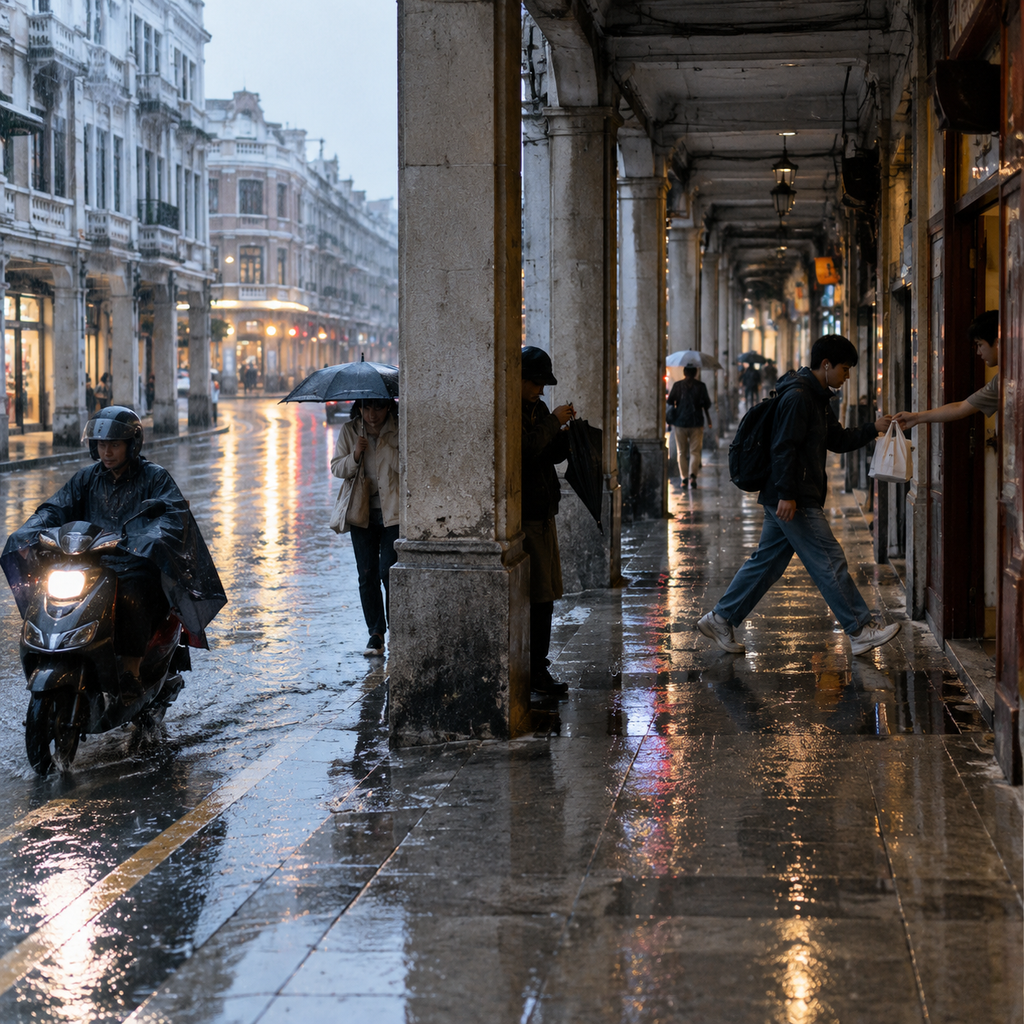
Neighborhood exchanges beneath the arcade are rarely aimed at “meeting new friends,” yet they produce clear responses in a shared space. Someone coming through a door first narrows a shoulder. Someone carrying a hot bowl waits for a diner to move the parcel inward. When the line of runoff shifts toward the walkway, someone gathers an umbrella behind a column. A newcomer can enter the flow quickly by responding to these movements. If a person focuses only on taking photographs or spreads a bag across the entrance, the lack of bad intention does not remove the detour created for others. I once leaned outward to see an oil mark on the wrapper and noticed that a person carrying a plate had to stop. I immediately moved back beside the table. No one scolded me, but when the passage opened again, I understood more clearly that courtesy in an arcade begins by letting one movement make room for another.
我也发现,骑楼会改变人对餐饮“选择丰富”的理解。并不是看见的门口越多,就应该在每个门口都比较;雨后的身体需要先找到可以站稳、可以放伞、可以不挡路的位置,然后才有余力闻气味、看纸包和判断自己是否想吃。对我来说,纸包鸡之所以在那时成为合适的选择,和它本身的香气有关,也和包装能暂时把热度、油脂和食用动作集中在一个可处理的范围内有关。若桌面太浅、入口太窄或雨水正好横过脚边,气味再明显也不代表适合坐下。骑楼把“想吃什么”放在“这里能不能好好吃完”之后,空间条件因此参与了餐饮偏好。
I also found that the arcade changes what it means for food choices to be “varied.” Seeing more doorways does not mean that one should compare every doorway. After rain, the body first needs a place to stand securely, put down an umbrella, and avoid blocking the passage. Only then is there enough attention left to notice smells, examine a parcel, and decide whether to eat. The paper-wrapped chicken suited that moment partly because of its aroma, but also because its wrapper temporarily gathered heat, fat, and eating movements into something manageable. If the tabletop is shallow, the entrance narrow, or runoff crosses the feet, a strong smell does not make the place suitable for sitting. The arcade puts “can I finish eating here comfortably?” before “what do I want to eat?” Spatial conditions therefore become part of appetite.
吃到最后几块时,纸包鸡和刚开始已经是两种不同的食物状态。热气不再把香味往外推,纸边也从柔软变得容易折回;盘中的骨头、纸角和肉块互相占用的空间更多,筷子需要避开已经冷下来的碎屑。我会先把能一口吃完的部分夹到盘子中央,再把骨头归到一侧,避免为寻找肉块而反复翻动纸层。若同行者还在吃,我会把袋子和伞向内收,给对方留下伸手的范围。这样整理不是把用餐变成程序,而是让最后的几口不破坏桌边的通畅。雨后的骑楼提醒我,食物的收尾同样属于公共空间的一部分。
By the last pieces, the paper-wrapped chicken is in a different state from when it first arrived. Steam no longer pushes the aroma outward, and the paper edges have become easier to fold back. Bones, corners, and pieces occupy more of the plate, so the chopsticks must avoid cooler scraps. I move pieces that can be eaten in one bite to the center, gather bones on one side, and avoid turning the layers over repeatedly while searching for meat. If my companion is still eating, I pull the bag and umbrella inward to preserve room for their hand. This is not an attempt to turn a meal into a procedure. It keeps the final bites from disrupting the shared table. After rain, the arcade makes clear that the end of eating also belongs to public space.
站在檐下重新决定下一段路时,我会把食物的状态和街面的状态放在一起看。纸袋底部若仍挺,伞面已经不再大滴落水,柱廊前方又有连续的干燥砖面,可以慢慢走;若袋底发软、外沿风把细雨吹进来,或者门口正有搬货和取餐的人流,就应该先留在原处,等条件改善后再移动。这里的“等”并不是空白,它包括检查袋底、把纸包放稳、确认脚下、让出门口和观察下一根柱子后的空间。骑楼把等待压缩成几个能完成的小动作,所以雨天的停留不必显得被动,反而能让决定有证据可依。
When deciding on the next stretch beneath the eaves, I look at the condition of the food and the street together. If the bottom of the paper bag is still firm, the umbrella has stopped releasing large drops, and a continuous line of dry-looking tiles lies ahead, I can walk slowly. If the bottom has softened, fine rain is being blown toward the outer edge, or people are moving goods and collecting food at the entrance, I should remain where I am until the conditions improve. “Waiting” is not empty time. It includes checking the bag bottom, stabilizing the parcel, confirming the footing, clearing the doorway, and observing the space beyond the next column. The arcade turns waiting into several small actions, so a pause in rainy weather need not feel passive. It can make the next decision evidence-based.
我离开时没有把街坊的照应写成热烈的故事,因为现场更接近一种轻微而持续的互相配合。有人把门边的椅子往后收一点,有人替刚进门的人挡了一下正在滴水的伞,有人把纸袋从湿地砖旁挪开。动作做完便继续手里的事,不需要互相介绍,也不需要留下漂亮的对白。对一个不熟悉梧州骑楼的外地人来说,这种交流反而很容易学习:先看别人怎样给端菜的人让路,再照着调整自己的盘子和伞;先确认袋底和纸边,再决定是否移动;先让入口保持流动,再寻找适合停留的位置。陌生感没有凭空消失,却在一连串可模仿的动作里变得不那么碍手。
I do not describe the neighbors’ care as a dramatic story, because what happened was closer to light, continuous coordination. Someone moved a chair slightly back. Someone shielded a newcomer from an umbrella that was still dripping. Someone moved a paper bag away from wet tiles. Each action ended, and the person returned to what they had been doing. No introductions or polished dialogue were needed. For a visitor unfamiliar with Wuzhou’s arcades, the exchange was easy to learn: watch how others make room for a person carrying dishes, then adjust one’s own plate and umbrella; check the bag bottom and paper edge before moving; keep the entrance flowing before searching for a place to pause. The feeling of being an outsider did not disappear by itself, but it became less awkward through a series of movements that could be copied.
我在檐下多停了一会儿,还看见雨水怎样把纸包鸡的香气和街道的距离联系起来。门口并不是气味的终点,风向一变,香味会沿着柱廊飘到更远的位置;但味道传得远,不代表每个位置都适合停下。靠近转角的人要给端盘者留出转身空间,靠近江边的一侧要留意雨丝是否被风吹进来,站在桌旁的人还要判断自己的伞会不会扫到纸包。香气负责把人吸引过来,空间条件却决定人能否留下。我先在柱后观察,再等一张椅子收回墙边,才把盘子放到桌上。这个等待让我明白,餐饮选择不是鼻子单独作出的决定,而是气味、脚下和别人正在进行的动作共同给出的答案。
I stayed beneath the eaves a little longer and watched how rain connected the aroma of the chicken with the distance of the street. The doorway was not the end of the smell. When the wind shifted, the scent traveled farther along the colonnade. Yet a smell carried far did not mean every place was suitable for stopping. People near a corner had to leave room for someone carrying a plate to turn. On the riverside side, they had to notice whether wind was pushing rain beneath the roof. Anyone beside a table had to consider whether an umbrella might brush the parcel. Aroma drew people closer, but spatial conditions decided whether they could stay. I observed from behind a column and waited until a chair was moved back against the wall before setting down the plate. That pause made clear that food choice is not made by the nose alone; it is an answer produced by smell, footing, and other people’s movements together.
纸包鸡吃到一半时,我把纸边重新折了一次,发现包装会把“已经吃过”和“还没有碰过”区分出来。被筷子碰过的内层留下油迹和细小撕痕,外侧仍然较干的折层则可以继续作为隔热和防滴的边界。若把所有纸都摊平,盘面看似开阔,实际上更容易让纸角沾到桌上的水;若一直保持原样,热气又会困在中央,夹取时不方便。我把用过的内层压低,把较干的外层竖在盘边,再把剩余肉块放到不与纸角重叠的位置。包装随着用餐被重新安排,保存判断也因此不只是看食物,还要看哪一面纸已经承担过油、热和水汽。
Halfway through the meal, I folded the paper edge again and noticed how the wrapper distinguished what had been touched from what had not. The inner layer handled by chopsticks carried oil marks and small tears, while the drier outer folds could still serve as a boundary against heat and dripping. Spreading every layer flat made the plate look open, but allowed the corners to meet water on the table more easily. Keeping the parcel closed trapped heat in the center and made serving awkward. I pressed the used inner layer low, kept the drier outer layer upright beside the plate, and placed the remaining meat away from the corners. As eating continued, the wrapper had to be rearranged. Judging whether food could be carried therefore involved more than the food itself; it also meant noticing which side of the paper had already taken on fat, heat, and moisture.
我走到沿江一侧时,湿气带来的判断并没有变成一个精确数字,而是变成了更谨慎的观察习惯。纸袋摸起来柔软,不一定说明里面的食物已经不适合处理,也可能只是外层吸收了空气里的水分;反过来,外层看起来完整,也不代表内部没有积热或渗汁。我会把包裹放在通风但不被雨打到的位置,先检查底部是否平整,再看封口和纸边,最后才决定是否打开。若打开后气味、颜色和触感都正常,我仍然会优先尽快吃完;若三者出现明显不一致,就不把“闻起来还行”当作继续携带的理由。沿江的潮湿教给我的不是一条万能保存线,而是遇到不确定状态时减少拖延、减少挤压、减少接触雨水。
When I reached the riverside side of the arcade, humidity did not become an exact number in my mind. It became a more careful habit of observation. A paper bag that feels soft does not necessarily mean the food is unsuitable; the outer layer may simply have absorbed moisture from the air. Conversely, an intact outer surface does not prove that heat or juices have not accumulated inside. I place the parcel somewhere ventilated but protected from rain, check whether the bottom remains level, inspect the closure and paper edges, and only then decide whether to open it. If the smell, color, and texture still agree, I prefer to finish it promptly. If they noticeably disagree, “it still smells fine” is not enough reason to keep carrying it. Riverside dampness taught me no universal storage limit. It taught me to reduce delay, pressure, and contact with rain when the condition is uncertain.
梧州骑楼的连续檐口还让我看到,吃饭与走路之间存在许多半步的过渡。人不是从街上突然跳进餐桌,也不是把最后一块肉咽下就立刻回到行走状态。收伞、侧身、放袋、移盘、夹取、擦鞋底、看水线,这些动作把室外和室内一点点接起来。纸包鸡的热度在其中起到一个缓冲作用:它让人愿意多等一会儿,让同行者有时间找到位置,也让街坊可以从门口经过而不被桌面完全拦住。等我把纸角折好、袋底托稳,再抬头看向下一段柱廊时,决定已经不是“雨停没停”,而是“此刻移动会不会让食物、脚步和别人都更麻烦”。
everyone else.
Public Source Notes
地方文旅公开资料 公开地图与街区空间资料 公开饮食文化资料
- 重庆火锅不需要你懂,它只需要你坐下来 | Chongqing Hotpot Doesn't Need You to Understand It — Just Sit Down
- 在景德镇看一只碗怎么出生:窑火、白粉和老师傅的手势 | Watching a Bowl Be Born in Jingdezhen: Kiln Fire, White Clay Dust, and a Master's Hands
- 在武汉,我把酒店地址和求助用语先放到了手机最前面 | In Wuhan, I Put My Hotel Address and Help Phrases at the Front of My Phone
- 现金还是手机支付?来华前必读 | Cash or Mobile Pay? What You Need to Know Before Visiting China
- 从桂林北站到阳朔西街,我选了一条不最省钱但最顺手的慢路线 | From Guilin North Station to Yangshuo West Street, I Chose the Route That Felt Easiest, Not Cheapest
- 茶国度如何爱上咖啡 | How a Tea Nation Fell for Coffee
- 在绍兴,一张公交卡小票和一座小桥一起把我领进了城 | In Shaoxing, a Transit Receipt and a Small Bridge Led Me into the City Together
- 在中国生活:完整指南 | Living in China: A Complete Guide
- 我在上海城隍庙买南翔小笼:怎么支付最快、最稳 | Buying Nanxiang Soup Dumplings at Shanghai City God Temple
- 中国书法用品 | Chinese Calligraphy Supplies
Comments (0)