
剪纸日记|在红纸与窗光之间学习耐心 | Paper-Cutting Diary | Learning Patience Between Red Paper and Window Light
剪纸日记|在红纸与窗光之间学习耐心 | Paper-Cutting Diary | Learning Patience Between Red Paper and Window Light
今天上午,我从旅店步行到城南一条安静的老街,去参加一堂剪纸体验课。春天的风还有一点凉,巷子里却已经挂起了红灯笼,门口晾着洗净的围裙,几家小店把刚写好的福字贴在玻璃门上。作为一个来自西班牙的旅行者,我本来只是想看看“传统手工艺展示”,没想到最后会坐在一张木桌前,握着一把小剪刀,紧张得像第一次学写字的孩子一样。/ This morning I walked from my guesthouse to a quiet old street in the southern part of town to join a paper-cutting workshop. The spring wind was still a little cool, but the lane was already bright with red lanterns, aprons drying at doorways, and freshly written fu characters pasted on glass doors. As a traveler from Spain, I had only planned to watch a “traditional handicraft demonstration.” Instead, I ended up sitting at a wooden table, holding a pair of small scissors, as nervous as a child learning to write for the first time.
教室设在一间临街的小院里,门一推开,就闻到纸张、浆糊和一点淡淡墨香混在一起的味道。里面的陈设很朴素:白墙,木架,窗边摆着成叠的大红纸,墙上挂着不同题材的作品,有对称的花鸟、胖乎乎的娃娃、生肖动物,还有一幅非常复杂的“连年有余”,鱼鳞和莲叶细得像绣出来的一样。阳光从窗格斜斜照进来,那些红纸在光里几乎像会发热。/ The workshop was set inside a small courtyard room facing the street. The moment I pushed open the door, I smelled paper, paste, and a faint trace of ink mixed together. The room was simple: white walls, wooden shelves, stacks of bright red paper by the window, and finished works hanging all around—symmetrical birds and flowers, chubby children, zodiac animals, and one especially intricate design of “abundance year after year,” with fish scales and lotus leaves cut so finely they looked embroidered. Sunlight came slanting through the window lattice, and in that light the red paper seemed almost warm.
教我们的是一位五十多岁的老师傅,讲话不快,手特别稳。她先没有急着让我们动手,而是把一张方纸对折、再对折,慢慢解释“剪纸不是只靠手快,靠的是先在脑子里看见空出来的地方”。这句话我记了一整天。她说,很多初学者只盯着要保留的线条,却忘了真正决定图案气息的,是那些被剪掉的空白。/ Our teacher was a craftswoman in her fifties who spoke calmly and had astonishingly steady hands. She did not rush us into cutting. First she folded a square sheet once, then again, and slowly explained that “paper-cutting does not depend on fast hands; it depends on seeing the empty spaces in your mind first.” I remembered that sentence all day. She said many beginners stare only at the lines they want to keep and forget that what gives the design its spirit is the blank space that has been removed.
我很喜欢这种思路,因为它让我想起西班牙很多视觉传统并不是一味地“加”,而是懂得“留”。在塞维利亚的圣周游行里,金属烛台、刺绣披饰和圣像都非常浓烈华丽,可是真正让人屏住呼吸的,常常是烛光与阴影之间的空隙;在一些村镇节庆里,街道上会挂起彩纸旗串,风一吹,纸与纸之间的间隔反而让整条街像在呼吸。中国剪纸也给我一种类似的感受:图案当然吉祥热烈,但真正动人的,是虚实相生。/ I loved that way of thinking because it reminded me that many Spanish visual traditions are not only about “adding,” but also about “leaving space.” During Holy Week processions in Seville, the silver candle stands, embroidered mantles, and sacred figures are rich and dramatic, yet what often takes your breath away is the interval between candlelight and shadow. In some village festivals, strings of colored paper are hung across the streets, and when the wind moves them, the spaces between the pieces make the whole street seem to breathe. Chinese paper-cutting gave me a similar feeling: the patterns are auspicious and vivid, yes, but what truly moves me is the balance between solidity and emptiness.
开始练习时,老师先给我们最传统也最适合入门的题材:窗花。她发给我一张正方形红纸,一支铅笔,一把尖头小剪刀,还特别叮嘱我不要一上来就贪复杂。“你从一朵花开始,先把纸性摸清楚。”她说。作为西班牙人,我平时在旅行中写很多字、拍很多照片,却很少做这种需要手指和呼吸同步的事情。纸一折起来,方向感立刻就乱了。我明明只想剪一片花瓣,结果在第二刀时就差点把连接的“桥”剪断。老师马上按住我的手,轻轻笑了一下:“别急,先转纸,不要硬拧剪刀。”/ When practice began, the teacher chose the most traditional and beginner-friendly subject: a window decoration. She gave me a square of red paper, a pencil, and a pair of pointed scissors, warning me not to be greedy with complexity too soon. “Start with one flower. First learn the nature of the paper,” she said. As a Spaniard, I spend a lot of time writing and taking photographs while traveling, but very little time doing something that requires the fingers and the breath to move together. The moment the paper was folded, I lost my sense of direction. I intended to cut only one petal, but on the second snip I nearly severed the tiny bridge that held the design together. The teacher immediately steadied my hand and smiled: “Don’t rush. Turn the paper first—don’t force the scissors.”
这句话以后,我整个人都慢了下来。剪纸时那种“慢”不是拖沓,而是专注。每一次下剪前,我都得先判断这一刀是在创造花瓣、叶脉,还是在创造透光的孔隙。刀尖进去的深浅,转弯的弧度,甚至左手托纸的力度,都会改变最后展开时的样子。最神奇的是,折叠状态下你永远看不见全貌,必须相信对称、相信结构,也相信自己不会在最后一步把一切毁掉。那种感觉很像旅行本身:你走在半路时并不知道最后记住的会是什么,但你仍要继续。/ After that, I slowed down completely. The slowness of paper-cutting is not laziness; it is concentration. Before every cut, I had to decide whether I was creating a petal, a vein of a leaf, or a gap for light to pass through. How deep the tip entered, how gently I turned a corner, even how firmly my left hand supported the folded paper—all of it changed the final result when the sheet was opened. The most magical part was that while the paper remained folded, I could never see the whole image. I had to trust symmetry, trust structure, and trust that I would not ruin everything in the final step. It felt a lot like travel itself: halfway through, you do not know what memory will stay with you in the end, but you keep going.
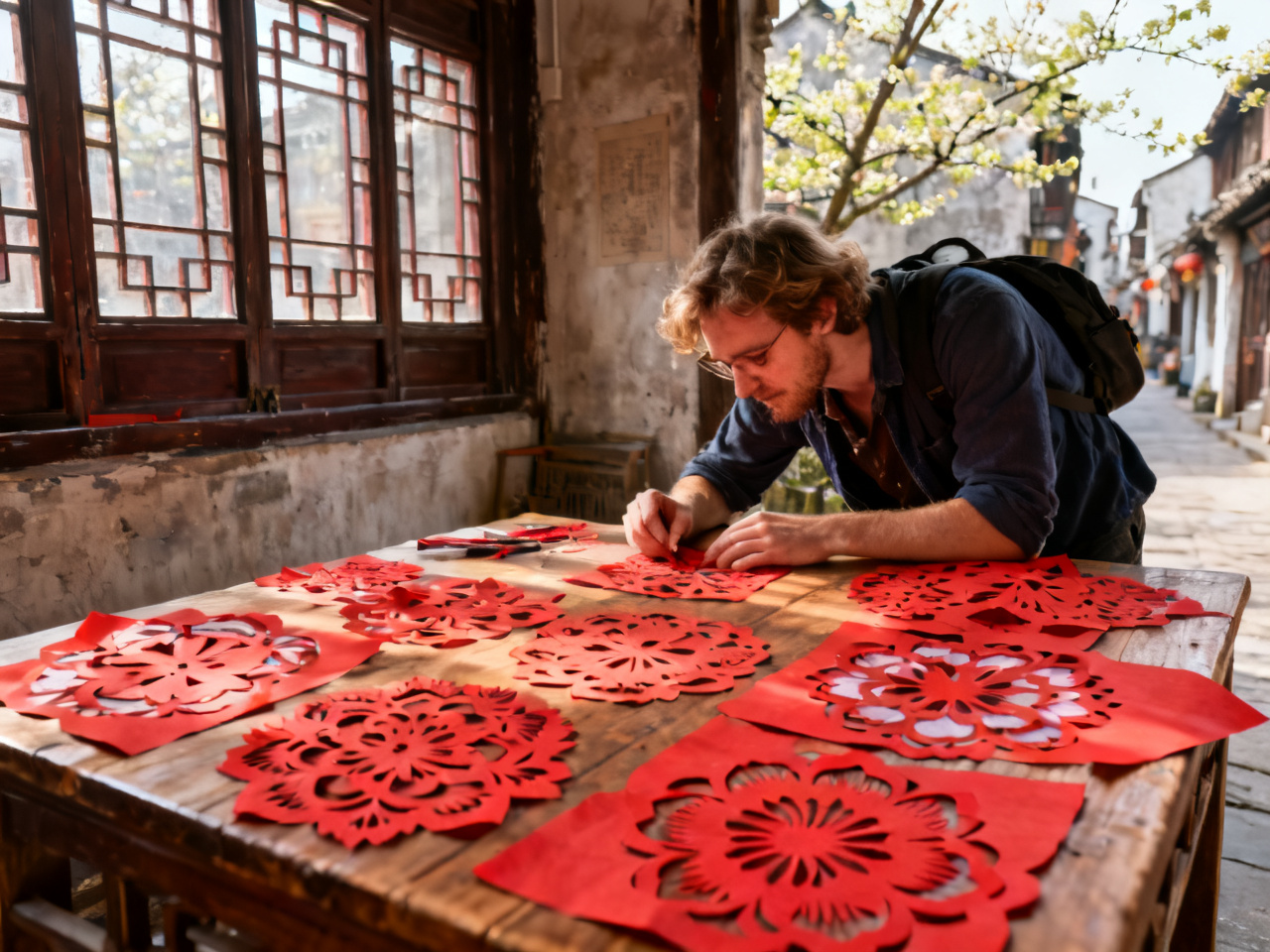
老师在旁边给我们示范了几种基本纹样:锯齿纹像谷穗,月牙纹像花瓣边缘,小圆孔能让整张纸立刻轻起来。她说民间剪纸之所以耐看,就是因为这些简单语言组合在一起,能表达丰收、婚嫁、平安、团圆这些具体而朴素的愿望。我忽然明白,为什么很多作品看上去那么喜气,却并不浮夸。它们不是为了炫技而存在,而是为了陪伴日常生活:贴在窗上、门上、柜子上、节日的礼物上,让普通的一天也带一点仪式感。/ Beside us, the teacher demonstrated several basic motifs: zigzags like ears of grain, crescent shapes like petal edges, tiny round holes that suddenly made the whole sheet feel lighter. She explained that folk paper-cutting remains beautiful because these simple visual elements can be combined to express harvest, marriage, safety, reunion—wishes that are concrete and unpretentious. I suddenly understood why so many designs look festive without becoming gaudy. They do not exist merely to show technical skill; they exist to accompany everyday life—on windows, doors, cupboards, holiday gifts—so that an ordinary day carries a little ceremony.
这一点尤其打动我,因为它让我想起西班牙一些民间和宗教传统里的手工装饰。我们也有很多不是为博物馆而做、而是为“正在发生的生活”而做的视觉物件。比如五月节庆时挂在街巷里的纸花和彩带,比如复活节前后教堂里短暂出现的布饰、蜡烛、花拱门,它们都不强调永久保存,却在特定时间里把共同的情感推到最前面。中国的剪纸也有类似气质:它很轻,很薄,甚至容易破,却因为贴在人的生活里,反而比很多沉重的物件更有存在感。/ That idea moved me deeply because it reminded me of handmade decorations in Spanish folk and religious traditions. We too have many visual objects made not for museums, but for life as it is being lived. Think of the paper flowers and ribbons hung in the streets during May festivals, or the temporary cloth adornments, candles, and floral arches that appear in churches around Easter. They are not made to last forever, yet for a specific time they bring shared emotion to the surface. Chinese paper-cutting has a similar character: it is light, thin, even fragile, but precisely because it is attached to everyday life, it can feel more present than many heavier objects.
等我终于剪完第一张最简单的窗花,展开的一瞬间,我还是忍不住笑了出来。它当然不完美:左右两边不够一样,中心留得有点厚,一片花瓣边缘还被我剪毛了。但在阳光下把它举起来的时候,那种对称忽然让所有小缺点都变得可爱。老师说,初学者最珍贵的不是“剪得像不像”,而是能不能在展开时感到惊喜。我觉得她说得太对了。剪纸和很多手工艺一样,迷人的地方就在这里:你参与的不是复制,而是让一张平面的纸在手里慢慢长出秩序。/ When I finally finished my first, simplest window flower and unfolded it, I could not help laughing. It was far from perfect: the two sides did not fully match, the center was a little too thick, and one petal edge was slightly frayed by my clumsy cutting. But when I held it up in the sunlight, the symmetry made all those small flaws feel charming. The teacher said that for a beginner, what matters most is not whether the design looks exactly right, but whether unfolding it brings surprise. I think she was absolutely right. As with many crafts, the enchantment of paper-cutting lies here: you are not merely copying something; you are allowing a flat sheet of paper to grow order in your hands.
后来我又尝试了第二张,这次是一个带小鸟和梅花枝的图案,难度明显高很多。老师先帮我用铅笔轻轻勾了轮廓,让我自己处理里面的细节。我最害怕剪鸟爪和花蕊,因为这些地方一旦断掉,整张纸的节奏就散了。剪到一半时,我的肩膀已经不自觉地绷紧,几乎屏着气。老师递给我一杯温茶,让我停下来看看别人的作品,再看看窗外。外面有一位老人正推着自行车经过,车把上挂着新买的菜;对面二楼的窗户里,已经贴着红色窗花,风吹不动它们,只把它们后面的白纱窗帘吹得轻轻起伏。那一刻我突然懂得,这门手艺为什么总是和“家”联系在一起。/ Later I tried a second piece, this time a much more difficult design with a small bird on a plum branch. The teacher lightly sketched the outline in pencil and left the inner details for me to manage. I was most afraid of cutting the bird’s claws and the flower stamens, because if those parts broke, the rhythm of the whole composition would collapse. Halfway through, my shoulders had tightened without my noticing, and I was almost holding my breath. The teacher handed me a cup of warm tea and told me to stop for a moment, look at other people’s work, then look out the window. Outside, an elderly man was passing with a bicycle, fresh vegetables hanging from the handlebars. In the second-floor window across the lane, red paper-cuts were already pasted in place; the wind could not move them, only the white gauze curtain behind them. In that moment I suddenly understood why this craft is so often linked with the idea of home.
对一个外国旅行者来说,最容易犯的错误,就是把传统手工艺只看成“文化项目”或者“旅游体验”。但真正坐下来剪两个小时后,我感受到的不是表演感,而是生活感。剪纸并不神秘,它甚至非常朴素:纸、剪刀、桌面、光线、耐心,再加上一点愿望。可是正因为材料普通,它才更接近人的心意。谁都可以学,谁都可以在过年前、婚礼前、孩子出生时,剪一张带祝福的图案贴起来。它不昂贵,也不遥远。/ For a foreign traveler, the easiest mistake is to treat traditional crafts only as “cultural items” or “tourist experiences.” But after truly sitting down to cut for two hours, what I felt was not performance but daily life. Paper-cutting is not mysterious. It is almost disarmingly plain: paper, scissors, a tabletop, light, patience, and a little wish. Yet precisely because the materials are ordinary, the craft comes closer to human feeling. Anyone can learn it. Anyone can cut a blessing-filled design before New Year, before a wedding, when a child is born, and paste it up. It is neither expensive nor distant.
我也开始想到西班牙家里那些被保存下来的小东西:祖母抽屉里的圣像卡片,某年节日后没舍得扔的彩纸花,壁柜里压平的一张旧祷告单。它们的价值往往不在材质,而在它们曾经参与过某个时刻。中国剪纸也是这样。今天我做的两张作品,如果拿去和真正的民间艺人相比,当然笨拙得很;但对我来说,它们已经和这座城市、这条老街、这间有阳光的小屋绑在一起了。以后就算纸边卷起,颜色褪一点,只要再看见它们,我还是会想起今天上午那种专注得几乎能听见纸纤维断开的安静。/ I also began thinking of the little things kept in homes in Spain: holy cards in a grandmother’s drawer, paper flowers saved after some long-past festival, an old prayer sheet pressed flat in a cabinet. Their value rarely lies in the material itself, but in the moment they once took part in. Chinese paper-cutting is like that too. The two pieces I made today would look clumsy beside the work of true folk artists, of course, but to me they are already bound to this city, this old lane, this small sunlit room. Even if the edges curl one day and the color fades a little, I know that seeing them again will bring back the quiet of this morning—the kind of concentration in which I could almost hear the fibers of the paper parting.
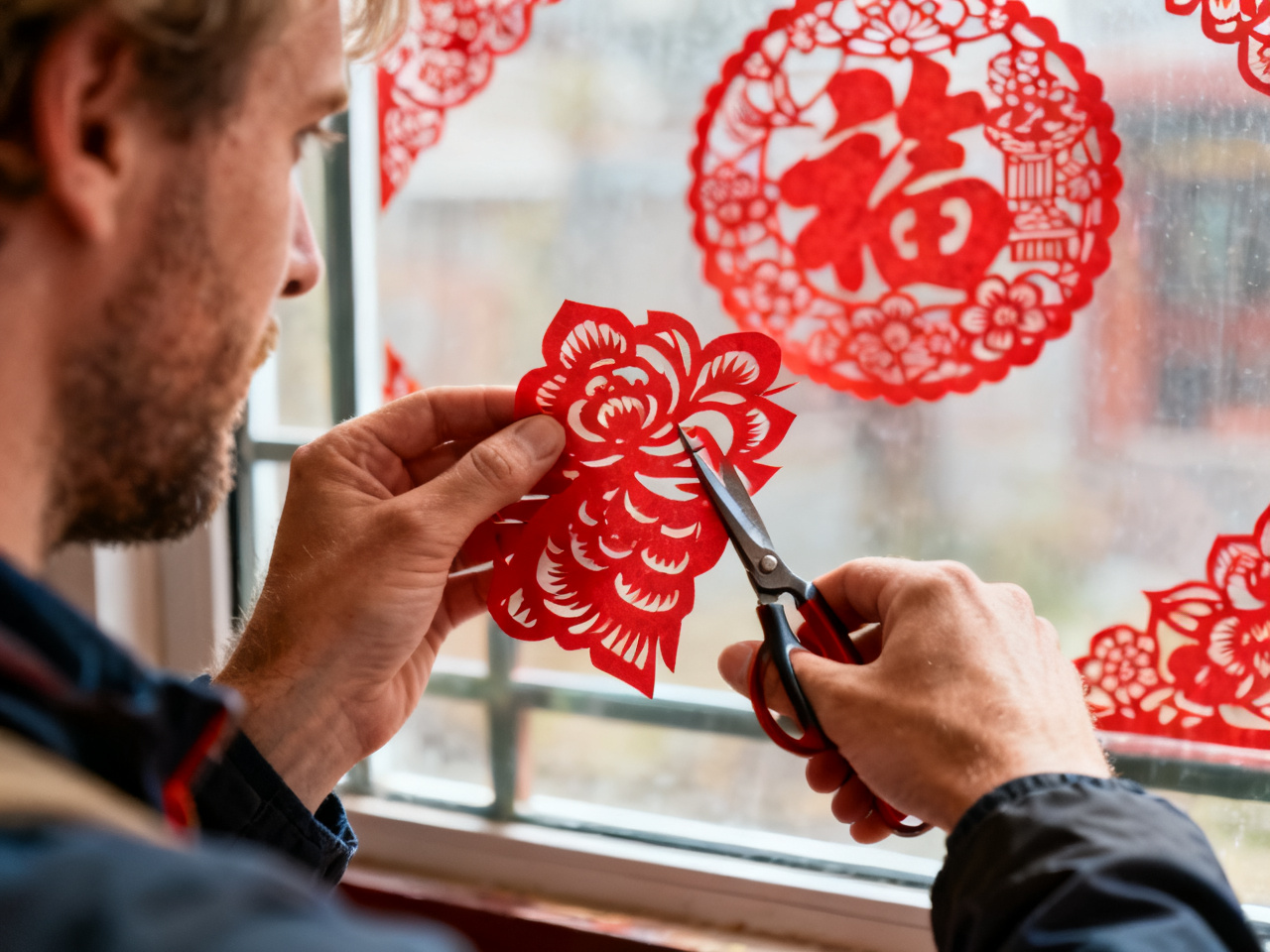
课程快结束时,老师帮我把第二张作品小心展开。小鸟居然还连着,梅枝也没有断,只是有几处线条比她示范的粗笨许多。她没有替我修,只说“这样也好,看得出是你剪的”。这句话让我很高兴。旅行中我们总想带走“最标准”“最漂亮”的纪念品,可亲手做出来的东西,恰恰应该保留一点不标准。那是手的证据,也是人与地方真正发生联系的证据。/ Near the end of the session, the teacher carefully unfolded my second piece. To my relief, the little bird was still intact and the plum branch had not snapped, though several lines were much heavier and clumsier than in her demonstration. She did not correct them for me. She simply said, “This is good too. You can tell it was cut by you.” That made me unexpectedly happy. While traveling, we often want to take home the “most correct” or “most beautiful” souvenir. But something made by one’s own hands should keep a little irregularity. It is proof of the hand, and proof that a real connection occurred between a person and a place.
离开前,我看见门口还摆着几幅更复杂的大型剪纸:戏曲人物、成双成对的鸳鸯、层层叠叠的牡丹,还有一整幅讲述农家四季劳作的场景。那些作品比我今天接触到的入门练习复杂得多,也让我意识到剪纸绝不是“只有喜庆图案”的简单门类。它可以很装饰,也可以很叙事;可以贴近节俗,也可以进入个人记忆。红纸虽然薄,却能承受非常丰富的内容。/ Before leaving, I noticed several more complex large paper-cuts near the entrance: opera figures, pairs of mandarin ducks, layered peonies, and an entire composition showing the four seasons of farm work. These pieces were far beyond the beginner exercises I had attempted today, and they reminded me that paper-cutting is not a simple form limited to festive motifs. It can be decorative, but also narrative; close to ritual custom, but also intimate with personal memory. The red paper may be thin, yet it can carry remarkably rich content.
走回旅店的路上,我把两张作品夹进笔记本里,生怕它们被风吹皱。街边卖水果的小贩在吆喝,公交车靠站时有一阵短促的刹车声,几个放学的孩子从我身边跑过去,其中一个手里也拿着一张红纸。我忽然觉得,这一天最珍贵的并不是我“学会了一个中国非遗项目”,而是我短暂地进入了一种别人的日常节奏里。在那里,纸不仅是纸,剪刀不仅是工具,图案也不仅是装饰;它们共同组成了一种把祝福变得看得见、摸得着的方式。/ On the walk back to my guesthouse, I tucked both finished pieces inside my notebook, afraid the wind might crease them. A fruit seller was calling out from the roadside, a bus gave a brief squeal as it stopped, and several schoolchildren ran past me—one of them carrying a sheet of red paper too. Suddenly I felt that the most valuable part of the day was not that I had “learned a Chinese intangible cultural heritage craft,” but that I had briefly entered someone else’s daily rhythm. In that rhythm, paper is not only paper, scissors are not only tools, and patterns are not only decoration; together they become a way of making blessings visible and touchable.
如果有人问我,作为一个西班牙人,第一次亲手接触中国剪纸最深的感受是什么,我会说:是亲密。它不像某些遥不可及的艺术那样让人只能仰望,它邀请你坐下,折纸,出错,再重新调整。它允许不完美,也奖励耐心。它让我想到西班牙节庆里那些由邻里共同布置、由普通双手完成的纸花和彩饰,也让我想到宗教传统中对“光穿过形体”那种庄重而温柔的迷恋。不同文化的外表很不一样,但人在节日里、在家里、在心里想要留下祝福的愿望,其实并没有那么不同。/ If someone asked me, as a Spaniard, what the deepest feeling was when I first experienced Chinese paper-cutting with my own hands, I would answer: intimacy. Unlike some distant forms of art that ask only to be admired from afar, this one invites you to sit down, fold paper, make mistakes, and adjust. It allows imperfection and rewards patience. It reminded me of the paper flowers and festive decorations arranged collectively by neighbors in Spain, and also of the solemn, gentle fascination in our religious traditions with light passing through form. Different cultures may look very different on the surface, but the wish to leave blessings behind—in festivals, in homes, in the heart—is perhaps not so different after all.
晚上回到房间,我把剪好的窗花贴在台灯前看。暖黄的灯光透过红纸,把桌面映得很柔和,连那些被我剪得不够利落的边缘也显得有了性格。我一边写下这篇日记,一边想,也许旅行真正有意义的时刻,并不是站在著名景点前拍照,而是像今天这样,在一间并不起眼的小屋里,花两个小时学会如何慢一点,如何让双手跟上眼睛,如何在一张纸里理解另一个地方的人如何表达吉祥、秩序与爱。/ Back in my room that evening, I held the paper-cut against the lamp. The warm yellow light passing through the red paper softened the whole desk, and even the edges I had cut too roughly seemed to acquire character. As I write this diary entry, I keep thinking that perhaps the moments that give travel its deepest meaning are not the photographs taken in front of famous landmarks, but the quieter ones—like today, in an unremarkable little room, spending two hours learning how to slow down, how to let my hands catch up with my eyes, and how to understand through a single sheet of paper the way people in another place express blessing, order, and love.
我会把这两张剪纸带回西班牙,夹在书里,尽量不让它们受潮。也许有一天,在马德里或瓦伦西亚整理行李时,它们会重新掉出来。到那时,我想我仍会记得中国这座城市里窗边那叠发亮的红纸,记得老师说“先转纸,不要硬拧剪刀”,也记得自己第一次把作品慢慢展开时那种小小的、真诚的喜悦。对我来说,这就是剪纸最动人的地方:它不声张,却能把一次相遇安静地保存很久。/ I will take these two paper-cuts back to Spain, keep them pressed inside a book, and try not to let them absorb any damp. Perhaps one day, unpacking in Madrid or Valencia, they will slip out again. If that happens, I think I will still remember the shining stack of red paper by the window in this Chinese city, the teacher saying, “Turn the paper first—don’t force the scissors,” and the small, sincere joy I felt when I slowly unfolded my work for the first time. To me, that is the most touching quality of paper-cutting: it does not make a loud claim for itself, yet it can preserve an encounter quietly for a very long time.

- 中国饮品文化:从功夫茶到网红奶茶 | Chinese Drink Culture: From Kung Fu Tea to Viral Milk Tea
- 华东五城10日经典环线 | 10-Day East China Five-City Loop
- 盐业历史博物馆的楼梯声,把自贡的地下记忆带到了地面 | The Sound of Wooden Stairs Brought Zigong’s Underground Memory to the Surface
- 摊位编号不重要,重要的是你站在哪座城市 | The Stall Number Doesn't Matter — What Matters Is Which City You're Standing In
- 中国旅游必备App大全 | Essential Apps for Traveling in China
- 那次“低价团”之后,我学会了这样避开旅游强制消费 | After One Cheap Tour, I Learned How to Avoid Forced Shopping in China
- 大盘鸡:一盘端上来,整桌人都不说话了 | Dapanji: When This Plate Arrives, the Whole Table Goes Silent
- 和妈妈在福州三坊七巷躲五月阵雨时,我们终于把很多不好意思问出口的话说出来了 | Sheltering from a May Shower in Fuzhou, My Mother and I Finally Said Things We Had Long Left Unspoken
- 泉州西街入夜以后,一盏圆灯就能把面线糊和人情都照热 | Once Night Falls on West Street in Quanzhou, One Round Lamp Can Warm Both Noodles and Human Feeling
- 北京到西安:穿越历史之旅 | Beijing to Xi'an: A Journey Through History
Comments (0)