
盐业历史博物馆的楼梯声,把自贡的地下记忆带到了地面 | The Sound of Wooden Stairs Brought Zigong’s Underground Memory to the Surface
盐业历史博物馆的楼梯声,把自贡的地下记忆带到了地面 | The Sound of Wooden Stairs Brought Zigong’s Underground Memory to the Surface
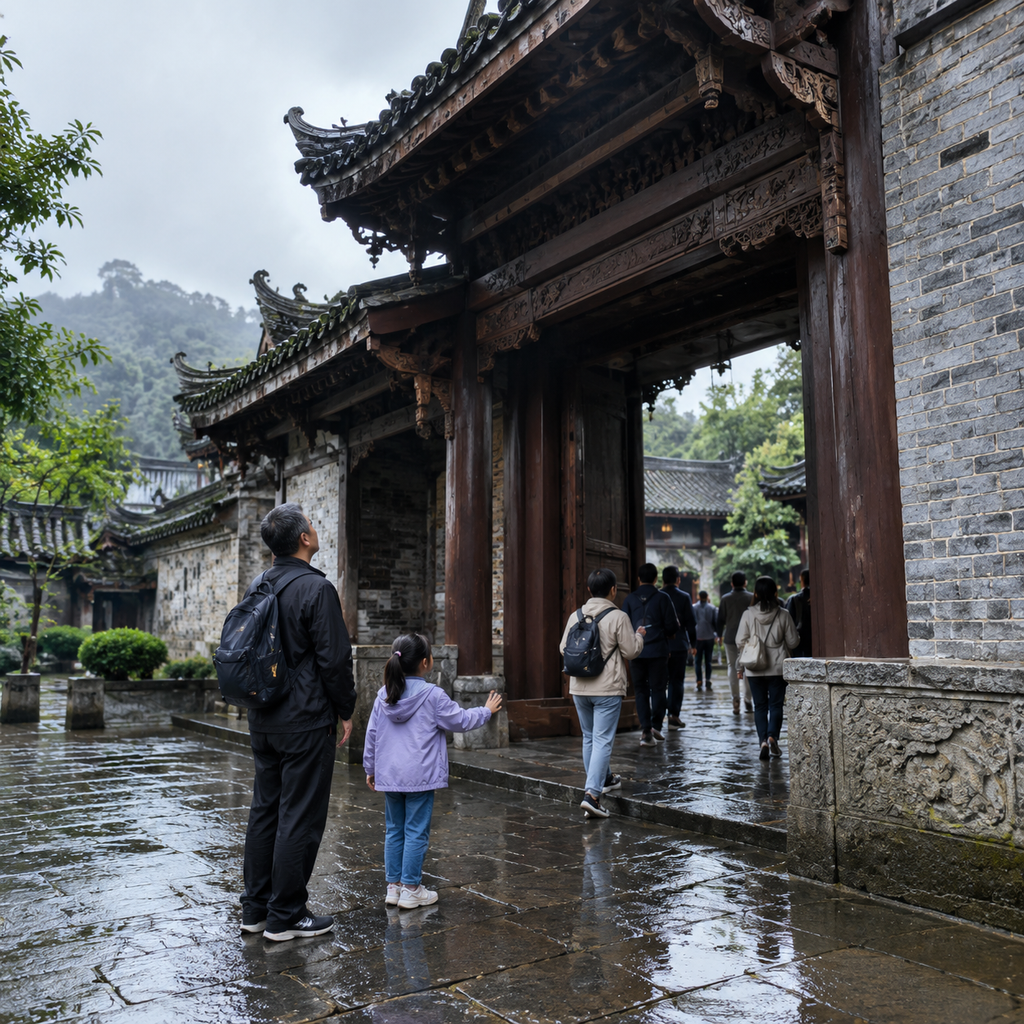
上午接近十点,自贡盐业历史博物馆的院门外,雨后的石板还留着一层暗亮的水色。来自成都的林先生把相机带子绕了两圈,先站在门口看那座依山就势的古建筑;同行的女儿林乔没有急着拍照,她把手掌贴在外墙下方的石基上,又抬头看屋檐。几名本地参观者从前面慢慢进去,鞋底碰到石面,声音被院墙收住。讲解员在入口附近招呼大家集合,却没有马上把参观变成一串年代和名词,而是先让人留意脚下的高度变化:这座博物馆本身,就在提醒来访者,盐井的故事从来不是平面的。
Near ten in the morning, the rain-darkened flagstones outside Zigong Salt History Museum still reflected a muted light. Mr. Lin, visiting from Chengdu, had wrapped his camera strap twice around his hand, but he paused before the gate to study the old buildings that follow the slope. His daughter, Lin Qiao, did not reach for her phone. She touched the stone base of an exterior wall and then looked up at the eaves. Several local visitors entered at an unhurried pace, their shoes making a small sound that the courtyard walls seemed to hold. A guide gathered the group near the entrance without turning the visit into a rapid list of dates. Instead, she directed attention to the changing levels underfoot. The building itself was already suggesting that the history of a salt well cannot be understood as a flat picture.
馆址所在的建筑通常被称作西秦会馆,原本带有会馆、祭祀和同乡交往的功能,后来成为盐业历史博物馆的重要空间。参观者从门楼进入,视线先被院落、戏楼式的建筑关系和木构件牵引,然后才逐渐靠近盐业生产的图像、器具和文字说明。林先生一开始想寻找一件“最古老”的物件作为拍摄中心,讲解员却把队伍带到一组关于井盐生产的说明前,指出自贡盐业不能只用一口井或一件工具代表。地下卤水、地面井架、工匠经验、运输组织和城市生活,是一条相互咬合的链。博物馆的观看顺序,恰好把这条链从建筑的公共性引向生产的具体性。
The museum occupies a complex commonly known as the Xiqin Guild Hall. Its earlier life involved guild gatherings, ritual practices, and fellowship among people from the same native region; today it provides one of the principal settings for the salt-history collection. After passing through the gate, visitors first encounter the courtyard, the relationship between the stage-like structure and surrounding halls, and the texture of timber construction. Only gradually do they move toward images, implements, and written accounts of salt production. Mr. Lin initially wanted to find a single “oldest” object to make the center of his photographs. The guide instead led the group to an explanation of well-salt production and emphasized that Zigong’s industry cannot be represented by one well or one tool. Brine below ground, well structures above it, craft knowledge, transport, and urban life formed an interlocking chain. The museum’s sequence moves along that chain, from public architecture to the particulars of labor.
自贡井盐的关键,不在于把海水搬到陆地上,而在于利用地下含盐卤水,并以长期积累的钻井和汲卤办法把它带到地面。这样的表述听起来简洁,实际包含许多难以想象的判断:哪里可能有卤水,井要向下延伸多深,怎样保持孔道,怎样判断井况,怎样把液体稳定地提上来。展厅里的文字与复原性展示让参观者看到,井盐并非一个突然出现的产业,而是地质条件、地方需求和技术耐心共同形成的生产方式。林乔听到“地下水”时低声问父亲,盐水是不是像井里打出来的普通水。父亲没有立刻回答,讲解员借着这个问题解释卤水含盐、需要经过煎制等处理,孩子于是把原先模糊的“盐在地下”改成了更清楚的生产想象。
The central fact of Zigong’s well-salt tradition is not the transport of seawater inland. It is the use of salt-bearing brine underground, brought to the surface through drilling and lifting practices developed over a long period. The sentence is short, but the decisions behind it are not: where brine might lie, how far a shaft should descend, how an opening could be kept usable, how workers could read the condition of a well, and how liquid could be raised with some regularity. The displays make clear that well salt was not a sudden invention. It grew from geology, local demand, and sustained technical patience. When Lin Qiao heard the phrase “underground water,” she quietly asked whether it was simply water drawn from a normal well. Her father hesitated. The guide used the question to explain that brine carries salt and must undergo further treatment, including boiling. A vague image of “salt beneath the earth” became, for the child, a more concrete production process.
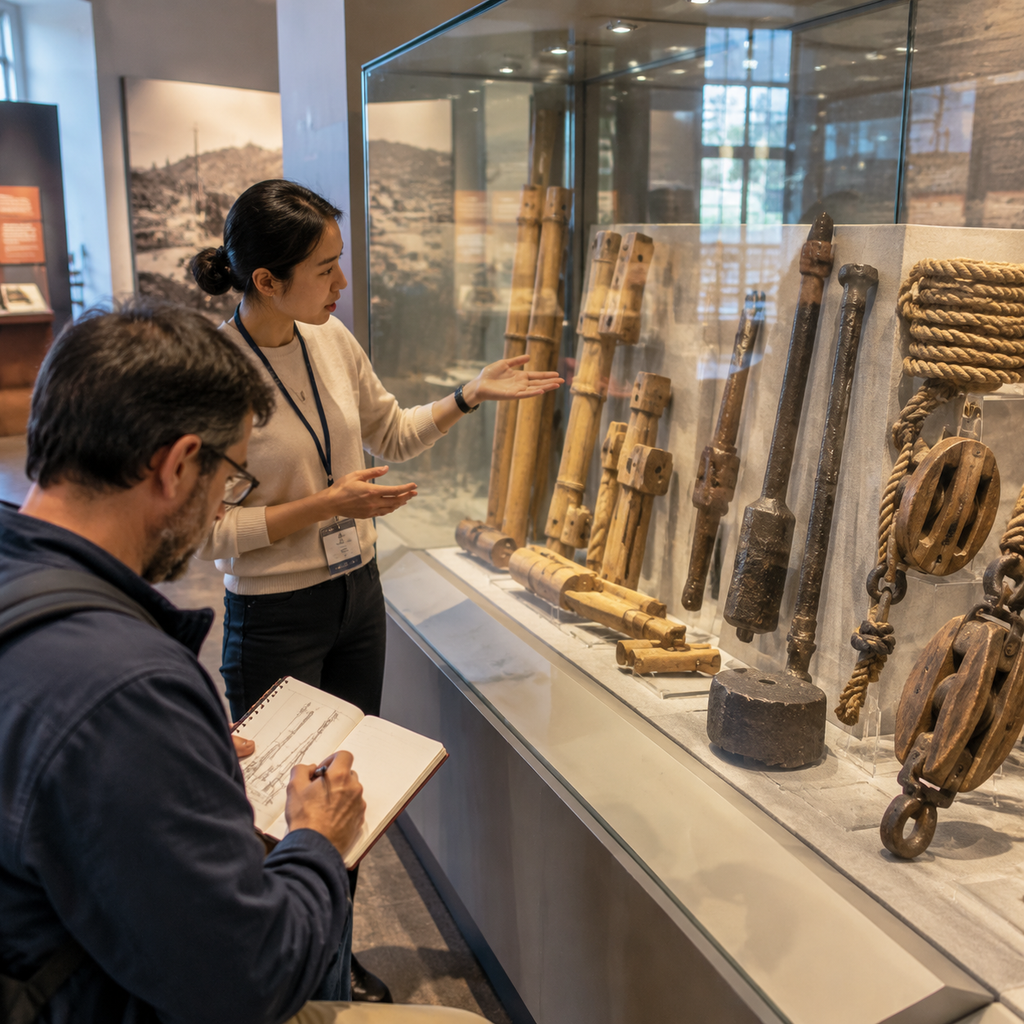
队伍继续向前,来到介绍钻井工艺的区域。这里最需要耐心,因为钻井不像一座高塔那样一眼呈现成果。参观者看到的是工具的形状、材料的组合和操作关系:竹制或木制的部件承担连接、悬挂、传力等任务,铁制工具负责破碎、冲击或清理,绳索把地面的人力与地下的动作联系起来。不同材料各有脾气,竹子有弹性,木材能承受结构压力,铁件坚硬却需要锻打和维护。讲解员没有把这些材料说成抽象的“古代智慧”,而是让大家想象一件工具在潮湿井场中反复升降,磨损、沾泥、受力,再被工匠重新调整。林先生听到这里,收起了相机,把手指放在笔记本上画下一个简略的连接示意。
The group then reached the section on drilling techniques, a place that rewards patience because drilling does not display its result like a tower in an open square. Visitors find themselves studying the shape of tools, the combination of materials, and the relationship between actions. Bamboo and timber components could connect, suspend, or transmit force; iron tools were used for impact, breaking, or clearing. Ropes joined the workers on the surface to movements far below. Each material had its own behavior: bamboo offered resilience, wood carried structural loads, and iron was hard but demanded forging and maintenance. The guide did not reduce this to an abstract celebration of “ancient ingenuity.” She asked the group to imagine a tool repeatedly lifted and lowered in a damp worksite, collecting mud, wearing down, taking stress, and being adjusted by a craftsperson. Mr. Lin put away his camera and drew a rough connection diagram in his notebook.
钻井与汲卤之间,有一道常被现代观众忽略的距离。今天的人习惯按下开关,让水泵、升降设备和管道完成连续动作;历史上的井场则需要人对工具、井口和节奏保持密切注意。汲卤不只是“把水提上来”,还涉及容器如何进入井内、绳索如何承重、何时提升、怎样避免损坏井壁以及地面如何接应。博物馆没有把所有细节都包装成确定无疑的单一答案,说明文字往往使用工艺演变、相关做法和复原展示这样的表达。讲解员也提醒参观者,眼前的模型用于帮助理解,并不等同于某一口具体盐井在所有时期的完整原貌。这种克制反而让林先生觉得可信,因为技术史本来就有变化、有地方差异,也有文献无法填满的空白。
There is a distance between drilling and brine lifting that modern visitors often overlook. People today press a switch and expect pumps, hoists, and pipes to perform a continuous sequence. A historical well site required close attention to tools, the mouth of the well, and the pace of work. Lifting brine meant more than “bringing up water.” It involved lowering a vessel, managing the load on a rope, deciding when to raise it, protecting the shaft, and coordinating the handoff at ground level. The museum does not force every detail into one certain answer. Its labels often refer to evolving methods, related practices, and interpretive reconstructions. The guide also noted that a model helps visitors understand a process but does not claim to reproduce the complete appearance of one named well in every period. That restraint made the account more convincing to Mr. Lin. Technical history contains change, local variation, and gaps that documents cannot fully close.
林乔在一处展示前蹲下来,观察绳索样的材料和木制构件的表面。她问这些东西为什么不用现在更结实的钢材,父亲先说因为当时没有现代工业,讲解员又补充了更重要的一层:材料选择不只取决于“谁更坚固”,还取决于能否获得、能否加工、能否替换,以及它在整套动作中承担什么功能。竹材轻,便于制作和连接;木材容易在地方获得,也能形成井架、滑轮或支撑所需的结构;铁件承担关键的切削和冲击,却不是所有部分都需要铁。孩子把这几种材料写在门票背面的空白处,旁边画了三个小圆圈。她的记录很稚拙,却已经从“古人很聪明”走向“每种材料都在解决一个问题”。
Lin Qiao crouched before one display and examined the surfaces of rope-like materials and wooden parts. She asked why people had not used the stronger steel familiar today. Her father began to answer that modern industry did not yet exist, but the guide added the more important point: material choice depends not only on which substance is strongest. It also depends on availability, workability, replacement, and the role each material plays in the whole sequence. Bamboo is light and useful for making and joining parts. Timber can often be obtained locally and shaped into frames, supports, or components of lifting equipment. Iron is needed for crucial cutting and striking work, but not every part requires it. On the back of her admission slip, Lin Qiao wrote the names of the three materials and drew three small circles. The drawing was childlike, yet her thinking had shifted from “people in the past were clever” to “each material solved a particular problem.”
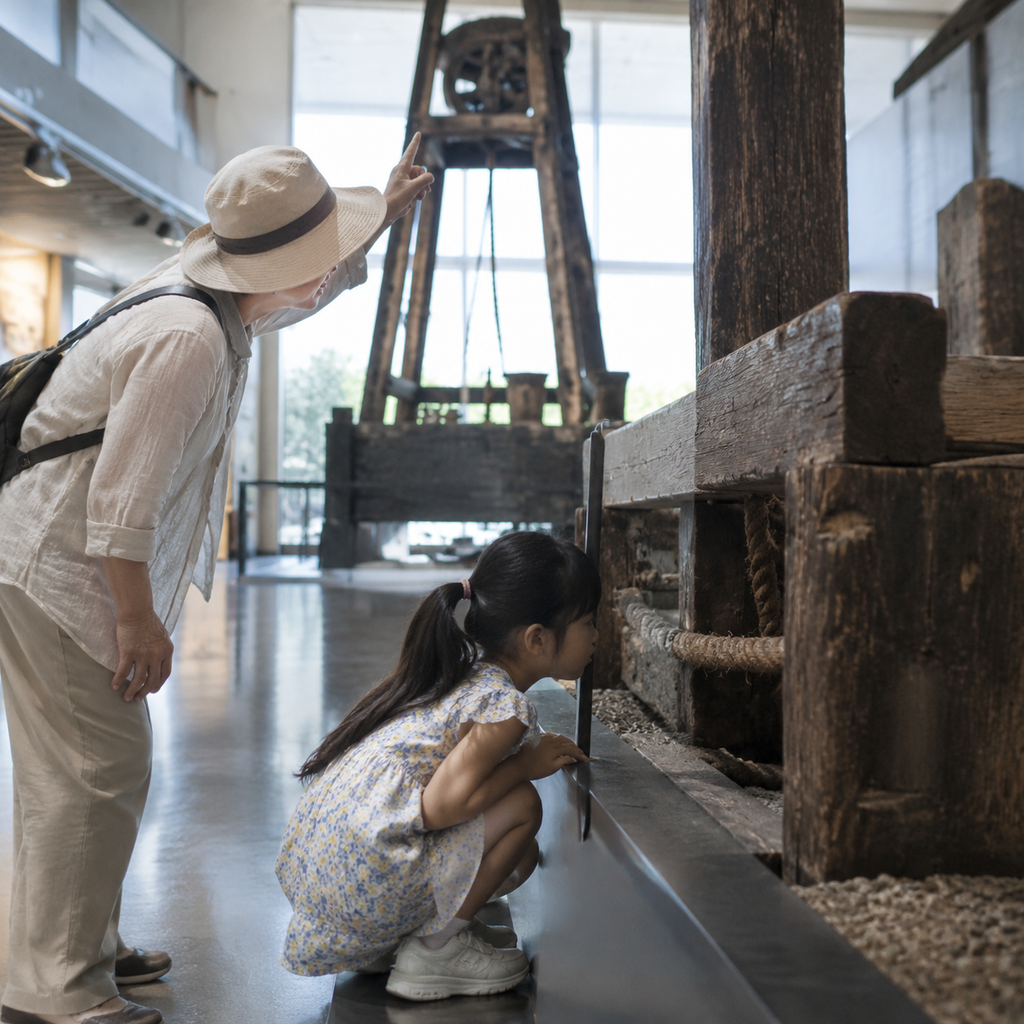
当讲解员讲到井架和地面作业时,一位戴灰色遮阳帽的老人从队伍后面走到前方。他没有打断讲解,只在说明结束后问,过去盐工是不是一直依靠身体力量。这个问题让空间里短暂安静下来。讲解员回答时没有简单把历史劳动归结为“全靠苦干”,而是指出器械、杠杆、滑轮、绳索和多人配合都在放大人的力量,身体仍然重要,但身体被编入了一套有顺序的技术系统。老人点了点头,伸手比画了一下绳索向下、向上的方向;林先生也跟着转身,看向刚才错过的结构关系。博物馆的讲解因此出现了一个很小却有效的变化:观看者从工具的外形,转向工具如何组织人。
When the guide discussed the derrick and the work done at ground level, an older man in a gray sun hat moved from the back of the group toward the front. He waited until the explanation ended before asking whether salt workers in the past relied entirely on bodily strength. The space fell quiet for a moment. The guide did not reduce historical labor to sheer endurance. She explained that devices, levers, pulleys, ropes, and coordinated teams amplified human effort. The body remained essential, but it operated inside a technical system with an order and a rhythm. The older visitor nodded and traced the downward and upward path of a rope with his hand. Mr. Lin turned as well, looking again at a structural relationship he had missed. The talk had quietly shifted the group from studying the outward shape of a tool to seeing how that tool organized people.
从钻井工具到汲卤设备,博物馆的陈列带着观众穿过一个由局部动作组成的生产世界。钻头接触岩层时,工匠无法直接看见地下发生了什么,只能从冲击的反馈、绳索的状态、井口的变化和经验判断作出决定。井壁是否稳定,工具是否卡住,泥屑如何排出,这些问题不一定都有戏剧性的瞬间,却决定了工程能否继续。讲解员说到“听”的时候,林乔立刻抬头。她把耳朵凑近一段木制展示结构,当然听不到井下声音,却第一次意识到盐井技术不仅靠眼睛看尺寸,也靠耳朵、手掌和脚底感受异常。历史中的工匠并非站在机器外面按按钮,他们要把身体变成判断设备的一部分。
From drilling tools to brine-lifting equipment, the displays lead visitors through a world of production made from small, connected actions. When a drill met the strata, the craft workers could not see directly what was happening below. They had to decide from the feedback of impact, the condition of the rope, changes around the well mouth, and accumulated experience. Was the shaft wall stable? Had the tool caught? How should the debris be cleared? These questions rarely create a dramatic instant, yet they determined whether the work could continue. When the guide mentioned listening, Lin Qiao immediately looked up. She leaned toward a wooden structure, though it could not carry any sound from underground. For the first time she understood that well technology was read not only through measurements visible to the eye, but also through the ear, the palm, and the soles of the feet. Historical workers did not merely stand outside a machine and press a button. Their bodies formed part of the diagnostic instrument.
在另一处空间,关于卤水加工和制盐的说明把地下和厨房、作坊、市场连接起来。卤水被提到地面之后,还要经过处理,盐分才能成为可使用、可运输、可交换的产品。煎盐需要燃料、容器和稳定的火候,火的强弱会影响工作节奏,容器的耐用程度又关系到材料消耗。参观者看到与盐业相关的器物时,容易把注意力集中在“盐”这一白色结果上;讲解员则反复把大家带回过程:盐不是从展柜里凭空出现的,也不是从地下直接长成晶体,它经过提取、煎制、晾置、装运和交易,才进入普通人的餐桌。林先生想到早晨在自贡街边吃到的面,忽然发现那点咸味背后,连接着一整套看不见的劳动安排。
In another room, explanations of brine processing and salt making connect the underground world to kitchens, workshops, and markets. Once brine reached the surface, it still had to be treated before salt became something usable, transportable, and exchangeable. Boiling required fuel, vessels, and control of heat; the strength of the fire affected the pace of work, while the durability of a vessel affected material consumption. Visitors can easily focus on the white result called salt. The guide kept returning them to the process: salt did not appear from a case in the museum, nor did it emerge from the ground as a ready crystal. It passed through extraction, boiling, settling or drying, packing, transport, and trade before reaching an ordinary table. Mr. Lin thought of the noodles he had eaten at a street stall that morning and realized that their simple saltiness was connected to an entire arrangement of labor usually invisible to the diner.
建筑本身在这里继续发挥作用。会馆的院落并不是一条只供人迅速通过的走廊,木构门窗、柱梁、檐下阴影和层层相接的空间,迫使参观者不断调整站立方向。林先生想把一组木雕拍完整,后面一位年轻母亲抱着孩子经过,他便侧身让出通道;那一刻他意识到,公共建筑的观看也包含人与人之间的协商。会馆原先承载交往、礼仪和聚集,博物馆今天又把生产史放进其中,观看者在院子里移动时,实际上同时感受两种秩序:一边是盐业作为行业的组织,一边是建筑作为社会空间的安排。盐井不只在地下运转,围绕盐形成的会馆、商路和城市关系也有自己的结构。
The architecture continues to shape the visit. The guild-hall courtyard is not a corridor designed for people to hurry through. Timber doors and windows, beams and columns, deep eave shadows, and linked chambers repeatedly ask visitors to change their position. Mr. Lin wanted to photograph a carved wooden group in full, but a young mother carrying a child approached from behind, so he stepped aside and opened the passage. He then realized that looking at a public building also involves negotiating with other people. The guild hall once supported fellowship, ritual, and gathering; the museum now places the history of production inside that setting. As visitors move through the courtyard, they encounter two forms of order at once: salt as an organized industry and architecture as an organized social space. The wells worked underground, but the guilds, routes, and urban relationships built around salt had structures of their own.
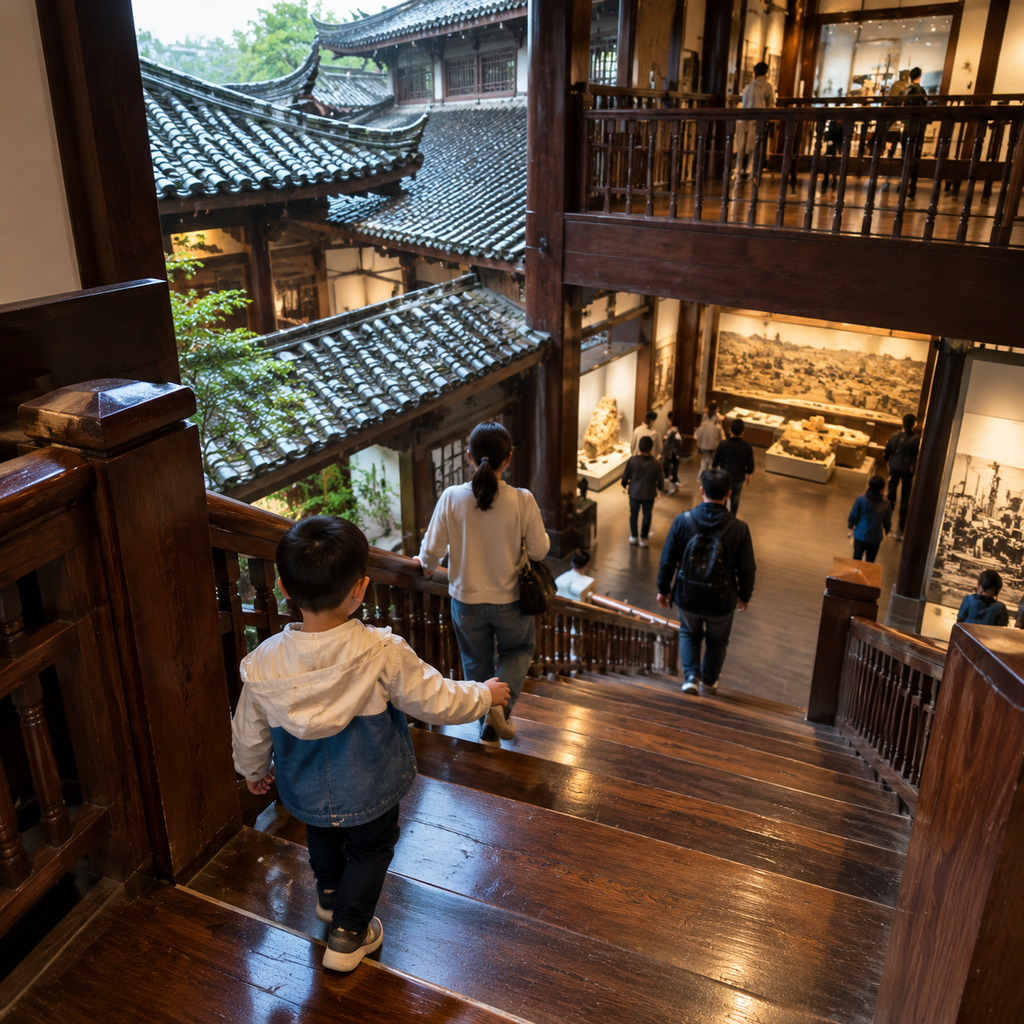
真正改变林乔观看方式的,是那段木楼梯。它并不以夸张的体量抢夺视线,台阶有使用过的质感,扶手和踏步把人的身体带向更高或更低的空间。队伍走到楼梯前,讲解员让大家不要拥在一起,而是按前后距离分开。林乔先把脚尖放在第一阶边缘,听父亲提醒后扶住一侧,慢慢往上。木板承受脚步时发出轻微的吱响,前面老人的鞋跟也敲出不同的节奏;有人停下来让抱孩子的母亲先过,楼梯上的声音于是忽近忽远。林先生没有拍女儿的脸,只拍了她的手从扶手上松开又握紧的动作。对于一个讲井盐的博物馆,楼梯把地下劳动转译成了身体经验:向下意味着进入想象中的井深,向上则意味着把卤水、工具和故事带回地面。
The wooden staircase changed the way Lin Qiao was looking. It did not seize attention through exaggerated size. Its steps carried the texture of use, and the handrail and treads guided the body toward a different level. At the foot of the stairs, the guide asked everyone not to crowd together and to leave space between one person and the next. Lin Qiao placed her toes near the edge of the first step, then held the side rail after her father reminded her to do so. The boards gave a faint creak under each foot. The older visitor ahead produced a different rhythm with his heels. Someone paused to let the mother with the child pass, and the sounds on the stairs moved closer and farther away. Mr. Lin did not photograph his daughter’s face; he photographed the moment her hand loosened and tightened around the rail. In a museum devoted to wells and salt, the staircase translates underground labor into bodily experience. Descending suggests the imagined depth of a shaft, while climbing brings brine, tools, and stories back to ground level.
楼梯声之所以重要,并不是因为它能直接复原盐工当年的声音。博物馆里的木楼梯属于今天的建筑和参观路线,不能被说成历史现场的录音替代品;它的作用更接近一个感官提示。参观者已经从文字中知道井要深入地下,从工具中看到人如何传力,从模型中理解液体如何提升,而脚下木板的弯曲、摩擦和回声,把这些抽象信息临时交给身体处理。林乔在楼梯转角回头,看到院落的屋顶被雨洗得发黑,几道檐口叠在一起。她问父亲,盐工是不是也要经常上下这样的楼梯。父亲说不能把博物馆楼梯直接等同于井场,讲解员随即补充,能比较的是“上下”和“往返”带来的劳动想象,而不是把今天的构件冒充成过去的原物。这个回答让孩子学会了历史观看的一条边界:相似的感觉可以帮助理解,却不等于事实本身。
The staircase sound matters precisely because it does not directly recreate the sound of a historical salt worker’s day. It belongs to the museum’s present architecture and route; it cannot be treated as a recording substitute for a worksite. Its role is closer to a sensory prompt. Visitors have read that a shaft descends into the earth, seen how tools transmit force, and studied how liquid can be raised. The flex, friction, and echo of a wooden board briefly hand those ideas over to the body. At the landing, Lin Qiao turned and saw rain-dark roofs layered beneath overlapping eaves. She asked whether salt workers had often climbed stairs like these. Her father said the museum stairs should not be equated directly with a well site. The guide added that the useful comparison was the imagination of going up, going down, and repeating a route, not the claim that a present-day component was an original object from the past. The child was learning an important limit of historical looking: a similar sensation can assist understanding without becoming evidence.
参观路线随后把人带回较开阔的院落。这样的回到明亮处,给了观看者重新整理信息的机会。林先生翻看笔记,发现自己记下的不是几个孤立名词,而是一串动作:寻找卤水,向地下钻进,借工具破岩,凭反馈判断,使用绳索和结构汲取,运到地面加工,再通过组织和运输进入市场。林乔则把那三个材料圆圈补上箭头,写下“轻”“支撑”“坚硬”。她还画了一条楼梯,楼梯下面画了一个黑色小方块,代表她想象中的井口。父女之间没有进行正式复述,却在院墙边互相看了一眼,像是确认对方也已经把博物馆从“看东西”变成了“跟着动作走”。
The route then returned the group to a more open courtyard, and the return to daylight gave everyone a chance to arrange the information again. Mr. Lin reviewed his notes and found that he had recorded not isolated terms but a chain of actions: locating brine, drilling downward, breaking rock with tools, judging conditions through feedback, lifting liquid with ropes and structures, processing it above ground, and moving it into markets through systems of organization and transport. Lin Qiao added arrows to her three material circles and wrote “light,” “support,” and “hard.” She drew a staircase too, with a small black square beneath it to represent the well mouth in her imagination. Father and daughter did not conduct a formal recap. Near the courtyard wall, they simply looked at one another, as if confirming that the museum had become more than a collection of things. They had followed a sequence of actions through it.
在靠近出口的部分,参观者开始谈论自贡这座城市。有人说以前只把它当作美食城市,知道有盐,却没有想到盐业会塑造如此复杂的技术和社会网络;有人提到地方道路、码头、商人和工匠,试图把展厅里的内容与城市地图对应起来。讲解员没有替大家做一个封闭的总结,只提醒,盐业遗产不能只放在过去的荣耀里观看,也要看到资源、劳动和环境之间的关系。井盐生产需要大量持续投入,地下空间并非无限透明,地面生活也会受到燃料、运输和市场变化影响。这样的解释使“繁荣”二字变得有重量:它既意味着城市获得机会,也意味着许多人必须在具体条件下承担风险、重复劳动和组织成本。
Near the exit, visitors began discussing Zigong as a city. One person admitted that he had previously thought of it mainly as a place associated with food. He knew there was salt, but had not imagined an industrial world with such intricate technical and social networks. Others mentioned roads, river transport, merchants, and craft workers, trying to match the exhibition’s account with the city outside. The guide did not impose a sealed conclusion. She reminded the group that salt heritage should not be viewed only through past glory; it also involves the relationship among resources, labor, and environment. Well-salt production required continuous investment, and neither the underground space nor the conditions above it were endlessly transparent or stable. The word “prosperity” consequently acquired weight. It meant opportunity for the city, but it also meant risk, repeated labor, and organizational costs carried by many people under concrete conditions.
林先生在最后一个院门前又停了一次。他把镜头转向木门的接缝、被手摸亮的扶手和地面雨水留下的细线,拍下几张没有人物正脸的照片。过去他拍博物馆常从最醒目的建筑开始,再寻找一件适合说明主题的文物;这次他的顺序被改变了:先看人怎样进入和移动,再看建筑怎样容纳观看,接着看工具怎样连接身体,最后才把盐晶体、卤水和城市历史放在同一幅理解中。顺序不是导览手册上的机械规定,而是一个帮助观众避免误读的方法。若一上来只盯着盐的结果,生产过程就会隐身;若只看工具的奇巧,工人的协作和材料限制又会被遮住。
Mr. Lin paused once more before the final courtyard gate. He turned his lens toward the joints of the wooden door, the handrail polished by contact, and fine lines left by rain on the ground. He took several photographs without showing anyone’s full face. In the past, he usually began a museum visit with the most striking building and then searched for an object that could illustrate the theme. This time the order changed. He first watched how people entered and moved, then how the architecture held that movement, then how tools connected with the body, and only afterward placed salt crystals, brine, and urban history within the same frame. The order was not a rigid rule from a guidebook. It was a way to reduce misunderstanding. If visitors look only at salt as a finished result, production disappears; if they look only at ingenious tools, cooperation and material limits disappear with it.
林乔离开时没有再问“最老的是哪一件”,而是问这座博物馆里有没有哪种材料最容易坏。这个问题把参观推向了维护和保存:木材会受潮,绳索会磨损,铁件会生锈,展陈需要通过环境控制、修缮和说明,把曾经用于工作的材料转化为可被后人观察的历史证据。她没有得到一个简单的材料排名,因为耐久性要看使用位置、保护方式和时间跨度。讲解员只告诉她,博物馆保存的不只是外形,还包括工艺关系和使用痕迹;参观者应当尊重展品距离,不用触摸去证明自己理解了它。孩子于是把刚才扶楼梯的手缩回身体一侧,走出门后才重新摸了摸自己的木制相机挂件。
As Lin Qiao left, she no longer asked which object was the oldest. She asked which material was easiest to damage. Her question carried the visit toward preservation. Timber can suffer from moisture, rope can wear through, and iron can corrode. Through environmental care, repair, and explanatory work, the museum turns materials once used in labor into historical evidence that later generations can study. She did not receive a simple ranking of durability, because durability depends on location, protection, and the span of time being considered. The guide told her that a museum preserves not only appearance but also relationships among techniques and marks of use. Visitors should respect the distance around an object rather than touching it to prove that they understand. Lin Qiao drew her hand back from the displays and, only after leaving, touched the wooden camera charm hanging from her bag.
走到街边时,雨后的空气里有湿石、树叶和城市车辆混在一起的味道。博物馆的院墙在身后逐渐被行道树遮住,楼梯的吱声也被街上的说话声和车轮声盖过。林先生没有急着给女儿看照片,而是问她从哪里开始讲这个地方。林乔想了几秒,说可以先讲地下有卤水,再讲人怎样钻进去、怎样把它提出来,然后讲那些木头、竹子、铁和绳索,最后讲他们走过的楼梯。她说“最后”时,手指在空中向上抬了一下。这个动作很小,却准确表达了博物馆留下的路径:地下不是一个只能靠想象的黑暗名词,它经过劳动、工具、建筑和观看,被一层层带回了地面。
On the street, the air held wet stone, leaves, and the mixed scent of passing traffic. The museum wall slowly disappeared behind roadside trees, while the creak of the staircase was covered by conversation and rolling wheels. Mr. Lin did not immediately show his daughter the photographs. He asked where she would begin if she had to explain the place. Lin Qiao thought for a few seconds. She said she would start with brine underground, then explain how people drilled toward it and lifted it upward, followed by the wood, bamboo, iron, and rope that made the work possible, and finally the staircase they had climbed. As she said “finally,” her finger rose slightly in the air. The gesture was small, but it captured the route the museum had left with them. Underground was no longer a dark term dependent only on imagination. Through labor, tools, architecture, and attentive looking, it had been brought back to the surface layer by layer.
自贡盐业历史博物馆最值得慢慢看的地方,也许正在于它没有把井盐只写成一项遥远的地方特产。它让观众看见资源怎样被发现,技术怎样在限制中形成,材料怎样分工,人的身体怎样参与,城市怎样承接一项产业留下的重量。观看者先进入会馆,再靠近井盐生产的说明,继而辨认钻井、破岩、汲卤和加工的动作,最后借一段木楼梯重新感受上下往返的方向,这个顺序使历史从“结果”恢复成“过程”。对林先生父女而言,离开时最清楚的记忆不是某个无法核实的数字,也不是一段被强行记住的名言,而是脚下木板发出的声音,以及声音如何把看不见的地下工作牵引到身体能够理解的地方。
The lasting value of Zigong Salt History Museum may lie in its refusal to treat well salt as merely a distant local specialty. It lets visitors see how a resource was located, how techniques formed under constraint, how materials divided tasks, how bodies entered the work, and how a city carried the weight of an industry. The route begins in the guild hall, moves toward explanations of well-salt production, identifies the actions of drilling, breaking rock, lifting brine, and processing, and then uses a wooden staircase to restore the direction of repeated movement between levels. History returns from a finished “result” to a lived process. For Mr. Lin and his daughter, the clearest memory was neither an unverifiable number nor a quotation forced into memory. It was the sound of boards underfoot, and the way that sound drew unseen underground work into a place the body could understand.
回到前院后,队伍里一位大学生拿出手机,打开地图给同伴看自贡的街区。他原本以为盐井只对应一个孤立的工业遗址,听完讲解才开始寻找井场、会馆和市场之间可能的联系。讲解员没有替他在地图上画出一条唯一线路,而是说,历史城市往往不是由一个景点独立构成,行业留下的痕迹会分布在建筑、道路、地名、饮食和地方记忆里。那位学生把手机从横屏转成竖屏,先拍了会馆的门,再拍屋檐下的木构细节。这个动作看似只是拍摄习惯的改变,却说明他开始把博物馆当成城市阅读的入口,而不是一座与街道隔绝的房子。
Back in the front courtyard, a university student took out his phone and opened a map of Zigong’s streets for his companion. He had imagined a salt well as an isolated industrial relic. After listening to the guide, he began to look for possible links among well sites, guild halls, and markets. The guide did not draw a single authorized route on the map. She said that a historical city is rarely made by one attraction standing alone. An industry can leave traces in buildings, roads, place names, food, and local memory. The student turned his phone from landscape to portrait orientation. He photographed the gate first, then the timber details under the eaves. It looked like a minor change in camera habit, but it showed that he was beginning to use the museum as an entrance into the city rather than as a house sealed off from the street.
一名带着速写本的女参观者在工具区域停留很久。她没有照着玻璃后的器物临摹完整轮廓,而是把每一件工具拆成握持处、受力处和连接处来画。她问讲解员,为什么许多解释都强调“工艺”,而不是只说“工具”。讲解员回答,工具离开使用环境,可能只是一个形状相似的物件;只有放回钻井、提卤、清理和维修的动作里,才能看见它的意义。女参观者于是把画纸折出几条辅助线,一条表示向下的冲击,一条表示向上的提升,还有一条表示工具被取出后检查和修整的路径。她的画没有追求古朴效果,反而把使用关系画得很清楚。
A visitor carrying a sketchbook stayed for a long time in the tool section. Instead of copying the complete outlines behind the glass, she divided each implement into its grip, its load-bearing area, and its points of connection. She asked why the guide kept emphasizing “technique” rather than simply naming the tools. The guide replied that, removed from its working environment, a tool may be no more than an interesting shape. Its meaning becomes visible only when it is placed back into drilling, lifting, clearing, and repair. The visitor folded several auxiliary lines into her drawing: one for downward impact, one for upward lifting, and one for the route an implement took when removed for inspection and adjustment. Her sketch did not try to manufacture an antique mood. It made the relationships of use unusually clear.
博物馆的安静也不是完全没有声音。玻璃柜附近有空调或环境设备的低响,木门合拢时会有轻轻的碰撞,讲解员翻动资料夹,游客压低嗓音交换判断。林先生在一段关于井盐发展脉络的文字前站得太近,身后的孩子无法看到,他向后退了半步,把阅读位置让开。那个孩子读完一行,又转身去看母亲手中的折页。空间动作持续在发生,历史信息正是在这些让位、停步、回望和靠近中被重新分配。博物馆把过去的劳动保存成展品,也把现在的观看变成一种需要共同维护的秩序。谁停留多久、谁先让出通道,都影响着别人能否完整理解一件事。
The museum’s quiet is not an absence of sound. Near the cases, ventilation or environmental equipment produces a low hum. A wooden door closes with a soft knock. The guide turns pages in her folder while visitors exchange judgments in lowered voices. Mr. Lin stood too close to a panel explaining the development of well salt, blocking a child behind him. He stepped back half a pace and opened the reading position. The child finished a line, then turned to look at the leaflet in her mother’s hand. Spatial actions continued to redistribute historical information through yielding, pausing, looking back, and moving closer. The museum preserves past labor as objects, but it also turns present-day looking into an order that visitors must collectively maintain. How long one person stays and when another gives way can affect whether someone else understands the display at all.
在说明井壁和井道的部分,讲解员特别谨慎地处理了“深”的概念。参观者很容易把深度当成一个越大越惊人的数字,仿佛技术的价值只由井有多深决定。她却把问题拆成几个层面:地质条件是否允许,钻井工具能否持续工作,井道如何维护,卤水是否值得开采,以及人和材料能否承担长期作业。没有这些条件,单独谈深度并不能解释井盐生产。林先生把刚才画的连接示意和这段说明放在一起看,发现一条绳子、一个钻头、一处支架都不是孤立的“古代器物”,它们共同形成了对地下空间的认识和控制。历史技术的困难,不只是抵达更深处,还包括在抵达之后继续保持可用。
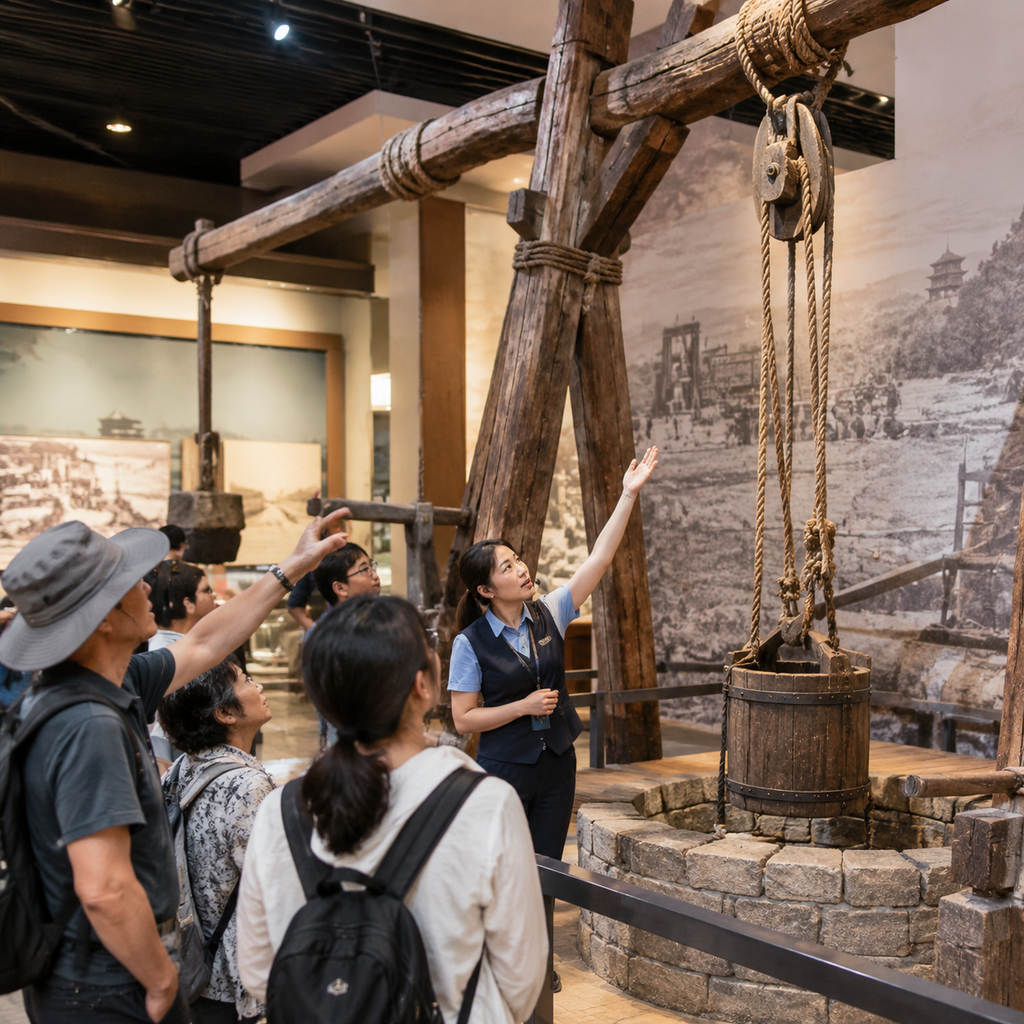
In the section dealing with shafts and well walls, the guide treated the idea of depth with particular care. Visitors can easily turn depth into a contest of impressive numbers, as though the value of a technique were measured only by how far a well descended. She separated the question into several parts: whether geology permitted the work, whether tools could continue operating, how the shaft could be maintained, whether the brine justified extraction, and whether people and materials could sustain the work over time. Without those conditions, depth alone explains very little about well salt. Mr. Lin placed his connection sketch beside the panel and saw that a rope, a drill, and a support were not isolated “ancient objects.” Together they formed a way of knowing and controlling underground space. The difficulty was not merely reaching farther down. It was keeping the system usable after reaching there.
一位年轻父亲带着两个孩子参观,哥哥对井架结构感兴趣,妹妹却被卤水加工的图示吸引。兄妹在不同位置来回跑,父亲几次抬手把他们叫回,却没有要求他们同时看同一块说明。讲解员让哥哥先用手指指出力从哪里传到哪里,再让妹妹说出液体从地下到地面经历了哪些步骤。两个孩子的答案并不完整,哥哥把滑轮说成了车轮,妹妹把煎制说成了“把盐水晒干”。讲解员没有立即判错,而是让他们回到图示中的箭头和火的符号,要求他们重新观察。兄妹第二次回答时仍然说得不整齐,却已经开始互相补充。对这类博物馆来说,理解不必一次完成,错误本身可以成为重新看图的入口。
A young father was visiting with two children. The older child was fascinated by the derrick structure, while the younger one preferred the diagram of brine processing. They moved back and forth between the displays, and their father repeatedly called them closer without demanding that they study the same panel. The guide asked the older child to point out how force traveled through the structure, then asked the younger child to describe the stages between underground brine and surface salt. Their answers were incomplete. The boy called a pulley a wheel, and the girl said boiling meant “drying the salt water in the sun.” The guide did not mark them wrong at once. She sent them back to the arrows and the symbol for fire and asked them to observe again. Their second attempt was still uneven, but now they were adding to one another’s answers. In a museum like this, understanding need not arrive in one pass. A mistake can become a reason to look again.
木材在这座博物馆里不只是视觉风格。它既出现在建筑的柱梁、门窗和楼梯,也出现在关于盐业工具与作业结构的叙述中,因此参观者必须区分不同位置的木材用途。建筑木构件承担空间和屋面的关系,工具木件则可能服务于连接、支撑、转动或传力;同样是木头,尺寸、加工方式、受力方向和维护环境并不相同。林乔把手从展示柜前收回后,开始仔细看木纹的方向。她发现楼梯踏步的纹理与门板不一样,便问父亲是不是因为它们承受的力不同。父亲这次没有抢答,只让她去问讲解员。讲解员说可以从使用位置和受力方式去思考,但不能凭一眼木纹断定具体年代或用途。
Timber in this museum is more than a visual style. It appears in columns, beams, doors, windows, and stairs, but it also belongs to the account of tools and working structures. Visitors therefore have to distinguish among uses. Architectural timber establishes relationships among rooms and roofs, while wooden tool parts may connect, support, turn, or transmit force. Even when the material is the same, dimensions, shaping, direction of stress, and maintenance conditions differ. After drawing her hand back from the case, Lin Qiao began to study the grain. She noticed that the grain on the stair treads did not look like the grain on a door panel and asked whether that was related to different forces. Her father did not answer immediately. He sent her to ask the guide. The guide said that use and load were sensible ways to think, but that one glance at wood grain could not establish an exact date or function.
参观者还会在燃料和火候的问题上停下来,因为煎盐把井口的液体与日常生活中的火联系起来。现代人看见盐,常常只想到调味瓶里干燥的颗粒,很少想到它曾经是需要容器、燃料和时间共同处理的卤水。展厅中的相关说明把生产拉回身体尺度:搬运燃料会消耗体力,守火需要持续注意,容器的清洗和更换也要安排在工作流程里。那位戴遮阳帽的老人说起自己小时候见过乡镇作坊里的大锅,却没有把记忆直接套在历史盐场上;他只说,火一旦不稳,做事的人就会很快感觉出来。讲解员接住这层生活经验,提醒大家相似的劳动感受可以帮助联想,但每个时代和地点仍需分别核对。
Visitors also paused over fuel and heat control, because boiling salt connects liquid at the well mouth with the everyday fire of the household. When modern people see salt, they often imagine dry grains in a shaker and rarely picture the brine that once required vessels, fuel, and time. The relevant displays return production to the scale of the body. Carrying fuel consumed strength, tending a fire demanded attention, and cleaning or replacing vessels had to fit into the working sequence. The older man in the sun hat recalled seeing a large pot in a township workshop when he was young, but he did not treat that memory as a direct description of a historical salt field. He only said that when a fire became unstable, the people working beside it noticed quickly. The guide used that everyday memory carefully, explaining that a shared feeling for labor may help imagination, while each period and place still needs its own evidence.
离开主展厅之前,林先生重新走了一遍刚才的路线,但速度明显慢了下来。他先站在建筑入口处看院落的纵深,再回到井盐生产的文字前确认几个概念,接着绕到工具侧面看连接处,最后在楼梯下方停留。他没有再次登楼,只是用鞋尖轻轻碰了碰第一阶旁边的地面,听见木板传来很短的回应。这个复看动作让他发现,第一次参观时许多空间关系被相机框住了,第二次则是身体在替他测量距离。历史解释因此不再只发生在说明牌上,也发生在“站在哪里才看得见”“退多远才不挡别人”“哪一个转角能同时看见院落和楼梯”这些具体选择里。
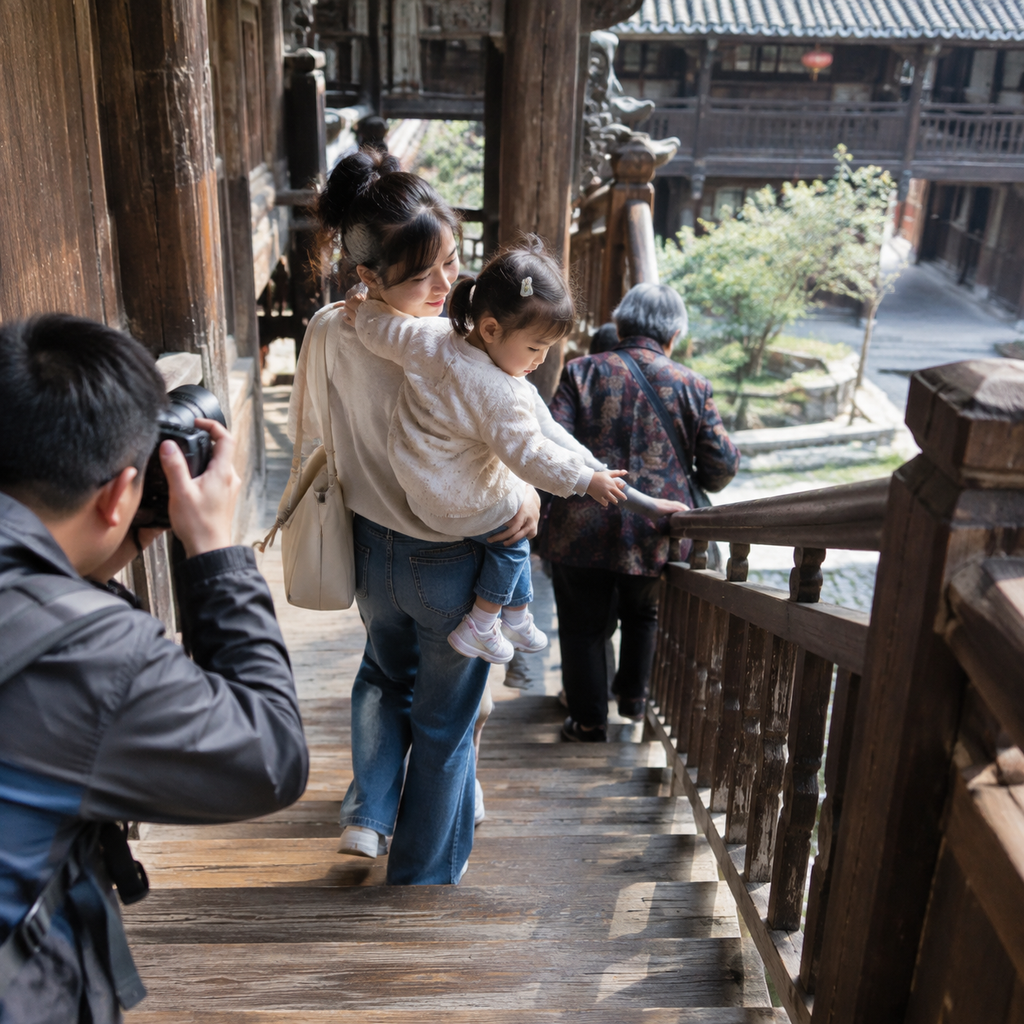
Before leaving the main exhibition rooms, Mr. Lin retraced the route at a noticeably slower pace. He first studied the depth of the courtyard from the entrance, then returned to the well-salt text to confirm several concepts, moved around the tools to inspect their points of connection, and finally stopped beneath the staircase. He did not climb again. He merely touched the ground beside the first step with the toe of his shoe and heard the board answer with a brief sound. The second pass revealed how much of the first visit had been framed by his camera. This time his body was measuring distance for him. Historical interpretation was happening not only on labels, but also in choices such as where to stand to see, how far to step back without blocking someone, and which corner allowed the courtyard and staircase to enter the same view.
林乔在出口处把折页夹进速写本,露出刚才那张写有“轻、支撑、坚硬”的纸。她又在下面加了一个词:“往返”。这个词并非展签中的专门术语,却是她从参观动作里提取出来的经验。钻井工具需要上下往返,汲卤需要重复提升,工匠需要在井口和工具之间往返,讲解员带着游客在建筑和展厅之间往返,游客也在看与再看之间往返。她没有把这些往返说成同一种事情,而是意识到它们具有不同的目的,却都依赖节奏、配合和耐心。小小的词语补写,成为她理解这座博物馆的个人索引。
At the exit, Lin Qiao slipped the leaflet into her sketchbook, leaving visible the page where she had written “light, support, hard.” Beneath those words she added one more: “back and forth.” It was not a specialist term from a label, but an experience extracted from the visit. Drilling tools moved up and down. Brine had to be lifted repeatedly. Craft workers moved between the well mouth and their equipment. The guide moved visitors between architecture and displays. Visitors themselves moved between looking and looking again. Lin Qiao did not pretend that all these movements meant the same thing. She noticed that they had different purposes but depended alike on rhythm, coordination, and patience. Her added word became a small personal index to the museum.
走出院门后的几分钟里,父女没有马上去别处。林先生把相机里的照片按时间浏览,女儿则站在路边把楼梯的线条重新画了一遍。这次她没有画出一个黑色井口,而是画了三个层次:地面的人、向下的工具、再向上回到地面的容器。她说自己以前以为博物馆是把过去放进房间里,今天才发现,参观者也会把自己的脚步带进去。父亲听完后没有把这句话改成更正式的历史判断,只问她下次看别的工业博物馆时先看什么。林乔回答,先看人怎么走,再看东西怎么工作。雨水从屋檐边滴下来,她低头避开水线,把速写本抱得更紧。
For several minutes after leaving the gate, father and daughter did not hurry elsewhere. Mr. Lin reviewed the photographs in chronological order, while his daughter stood beside the road and redrew the staircase. This time she did not draw a black well mouth. She drew three levels: people on the ground, tools moving downward, and a vessel returning upward. She said that she had once thought a museum put the past inside a room. Today she had realized that visitors bring their own footsteps into it. Her father did not turn the sentence into a formal historical judgment. He only asked what she would look at first in another industrial museum. Lin Qiao answered, “First I would see how people move, then how things work.” Water dripped from the eaves. She stepped around the falling line and held her sketchbook closer.
自贡盐业历史博物馆的观看价值,正在这种由建筑、技术和身体共同完成的理解里。会馆让人先意识到行业并非只属于工厂,也属于聚集、礼仪和城市关系;井盐展陈让人明白地下卤水不是故事的终点,而是钻井、判断、汲取、加工和运输的起点;竹、木、铁和绳索则把“技术”拆成可以观察的材料选择。木楼梯最后把这些知识落在脚下,却没有声称自己就是旧井场的原声。它只用当下真实的吱响,让参观者在上行和停步之间感觉到历史需要被逐层接近。林先生父女走远以后,院门内仍有新的脚步声进来,木板继续回应每一个不完全相同的重量。
The value of viewing Zigong Salt History Museum lies in this joint work of architecture, technology, and the body. The guild hall first makes clear that an industry belongs not only to factories but also to gathering, ritual, and urban relationships. The well-salt displays show that underground brine is not the endpoint of the story, but the beginning of drilling, judgment, lifting, processing, and transport. Bamboo, timber, iron, and rope break the word “technology” into material choices that can be observed. The wooden staircase finally places these ideas under the feet, without pretending to be the original sound of an old well site. Its present-day creak simply lets visitors sense, between climbing and pausing, that history must be approached layer by layer. After the Lin family had gone, new footsteps continued to enter the courtyard, and the boards answered each differently weighted arrival.
Public Source Notes
本文依据自贡盐业历史博物馆公开可见的馆址信息、盐业历史主题介绍、井盐生产与传统钻井工艺的常识性资料,以及现场参观中可观察的建筑与展陈关系写作。文中林先生、林乔、讲解员及其他参观者为叙事化人物,相关对话为情境重构,不对应任何可核实的原话;文中未使用无法确认的展品编号、价格或开放时间。
- 第一次在中国小区门口等人,我学会站在门侧别贴着门禁 | The First Time I Waited Outside a Chinese Compound Gate, I Learned to Stand to the Side Instead of Pressing Up Against the Access Door
- 在中国公园跟着陌生人倒着走那十分钟,我第一次不再急着解释自己 | The Ten Minutes I Walked Backward with Strangers in a Chinese Park Was the First Time I Stopped Rushing to Explain Myself
- 一只陶马,让孩子在西安开始认真追问历史 | A Clay Horse Opened the Door to History for My Child in Xi’an
- 中国最美高铁线路TOP5:窗外就是风景 | Top 5 Most Scenic High-Speed Rail Routes in China
- 敦煌到吐鲁番:三天穿越丝绸之路 | Dunhuang to Turpan: A 3-Day Silk Road Crossing
- 罗平没有油菜花的那天,我还是走上了田野公路 | I Took Luoping’s Country Road Even Without the Canola Blooms
- 甘南:被遗忘的藏区秘境七日行 | Gannan: A 7-Day Journey Through Tibet's Forgotten Frontier
- 菜市场早餐摊前,我靠一个“这个”吃到了热豆浆 | At a Wet Market Breakfast Stall, One “This One” Got Me Hot Soy Milk
- 凌晨一点我还敢一个人走回酒店:在中国把安全感走成了日常经验 | At 1 a.m. I Still Walked Back to My Hotel Alone: How Safety in China Became Ordinary to Me
- 带爸妈游中国七日:一份不累不赶的行程单 | 7 Days in China with Aging Parents: A No-Rush Itinerary
Comments (0)