
苗绣与蜡染:我在贵州看见布上的山河 | Miao Embroidery and Batik: In Guizhou, I Saw Mountains and Rivers Written on Cloth
苗绣与蜡染:我在贵州看见布上的山河 | Miao Embroidery and Batik: In Guizhou, I Saw Mountains and Rivers Written on Cloth
如果要我回想这次贵州之行里最安静、却也最有力量的一天,我一定会想到我第一次认真看苗绣与蜡染的那一天。作为一个长期在亚洲旅行的外国人,我原本以为自己已经很熟悉“布上的传统”这件事了。毕竟在印度尼西亚,我看过爪哇的巴迪克匠人用蜡刀一点一点画出纹样,也见过不同岛屿如何把织物当成身份、礼仪和记忆的一部分。可是真的走进贵州苗寨,近距离看见苗绣和蜡染的时候,我还是立刻意识到:我过去知道的,只是“工艺”这个词的表面。
If I had to recall the quietest yet most powerful day from my trip in Guizhou, I would immediately think of the first day I truly paid attention to Miao embroidery and batik. As a foreign traveler who has spent a long time moving around Asia, I had assumed I already understood what “tradition on cloth” meant. After all, in Indonesia I had watched Javanese batik artisans draw patterns little by little with wax tools, and I had seen how different islands treat textiles as part of identity, ritual, and memory. But the moment I entered a Miao village in Guizhou and saw Miao embroidery and wax-resist dyeing up close, I realized at once that what I had known before was only the surface of the word “craft.”
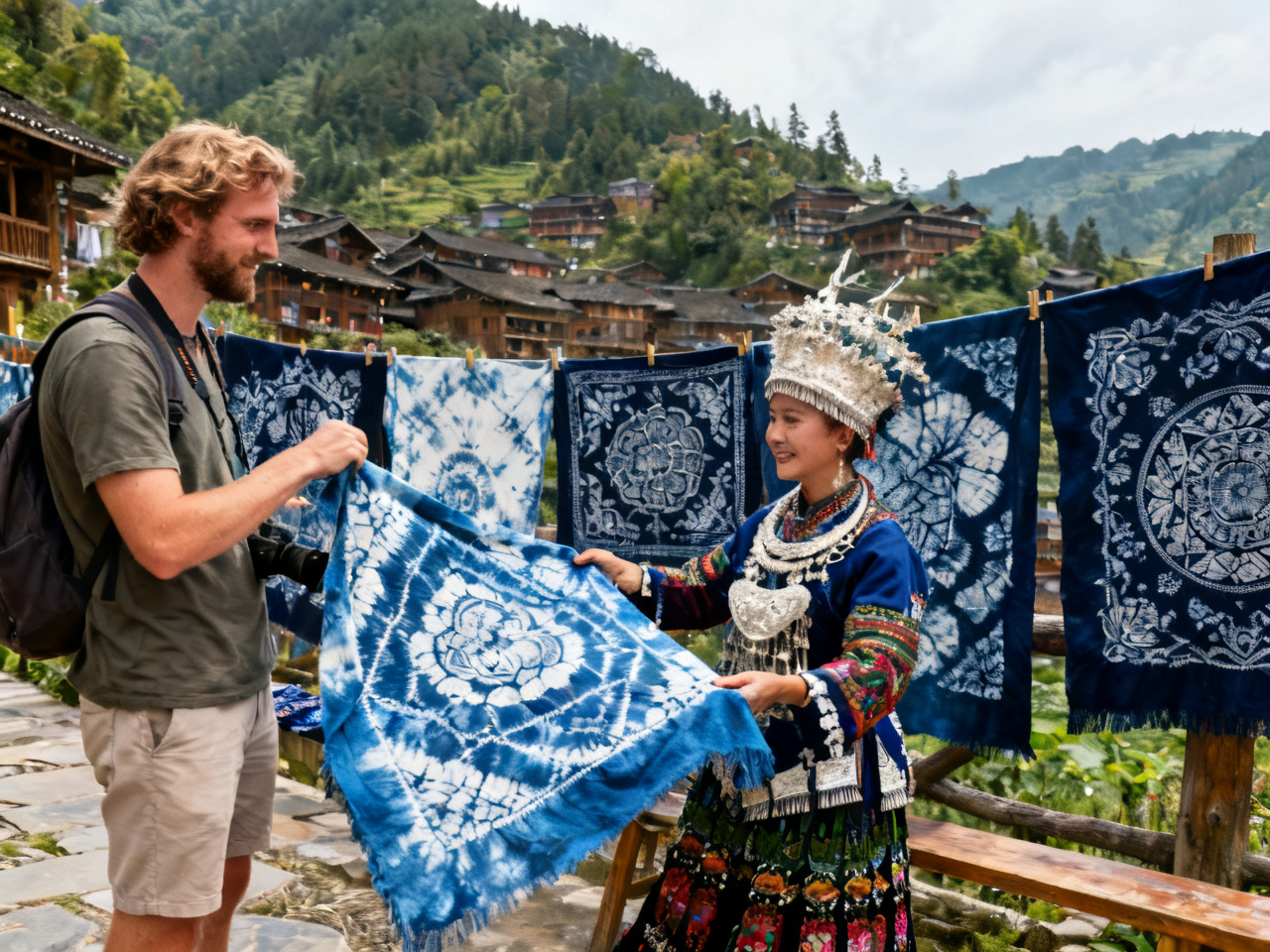
那天山里的空气很潮,石板路带着一点雨后反光。我沿着寨子慢慢往里走,最先抓住我注意力的并不是建筑,而是衣服和布料。深蓝色的裙摆、密密叠叠的花纹、衣襟和袖口上像要溢出来的针脚,让我一边走一边忍不住停下来多看几眼。它们不是那种被摆在橱窗里、专门等游客拍照的“民族风装饰”,而是很自然地穿在人的身上,出现在背带、围腰、包布和家用织物上。那一刻我突然明白,真正活着的传统,首先会以一种毫不费力的方式进入日常。
The mountain air that day was damp, and the stone path reflected a little light from recent rain. As I slowly walked deeper into the village, what first captured my attention was not the architecture but the clothing and textiles. Dark blue skirts, densely layered patterns, and stitching that seemed to overflow from collars and cuffs kept making me stop and look again. These were not the kind of “ethnic-style decorations” displayed in shop windows for tourists to photograph. They were naturally worn on people’s bodies and appeared on baby carriers, aprons, bags, and household cloths. At that moment, I suddenly understood that a tradition that is truly alive enters daily life without effort.
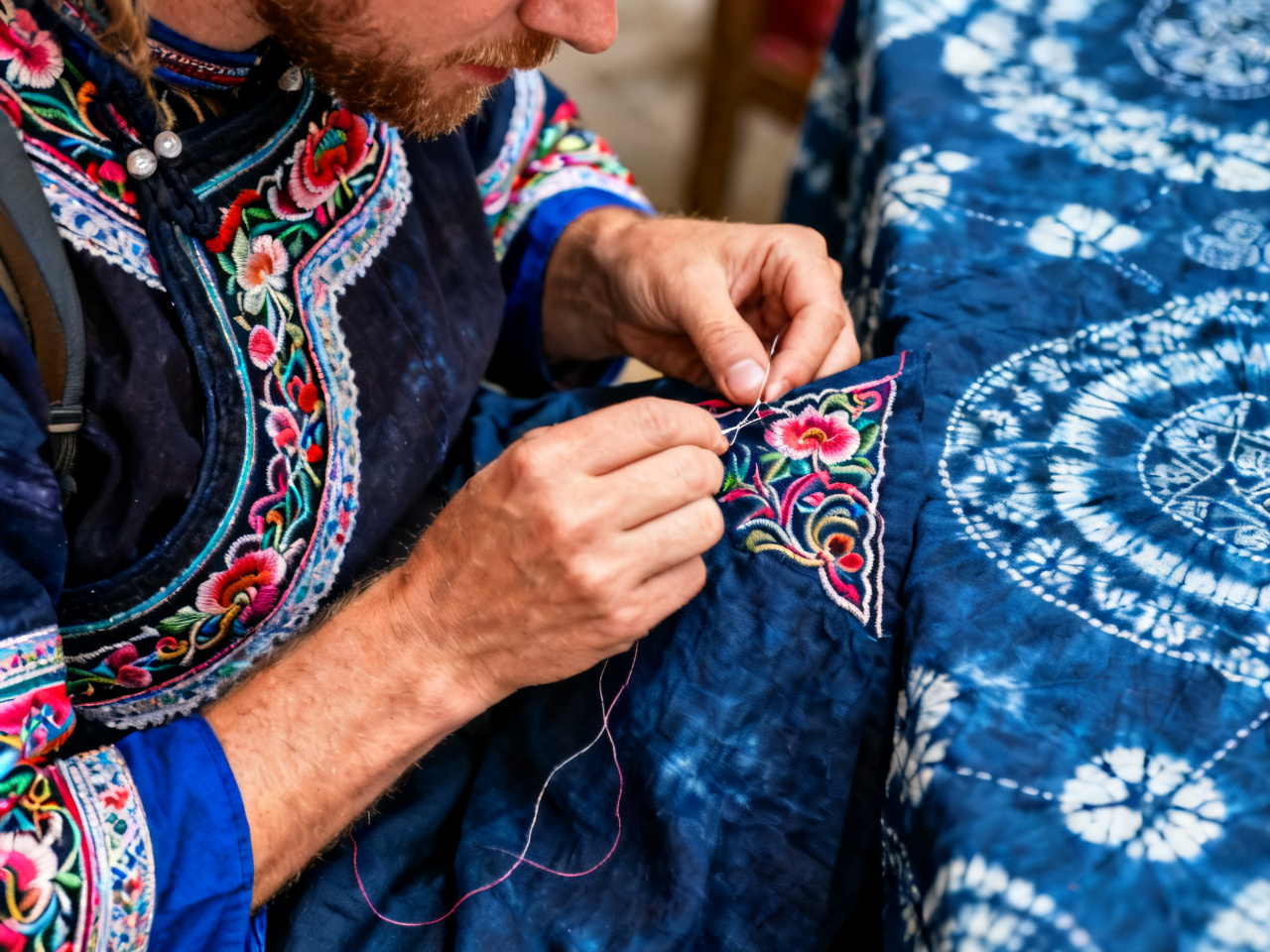
后来我坐在一位苗族阿姨旁边,看她继续手里的绣活。她没有刻意放慢动作,也没有把这件事处理成给外人看的表演,只是非常自然地低头、穿针、收线。正因为这样,我反而更受触动。她手中的针法细得惊人,布面上的图案一层压着一层,几乎没有任何敷衍的地方。远看是花,是蝶,是鸟,是鱼;近看又像地形、像水路、像某种被世代记住的密码。作为外来者,我当然不可能一下子读懂所有纹样,但我很清楚地感觉到,这些图案绝不是单纯为了“好看”而存在。
Later, I sat beside a Miao auntie and watched her continue her embroidery. She did not slow down for effect, nor did she turn the act into a performance for outsiders. She simply lowered her head, threaded the needle, and drew the thread through the cloth as naturally as breathing. Precisely because of that, I was even more moved. Her stitches were astonishingly fine, and the patterns on the fabric pressed layer upon layer with almost no careless space anywhere. From far away, I saw flowers, butterflies, birds, and fish; from close up, they began to resemble topography, waterways, or some code remembered across generations. As an outsider, I could not possibly understand every motif at once, but I could clearly feel that these designs did not exist merely to look beautiful.
我问起这些纹样时,得到的回答也很有意思。没有人递给我一套标准答案,反而更像是在打开一个故事库:蝴蝶会让人想到古老传说,鱼会让人想到生命力和繁衍,鸟、花、水纹和梯田纹又和自然环境、迁徙记忆、家族愿望联系在一起。听着这些解释,我想到的不是博物馆标签,而是语言。苗绣给我的感觉,像是一种没有字母却非常完整的书写系统。一个人穿上这样的衣服,不只是在穿装饰,而是在把族群记忆穿到身上。
The answers I received when I asked about these motifs were also fascinating. No one handed me a standardized explanation. Instead, it felt as if a story archive had been opened: butterflies could point toward old origin legends, fish toward vitality and fertility, while birds, flowers, water patterns, and terraced-field motifs connected to the natural environment, memories of migration, and family hopes. Listening to these interpretations, I did not think of museum labels. I thought of language. Miao embroidery felt to me like a complete writing system without an alphabet. When someone wears clothing like this, they are not simply wearing decoration. They are wearing collective memory.
这让我很自然地想到印度尼西亚的纺织和巴迪克传统。在爪哇,有些巴迪克纹样过去和王室、等级、地域有关,不是什么场合都能随便使用;在苏门答腊或巴厘岛,某些织物也常常和婚礼、祭礼、人生阶段紧密相连。苗绣给我的感受和这种经验很接近:图案从来不是中性的,它们背后总有社会关系,也总有文化语法。只是两者的气质并不一样。印尼的巴迪克常常给我一种更讲秩序、更讲重复与节奏的感觉,而苗绣则更像把神话、自然和情感一起缝进了一块布里,密度更高,也更有“讲故事”的冲动。
This naturally made me think of Indonesian textile and batik traditions. In Java, certain batik patterns were historically associated with royalty, rank, or region, and could not simply be worn in any setting. In Sumatra or Bali, some textiles are still closely tied to weddings, rituals, and stages of life. Miao embroidery gave me a feeling very close to that experience: patterns are never neutral, and behind them there are always social relationships and cultural grammar. But the temperament of the two is not identical. Indonesian batik often gives me a stronger sense of order, repetition, and rhythm, while Miao embroidery feels more like myth, nature, and emotion being stitched into one piece of cloth all at once. It is denser, and more eager to tell stories.
看苗绣的时候,我最强烈的感受其实是“慢”。在今天的旅行里,我们太容易被训练成快速消费一切:快速拍照、快速判断、快速购买、快速离开。但苗绣完全不属于这种时间。你只要在旁边坐几分钟,就会明白一件复杂的绣品需要多少耐心。每一个针脚都要求稳定,每一处配色都需要经验,每一个局部都得服从整体节奏。它的美之所以成立,恰恰是因为它不能快。那一刻我甚至有点惭愧,因为我平时也会用现代效率的眼光去衡量很多传统手工:值不值、贵不贵、有没有必要做得这么慢。可坐在那里以后,我忽然觉得这些问题都问得太急了。
What I felt most strongly while watching the embroidery was actually slowness. In travel today, we are too easily trained to consume everything quickly: photograph quickly, judge quickly, buy quickly, and leave quickly. But Miao embroidery belongs to a completely different time. If you sit beside it for even a few minutes, you immediately understand how much patience a complex embroidered piece requires. Every stitch demands steadiness, every color choice depends on experience, and every local detail must obey the rhythm of the whole. Its beauty exists precisely because it cannot be rushed. At that moment I even felt a little ashamed, because I too often evaluate traditional crafts through the lens of modern efficiency: Is it worth it? Is it too expensive? Is there any need for it to be this slow? But once I sat there, those questions suddenly felt too impatient.
如果说苗绣像一首热烈而复杂的歌,那么蜡染在我眼里更像一首安静的诗。因为我之前在印尼已经看过巴迪克,所以我对“以蜡防染”这件事并不陌生。我原本甚至有点自以为是,以为自己大概能预判贵州蜡染会给我什么感觉。结果真正看到成品和制作过程时,我立刻发现自己错了。贵州苗族蜡染最打动我的,是那种蓝白之间的呼吸感。白色纹样不是被硬生生贴在深蓝底上,而像是从蓝色里面慢慢浮出来。再加上自然形成的冰纹和细裂,它看起来像溪水、像风、像薄霜,也像山间夜色里忽然出现的月光。
If Miao embroidery felt like an intense and complicated song, then batik appeared to me more like a quiet poem. Because I had already seen Indonesian batik before, the idea of using wax as a resist in dyeing was not unfamiliar to me. In fact, I was almost a little too confident, assuming I could probably predict what Guizhou batik would feel like. But the moment I saw the finished pieces and the process up close, I realized I was wrong. What moved me most in Miao batik from Guizhou was the breathing space between blue and white. The white motifs did not seem harshly placed on top of a dark blue ground; they seemed to rise slowly out of the blue itself. Combined with the naturally formed crackles and ice-like lines, the cloth looked like stream water, wind, light frost, or moonlight suddenly appearing in a mountain night.
我站在那里看那些蓝白布料,看得几乎有点出神。它们的图案里有蝴蝶、花草、旋涡、水纹,也有一些很有几何秩序的组合。但无论图案具体是什么,整体气质都让我联想到山里的雾气和水流。和一些色彩更热烈、层次更复杂的印尼巴迪克相比,苗族蜡染给我的感觉更清澈、更克制,也更接近自然本身的节奏。印尼巴迪克里常常能看到宫廷、贸易、宗教和热带世界长期叠加出来的装饰感;而我这次看到的苗族蜡染,更像是山地生活把风景慢慢留在了布上。
I stood there looking at those blue-and-white cloths until I was almost spellbound. Their patterns included butterflies, flowers, spirals, water motifs, and also some very geometric arrangements. But whatever the exact motif was, the overall character kept reminding me of mountain mist and moving water. Compared with some Indonesian batik styles that are warmer in color and more layered in visual complexity, Miao batik felt clearer, more restrained, and closer to the rhythm of nature itself. In Indonesian batik, one often sees the decorative density created through long histories of courts, trade, religion, and the tropical world. In the Miao batik I saw here, it felt instead as though mountain life had slowly left the landscape on cloth.
我尤其喜欢这种比较带来的启发。相同的是,两者都证明了一块布可以远远超出“实用”的定义,可以承载身份、美感、祝福和记忆;不同的是,它们生长于完全不同的地理环境和文化性格之中,所以最后呈现出的语言也不同。印尼巴迪克更像一套经过漫长历史沉淀出来的纹样体系,很多时候讲究连续、对称和反复生成的节奏;苗族蜡染则更让我感到一种山地民族对自然纹理的敏感,它允许偶然的裂纹、留白的呼吸和蓝白的对照直接参与表达。一个像热带历史织成的秩序,一个像高山水气留下的诗意。
I especially loved what this comparison taught me. What the two share is the proof that a piece of cloth can exceed the definition of mere utility and carry identity, beauty, blessing, and memory. What differs is that they grow out of completely different geographies and cultural temperaments, so the languages they finally present are also different. Indonesian batik feels more like a pattern system shaped through a long historical sedimentation, often emphasizing continuity, symmetry, and repetitive rhythm. Miao batik, by contrast, made me feel a mountain people’s sensitivity to natural textures. It allows accidental crackles, the breathing of blank space, and the contrast between blue and white to participate directly in expression. One feels like order woven from tropical history; the other like poetry left behind by mountain air and water.
随着看得越来越久,我慢慢意识到,苗绣和蜡染最珍贵的地方还不只是“好看”,而是它们从来不是孤立存在的作品。它们和婚嫁、节庆、家庭、代际传承、女性劳动、地域认同都连在一起。也就是说,这些工艺并不是先被发明出来给人欣赏,然后才偶尔进入生活;恰恰相反,它们原本就长在生活里面,所以才有了今天我们看到的美感。这一点和我在印尼乡间感受到的某些传统织物经验非常相似。真正有生命力的布艺,往往不是靠展板活着,而是靠被穿、被用、被赠送、被记住活着。
As I kept looking longer, I slowly realized that the most precious thing about Miao embroidery and batik was not simply that they are beautiful, but that they have never existed as isolated artworks. They are tied to marriage, festivals, family, intergenerational transmission, women’s labor, and regional identity. In other words, these crafts were not first invented to be admired and only later brought into life. On the contrary, they grew inside life from the beginning, which is exactly why they have the beauty we see today. This is very similar to what I have felt around certain traditional textiles in rural Indonesia. Cloth traditions with real vitality usually do not survive through display boards. They survive by being worn, used, gifted, and remembered.
作为一个外国游客,我也不得不提醒自己,不能只是站在“惊叹者”的安全位置上。说一句“真美啊”当然很容易,拍几张照片、买一点纪念品也很容易,可如果我只做到这里,那我对这些工艺的尊重其实还是很浅。苗绣和蜡染让我不断想问更多问题:是谁在做这些东西?这些技艺今天如何传下去?年轻人愿不愿意学?当市场上出现大量机器复制品和廉价仿制品时,真正的手工又怎样被公平看待?这些问题并不轻松,但它们决定了一项传统究竟是被消费,还是被理解。
As a foreign tourist, I also had to remind myself not to remain in the safe position of mere admiration. It is easy to say, “How beautiful,” and easy to take a few photos or buy a few souvenirs. But if that is all I do, then my respect for these crafts is still shallow. Miao embroidery and batik kept making me ask more: Who is making these things? How are these skills being passed on today? Do younger people still want to learn them? When the market fills with machine-made copies and cheap imitations, how can genuine handwork still be valued fairly? These are not easy questions, but they determine whether a tradition is merely consumed or actually understood.
离开前,我买了一小块蜡染布和一个带苗绣纹样的手工包。它们不算便宜,但拿在手里的时候,我非常清楚自己买下的并不只是“东西”。我买下的是做它们的人花进去的时间,是纹样背后的文化判断,也是那一天我在苗寨获得的某种提醒:真正能留在记忆里的美,往往不是最新、最快、最响亮的,而是那些被一代代人安静重复、认真守住的东西。回到住处以后,我把那块蜡染布铺在桌上看了很久,蓝色在灯下变得更深,白色像浮在水上的月影。我忽然觉得,布之所以适合保存文化,也许正因为它会贴近身体,会陪着人生活,会慢慢变旧。
Before leaving, I bought a small piece of batik cloth and a handmade bag decorated with Miao embroidery. They were not cheap, but as I held them in my hands, I knew very clearly that I was not merely buying objects. I was buying the time that had gone into making them, the cultural judgment behind the patterns, and also a reminder I had received that day in the village: the forms of beauty that remain in memory are often not the newest, fastest, or loudest ones, but the things quietly repeated and carefully guarded across generations. Back at my lodging, I spread the batik cloth on the table and looked at it for a long time. Under the lamp, the blue became deeper and the white looked like moonlight floating on water. Suddenly I felt that cloth may be especially suited to preserving culture precisely because it stays close to the body, accompanies people in life, and slowly grows old with them.
如果有人问我,这次看苗绣与蜡染之后最大的感受是什么,我大概会说:它们让我再次确认,亚洲很多传统工艺虽然诞生在不同土地上,却共享一种很深的精神——尊重材料,尊重手的劳动,也尊重人与群体、人与自然之间缓慢而持久的联系。贵州的苗绣与蜡染让我想到印度尼西亚的巴迪克,但它们绝不是彼此的复制品。相反,正因为相似处和差异都那么清楚,我才更能看见每一种传统各自独特的美。作为一个过路的外国人,我很庆幸自己那天没有只看见颜色和花纹。我还看见了一点点,布上的山河,以及藏在针脚和蓝白之间的时间。
If someone asked me what stayed with me most after seeing Miao embroidery and batik, I would probably say this: they made me confirm once again that many traditional Asian crafts, though born in different lands, share a deep spirit—respect for materials, respect for the labor of the hand, and respect for the slow and lasting ties between people and community, and between people and nature. Miao embroidery and batik in Guizhou reminded me of Indonesian batik, but they are by no means copies of one another. On the contrary, it is precisely because both their similarities and their differences are so clear that I can better see the unique beauty of each tradition. As a passing foreign traveler, I am grateful that on that day I did not see only colors and patterns. I also saw, just a little, mountains and rivers on cloth, and the time hidden inside stitches and blue-and-white dye.
- 我坐绿皮火车从昆明晃到北京 | I Took a Slow Train from Kunming All the Way to Beijing
- 中国货币与支付 | Chinese Currency and Payment
- 落地后的第一笔钱:在中国旅行建立支付备用方案 | Your First Payment After Landing: Building a Backup Plan for Travel in China
- 带爸妈游中国七日:一份不累不赶的行程单 | 7 Days in China with Aging Parents: A No-Rush Itinerary
- 广州真正上镜的,不只是早茶和烧味,而是吃这件事怎样带着整座城往前走 | What Truly Films Well in Guangzhou Is Not Only Dim Sum and Roast Meats but the Way Eating Pulls the Whole City Forward
- 陶艺课上的半天:我第一次知道一团泥为什么也有“火后的性格” | Half a Day in a Pottery Workshop: The First Time I Learned That Clay Has a Personality After Fire
- 长沙宵夜:嗜辣之城的深夜食堂 | Late-Night Changsha: The Spice Capital's After-Dark Kitchen
- 木版年画体验:我第一次在一张纸上看见“过年”被印出来 | Woodblock New Year Print Experience: The First Time I Saw New Year Spirit Printed onto Paper
- 我第一次在中国茶馆里学会慢下来 | The First Time I Learned to Slow Down in a Chinese Teahouse
- 在中国吃素这件事,比你想象的难,也比你想象的容易 | Eating Vegetarian in China: Harder Than You Think, Easier Than You Fear
Comments (0)