
我站到皮影戏幕布后面的一晚 | The Night I Stepped Behind the Shadow Puppetry Screen
我站到皮影戏幕布后面的一晚 | The Night I Stepped Behind the Shadow Puppetry Screen
那天傍晚,我走进中国一座古镇里的小剧场时,天还没有完全黑下来。青石板路上还留着白天的热气,门口挂着的红灯笼已经亮了,光不强,却把木门和旧招牌照得很温柔。作为一个来自土耳其的外国旅行者,我原本只是想看一场传统演出,安静地坐在台下,像大多数游客那样,看看中国皮影戏到底是什么样子。但没想到,那天最难忘的部分,不是在观众席,而是在幕布后面,在那块发亮的白布之后,我第一次真正看见一场戏是怎样被人的手、呼吸、声音和光线一起“点亮”的。
That evening, when I entered a small theater in an old Chinese town, the sky was not fully dark yet. The stone street was still holding the warmth of the day, and the red lanterns at the entrance had already been lit. Their glow was soft, but enough to warm the wooden door and the old signboard. As a foreign traveler from Turkey, I had only planned to watch a traditional performance from the audience like any other visitor. I wanted to quietly see what Chinese shadow puppetry was really like. I did not expect that the most unforgettable part of the night would not be in front of the stage, but behind the screen. Behind that glowing white cloth, I saw for the first time how a play is truly brought to life by hands, breath, sound, and light.
演出开始前,工作人员让我们几位观众短暂地到后台参观。我一听到这个机会,几乎立刻就点头了。对我来说,这种能看见“表演内部”的时刻,总比单纯打卡更珍贵。刚绕到幕布后面,我的眼睛先是被那盏强灯晃了一下。和前台的柔和感完全不同,后台并不浪漫,甚至可以说有点紧张。灯是热的,空气里混着木头、皮革、灰尘和一点旧布料的味道。几位艺人站得很近,周围挂满了大大小小的影偶,像一排排正在等待上场的角色。有人在整理操纵杆,有人在试声音,有人在低声确认下一段唱词。那一刻我突然明白,观众前面看到的是故事,幕后的人面对的却是密集而精确的劳动。
Before the show began, the staff allowed a few of us to briefly visit backstage. The moment I heard that, I nodded almost immediately. For me, moments like this—when you can see inside a performance—are always more valuable than simply checking off a tourist attraction. As soon as I stepped behind the screen, the bright lamp almost hit my eyes. It felt completely different from the gentle atmosphere in front. Backstage was not romantic. It was tense, concentrated, almost mechanical in the best sense. The lamp was hot, and the air carried the smell of wood, leather, dust, and old fabric. Several performers stood close together, surrounded by puppets of different sizes hanging in rows like actors waiting for their cue. One person was organizing control rods, another was testing the voice, another was quietly confirming the next lines to sing. In that instant, I understood something simple and important: what the audience sees is a story, but what the performers face behind the screen is dense, exacting labor.
我站在一旁,看一位老师拿起一个武将形象的皮影给我们展示。近距离看,它比我想象得精细得多。人物侧脸轮廓锐利,头盔上有复杂的镂空花纹,衣甲被染成层次分明的红、绿、黄,透光以后颜色像从里面亮起来一样。更让我吃惊的是它的关节:肩膀、手肘、手腕、腰、腿,都不是僵硬连在一起的,而是通过小小的连接点灵活活动。老师轻轻一抬手,那名武将就像突然有了脾气;再一转腕,人物的身体立刻出现了方向感和姿态感。明明只是平面的影偶,可在他手里,那种“平面”一点也不扁,反而有一种浓缩后的生命力。
I stood aside and watched one master pick up a warrior puppet to show us. Up close, it was far more intricate than I had imagined. The side profile was sharp, the helmet was filled with delicate cutout patterns, and the armor was dyed in layers of red, green, and yellow that seemed to glow from within once the light passed through. What surprised me even more were the joints. The shoulders, elbows, wrists, waist, and legs were not fixed stiffly together. They moved through tiny connection points with remarkable flexibility. The master lifted his hand slightly, and the warrior suddenly seemed to gain temperament. With a turn of the wrist, the whole body gained direction, tension, and posture. It was only a flat puppet, yet in his hand that “flatness” did not feel flat at all. It felt like concentrated life.
真正的震撼来自他们开始试演的时候。一个人物刚被送到幕布前,白布上立刻出现了清晰的彩色影像。那种变化太快了:在我身边,它只是几片被连接起来的材料和几根细杆;一贴上光,它就成了一个角色。艺人的手几乎没有停顿,左手稳定主杆,右手不断调整另外几根细杆,控制头部、手臂和身体的角度。人物往前走时,脚步并不是真的一步一步“踩”出来,而是通过轻微而连续的节奏变化,让观众相信他在走;人物回头时,也不是简单地转个方向,而是先有一点停顿,再抬手,再偏头,于是情绪就出来了。站在幕后,我第一次意识到,皮影戏最厉害的地方,不只是“会动”,而是它知道怎样用最少的空间制造最完整的动作幻觉。
The real shock came when they began demonstrating a scene. The moment one puppet was placed against the lit screen, a clear colored figure instantly appeared on the white cloth. The transformation was so fast. Beside me, it was only a few connected pieces of material attached to thin rods. Against the light, it became a character. The performer’s hands barely paused. The left hand stabilized the main rod while the right hand constantly adjusted the other rods, controlling the angle of the head, arms, and body. When the figure walked forward, the steps were not literally “stepped” one by one. Instead, tiny continuous shifts in rhythm made the audience believe that he was walking. When the character turned around, it was not just a simple change in direction. There was a slight pause, then a lifted arm, then a tilted head—and suddenly emotion appeared. Standing backstage, I realized for the first time that the brilliance of shadow puppetry is not merely that it can move, but that it knows how to create the fullest illusion of movement with the smallest possible space.
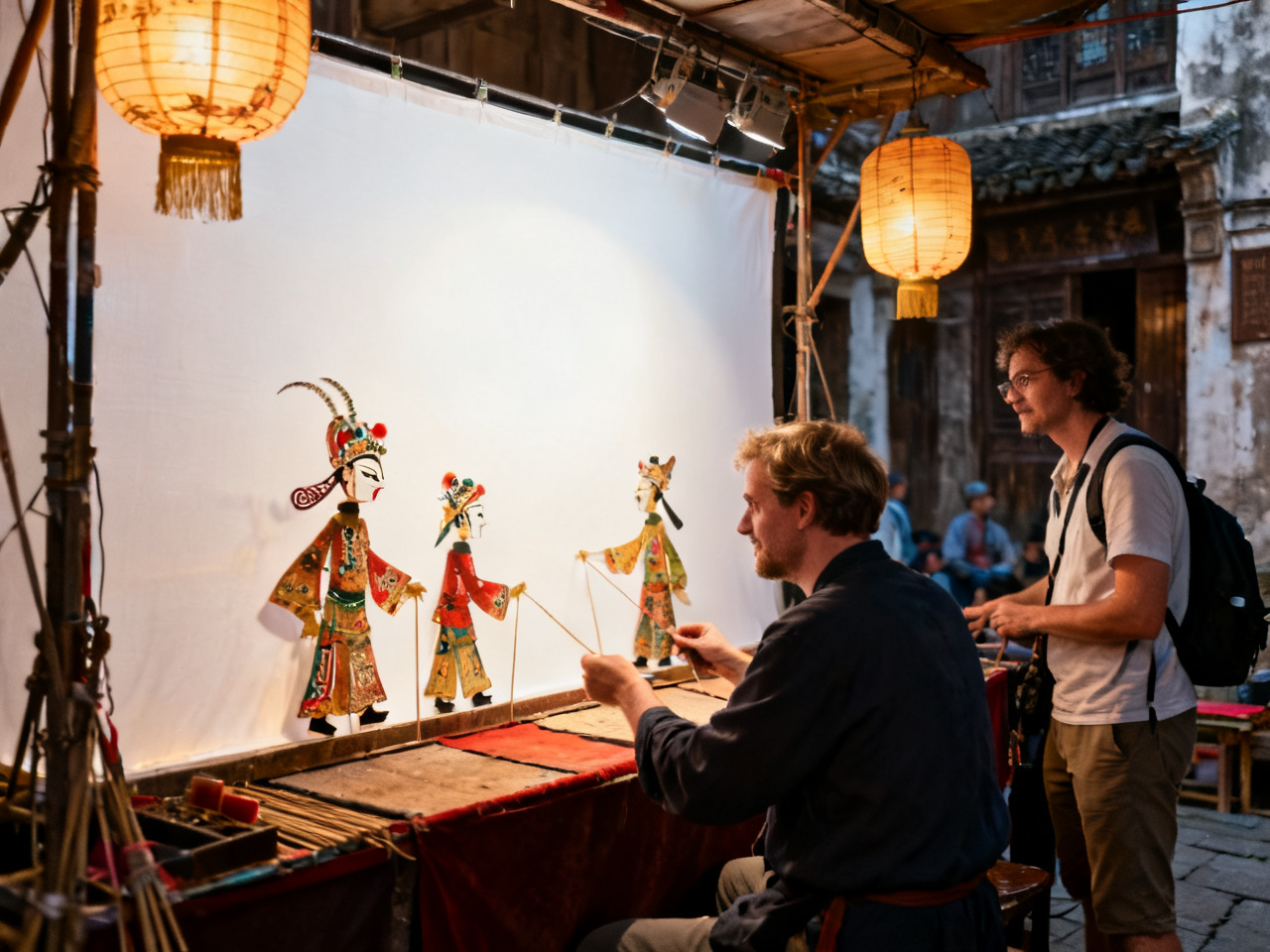
声音也让我很难忘。以前坐在观众席时,我会把唱腔、念白和乐器声当成整场演出天然的一部分,好像它们自己就该在那里。但在幕后,我看见这些声音是怎样被现场制造出来的。说唱并不是松弛地“发出来”,而是要卡住动作的点,给人物的出场、停顿、转身甚至情绪变化服务。鼓点一敲,人物的气势就立刻变了;小锣一响,节奏就被推快了;唱腔一拉长,手上的动作也像被拉出了空间。那种手、口、耳同时工作的状态特别惊人。我甚至觉得,艺人不像是在单独操纵一个人偶,更像是在同时驾驶一整套微型戏剧机器,而那台机器只有在节奏完全合拍时才会运转得漂亮。
The sound was equally unforgettable. When I used to sit in the audience, I treated the singing, spoken lines, and instruments as a natural part of the performance, as if they simply belonged there by themselves. But backstage, I saw how these sounds were produced in real time. The vocal delivery was not relaxed or casual. It had to hit the exact points of movement and serve the character’s entrance, pause, turn, and emotional shift. One drumbeat changed the whole force of a figure. One strike of a small gong pushed the rhythm forward. A stretched note in the singing seemed to pull the puppet’s motion into a larger space. The way the hands, mouth, and ears had to work together was astonishing. I even felt that the performer was not merely controlling a puppet, but piloting an entire miniature theater machine—one that only runs beautifully when every rhythm locks perfectly into place.
因为我来自土耳其,艺人很自然地问我,我们那里是不是也有类似的东西。我马上想到了 Karagöz,也就是土耳其非常著名的传统影子戏。那一瞬间,我心里其实有点兴奋,因为终于能把两种我都真实接触到的民间表演放在一起看。Karagöz 对我来说,是带着幽默、讽刺和市井气息的。它常常依靠人物之间的机智对话、误会、夸张冲突来推动,观众会被角色性格和语言节奏直接吸引。中国皮影戏当然也有幽默和热闹的一面,但我在这个后台最强烈感受到的,是它和戏曲传统的联系特别深。人物的身份、气质、忠奸、文武,不只是靠台词说明,也靠造型、唱腔、动作架势一起建立。换句话说,土耳其影子戏在我记忆里更像语言把角色推出来,而中国皮影戏更像造型、音乐和动作共同把角色“立”起来。
Because I am from Turkey, one of the performers naturally asked whether we had something similar back home. I immediately thought of Karagöz, the famous traditional Turkish shadow theater. At that moment I felt genuinely excited, because I could finally compare two folk forms I had both encountered in real life. For me, Karagöz carries humor, satire, and an urban, everyday spirit. It often relies on witty dialogue, misunderstanding, and exaggerated conflict between characters, and the audience is drawn directly by personality and verbal rhythm. Chinese shadow puppetry can certainly be lively and humorous too, but what I felt most strongly backstage was its deep connection to operatic tradition. A character’s identity, moral nature, civility or martial power is not explained only through words. It is built through shape, singing, and stylized movement together. In other words, Turkish shadow theater in my memory often pushes a character forward through language, while Chinese shadow puppetry raises a character into being through the combined force of design, music, and gesture.
还有一个差别,是“观看距离”的感觉。在土耳其影子戏里,我常常会先听人物说什么,再去感受戏的味道;而在这次中国皮影戏后台,我发现很多信息在人物一亮相时就已经到了观众眼前。头冠有多高,袖子有多宽,胡须怎样飘,盔甲纹样多复杂,都是叙事的一部分。后台的老师把几个不同角色并排挂起来给我们看时,这种差别尤其明显。忠臣、武将、年轻女子、丑角,哪怕一句话不说,气质也已经分别立住了。我很喜欢这一点,因为它让我想到旅行本身:有些文化先通过语言进入你,有些文化先通过视觉和身体感觉进入你。中国皮影戏对我来说,就强烈属于后者。
There was another difference too: the feeling of viewing distance. In Turkish shadow theater, I often first listen to what the characters are saying and then absorb the flavor of the performance. But backstage at this Chinese shadow play, I realized that much of the information reaches the audience the moment a figure appears. How high the headdress is, how wide the sleeves are, how the beard falls, how complex the armor pattern is—these are all parts of storytelling. When the master hung several characters side by side for us to compare, this difference became especially clear. A loyal official, a warrior, a young woman, a comic role—even without a single line spoken, each one already possessed a distinct presence. I liked this very much, because it reminded me of travel itself: some cultures first enter you through language, and some first enter you through the eye and the body. Chinese shadow puppetry, for me, strongly belongs to the second kind.
我一直记得那块幕布后的光。它非常直接,没有舞台前方那种修饰感,甚至有些“残酷”,因为每个动作都必须在这道强光面前接受检验。人物贴得太远,颜色就弱;角度偏得太多,形象就不稳;手上慢半拍,观众看到的节奏就会松掉。后台没有什么可以掩饰失误的空间。这也让我更佩服那些艺人的沉着。他们说话时很平静,甚至有些随意,可一旦人偶举到幕前,整个人的注意力立刻收紧。我能看到他们的手指细小地发力,手腕迅速地调整,肩膀几乎不乱动,身体却始终跟着节奏微微前倾。那是一种长期训练后才会出现的身体智慧,不需要夸张,却非常准确。
I still remember the light behind that screen. It was direct and unforgiving, with none of the decorative softness of the front stage. In fact, it felt almost severe, because every movement had to survive inspection under that strong lamp. If the figure was held too far from the screen, the color weakened. If the angle shifted too much, the image lost stability. If the hand was half a beat late, the rhythm in the audience’s eyes would loosen. Backstage, there was almost no room to hide mistakes. That made me admire the performers even more. When they spoke to us, they were calm, even casual. But the moment a puppet rose to the screen, their concentration tightened instantly. I could see small bursts of force in their fingers, quick adjustments in the wrist, shoulders that remained disciplined and quiet, and bodies that leaned forward almost invisibly with the rhythm. It was a kind of bodily intelligence that only long training can produce—never exaggerated, but extremely precise.
我还特别喜欢后台那种“热闹中的秩序”。第一次看时,我以为幕后应该是某种神秘而安静的空间,像博物馆修复室那样,人人小声说话,动作轻慢。但真实情况不是。后台其实很活,有很多小声音:杆子碰到一起的轻响,影偶翻动时材料发出的摩擦声,乐器试音,嗓子清一下,鞋底轻轻挪位置,演员快速确认下一步。可这些声音虽然多,却没有乱。每个人都知道自己什么时候进,什么时候等,什么时候让出一点位置,什么时候把节奏顶上去。作为一个外来者,我站在旁边看这种配合,会想起港口、厨房、集市,或者任何那种看上去忙乱、其实内部秩序极强的工作现场。民间艺术在这一刻对我来说不再抽象,它就是一种真实的协作技术。
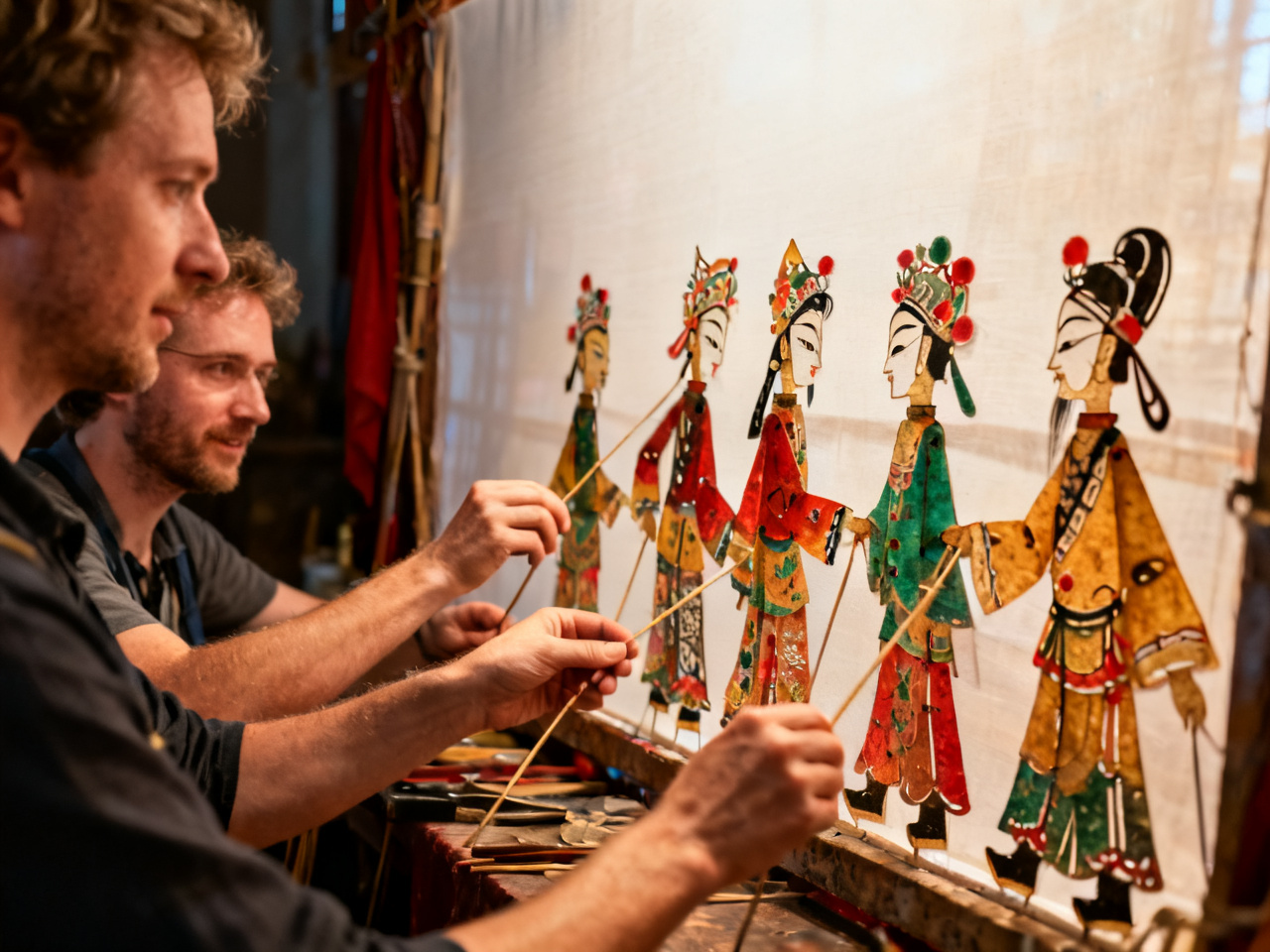
I also loved the sense of “order inside liveliness” backstage. Before seeing it, I had imagined the area behind the screen as something quiet and mysterious, almost like a museum conservation room where everyone speaks softly and moves slowly. The reality was different. Backstage was full of life. There were many small sounds: rods lightly touching each other, the rustle of material when puppets were turned, instrument testing, a quick clearing of the throat, a subtle shift of feet, performers confirming the next cue. Yet although there were many sounds, there was no chaos. Everyone knew when to enter, when to wait, when to give a little space, and when to push the rhythm forward. As an outsider watching this coordination, I was reminded of ports, kitchens, markets, or any workplace that looks busy from the outside but is held together by powerful internal order. In that moment, folk art stopped feeling abstract to me. It became a real technique of collaboration.
后来我回到观众席,再看正式演出时,感受已经完全不同了。幕布前面依然是我熟悉的那个“好看”的世界:人物出场,颜色明亮,唱腔悠长,打斗热闹,观众会在精彩处轻轻惊呼或者笑出来。但因为我已经见过幕后,所以这份“好看”有了厚度。我知道一位人物抬手的背后,可能是两三根杆同时被准确控制;我知道一句唱腔拖长,不只是为了好听,也可能是在给动作转换留呼吸;我知道看似轻巧的一次转身,其实需要灯光位置、手腕方向、人物角度都刚好配合。正因为知道它有多不容易,我反而看得更投入。很多传统表演在游客眼里容易变成一种表面印象:古老、漂亮、有地方特色。但当你看见它是怎么被完成的,你会失去一点轻飘飘的浪漫,换来一种更深的尊重。
Later, when I returned to the audience and watched the full performance, the experience had completely changed. In front of the screen, it was still the beautiful world I expected: characters entering in bright color, long melodic singing, lively combat scenes, audience members gasping or laughing at the right moments. But because I had already seen backstage, that beauty now had weight. I knew that a single lifted arm might require two or three rods to be controlled precisely at once. I knew that a stretched vocal line was not only musical beauty but might also be giving breathing space to a transition in movement. I knew that a turn that looked effortless probably required the lamp position, wrist direction, and puppet angle to align perfectly. Because I knew how difficult it was, I became even more absorbed. Many traditional performances can easily become surface impressions in the eyes of tourists: old, pretty, local, memorable. But once you see how they are actually made, a little of the floating romance disappears and is replaced by a deeper respect.
如果要用日记的方式记下那一晚,我会写:今天我第一次明白,皮影戏不是“影子”本身,而是制造影子的那整套知识。它是雕刻,也是连接;是绘色,也是照明;是唱,也是听;是手上的细功,也是身体里的节奏感。作为一个土耳其人,我本来以为自己对影子戏不会太陌生,毕竟 Karagöz 也是我成长文化里很重要的一部分。但正因为我带着这种熟悉感来到这里,最后受到的触动反而更大。相似让我更容易靠近,差异让我真正产生敬意。我在中国看到的不是一种“异国版本”的影子戏,而是一套完整而成熟、和本地历史审美紧密相连的舞台传统。
If I had to record that night in diary form, I would write this: today I understood for the first time that shadow puppetry is not the shadow itself, but the whole body of knowledge required to make the shadow live. It is carving, but also joining; coloring, but also lighting; singing, but also listening; delicate hand technique, but also rhythm stored in the body. As a Turk, I had assumed I would not find shadow theater too unfamiliar, because Karagöz is also an important part of the culture I grew up around. But precisely because I came here with that sense of familiarity, I was affected even more deeply. Similarity helped me approach it; difference taught me respect. What I saw in China was not simply a foreign version of shadow theater, but a complete and mature stage tradition deeply tied to local history and aesthetics.
演出结束后,我又慢慢走到后台口看了一眼。灯暗了,幕布不再发光,刚才在白布上奔跑、挥刀、转身、唱念的人物,现在安静地挂回架子上,像忽然睡着了一样。那一瞬间我觉得很动人。舞台上的魔法消失得很快,留下来的却是实实在在的工具、材料和练习的痕迹。也许这正是我最喜欢的旅行时刻:不是只看见成品,而是看见成品背后的人怎样工作。对游客来说,一场皮影戏可能只占去夜晚的一小时;但对那些艺人来说,这一小时背后可能是很多年的手上功夫、嗓子训练、默契配合和重复排练。想到这里,我就更能理解为什么这种艺术值得被认真保护。保护它,不只是保存几个漂亮的影偶,而是保存让它们在光里活起来的方法。
After the performance, I slowly walked back toward the backstage entrance and took one more look. The lamp had dimmed, the screen no longer glowed, and the figures that had just been running, fighting, turning, singing, and speaking across the white cloth were now hanging quietly on their rack, as if they had suddenly fallen asleep. I found that moment deeply moving. The magic of the stage vanished quickly, but what remained were the real tools, materials, and marks of practice. Perhaps this is exactly the kind of travel moment I love most: not only seeing the finished result, but seeing how people work behind it. For a tourist, one shadow play may take only an hour of an evening. But for the performers, that hour may rest on many years of hand technique, vocal training, coordination, and repeated rehearsal. Thinking of that, I understand even more clearly why this art deserves serious protection. To protect it is not only to preserve beautiful puppets, but to preserve the methods that make them come alive in the light.
如果以后有人问我,在中国看过哪一种传统艺术最让我改观,我很可能会提到这次皮影戏后台体验。因为它改变的不是我的“知识”,而是我的观看方式。以前我会先被表面的美吸引;现在我会下意识地去想,光从哪里来,声音怎么接上动作,手在幕后怎样把一个平面角色变得有重量、有脾气、有故事。也许这就是一场真正好的传统表演能带给外国人的东西:它不要求你先完全懂它,却能让你在某个瞬间真切地感到,自己正站在一种长期积累的人类技艺面前。而那一晚,站在中国皮影戏的幕布后面,我确实有了这种感觉。
If someone asks me in the future which traditional art form in China most changed the way I see things, I will very likely mention this backstage shadow puppetry experience. Because what it changed was not just my knowledge, but my way of looking. Before, I would be drawn first by surface beauty. Now I instinctively ask where the light comes from, how the sound meets the movement, and how the hands behind the screen turn a flat figure into something with weight, temper, and story. Perhaps that is what a truly great traditional performance can offer a foreign visitor: it does not require you to understand everything in advance, yet in one moment it can make you feel with complete clarity that you are standing before a long-accumulated human skill. And that night, behind the screen of Chinese shadow puppetry, I truly felt that.

- 在社区修理铺门口等十分钟,我才明白中国人为什么总说“先看看能不能修” | Waiting Ten Minutes Outside a Neighborhood Repair Shop, I Finally Understood Why People in China Always Say, “Let’s See If It Can Be Fixed First”
- 菜市场早餐和街边小吃的点单经验 | What I Learned Ordering Breakfast and Street Snacks Beside a Chinese Wet Market
- 我在中国高铁上学会安静地分享空间,不是靠规则,而是靠先读懂别人的节奏 | On a Chinese High-Speed Rail Trip, I Learned to Share Space Quietly Not Through Rules, but by Reading Other People’s Rhythm First
- 我在大理的风里,重新听见自己说话 | In Dali’s wind, I heard myself speak clearly again
- 云南雨季反向玩法:人少、景美、预算可控 | Yunnan in Rainy Season: Fewer Crowds, Better Value
- 扬州早茶不是一张菜单:我在园林之间学会给一顿饭留时间 | Yangzhou Morning Tea Is Not Just a Menu
- 灯彩作坊里的一小时:我第一次发现光也可以被“做出来” | In a Lantern Workshop: The First Time I Realized Light Can Be Crafted by Hand
- 一锅潮汕牛肉的时间表:从早市吃到深夜粿条 | The Timetable of Chaoshan Beef: From Morning Market to Late-Night Noodles
- 脸谱绘制体验:我第一次明白一张脸为什么可以先于台词说话 | Opera Face-Painting Workshop: My First Time Understanding How a Face Can Speak Before the Lines
- 中国送礼学问 | The Art of Gift Giving in China
Comments (0)