
漆扇体验之后,我第一次发现“流动的颜色”也能有秩序 | After Trying Lacquer Fans, I Realized for the First Time That Flowing Color Can Also Have Order
漆扇体验之后,我第一次发现“流动的颜色”也能有秩序 | After Trying Lacquer Fans, I Realized for the First Time That Flowing Color Can Also Have Order
- 编号: 15
- 类别: 6
- 主题: 民艺 / Folk Art
- 对比国家: 日本
如果不是亲手做过一次漆扇,我大概会一直把它理解成一种“看起来很漂亮的旅游手作”。扇子本来就容易给人留下优雅、轻巧、适合夏天的印象,而“漆”这个字又天然带着一点精致和传统感。所以在走进体验空间之前,我其实并没有意识到,这门手艺最迷人的地方并不只是成品,而是颜色在水面上流动、相遇、被捕捉的那个过程。作为一个来自日本的外国人,我原本以为自己对扇子和漆艺都不算陌生,可真正开始做中国漆扇之后,我还是很快发现:这里最动人的,不是单纯的装饰,而是把偶然慢慢变成了审美。
If I had not made a lacquer fan with my own hands, I probably would have kept thinking of it as simply a beautiful tourist craft. A fan already carries associations of elegance, lightness, and summer, while the word “lacquer” naturally suggests refinement and tradition. So before entering the workshop, I did not fully understand that the most fascinating part of this craft lies not only in the finished object, but in the moment when colors flow across water, meet one another, and are captured. As a foreigner from Japan, I had assumed I was not unfamiliar with either fans or lacquerwork. But once I began making a Chinese lacquer fan, I quickly realized that what moves me most here is not decoration alone. It is the way chance is slowly turned into aesthetics.
真正站到水盆前时,我才知道“配色”原来不是最难的 | Only when I stood before the basin did I realize that color choice is not the hardest part
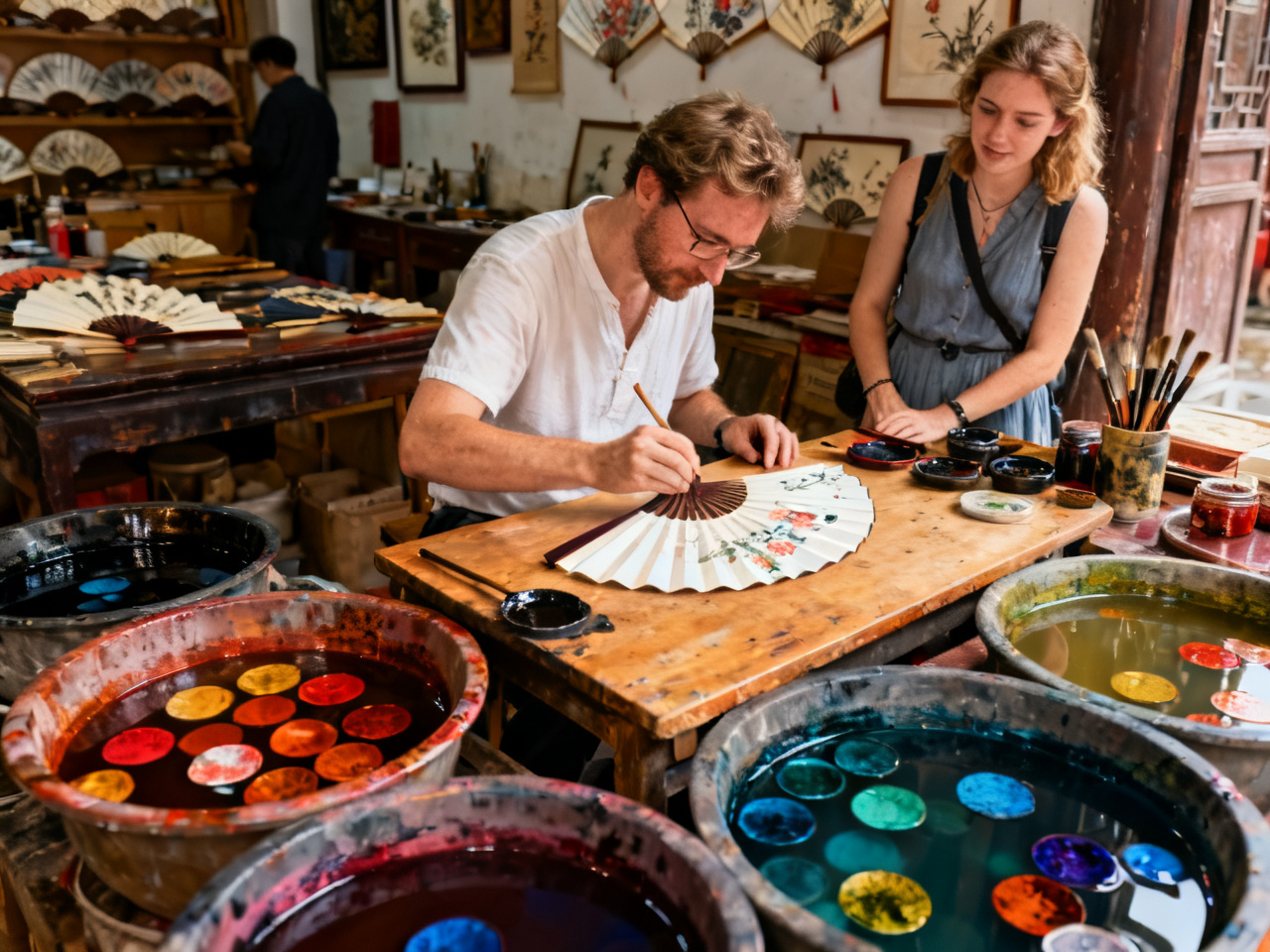
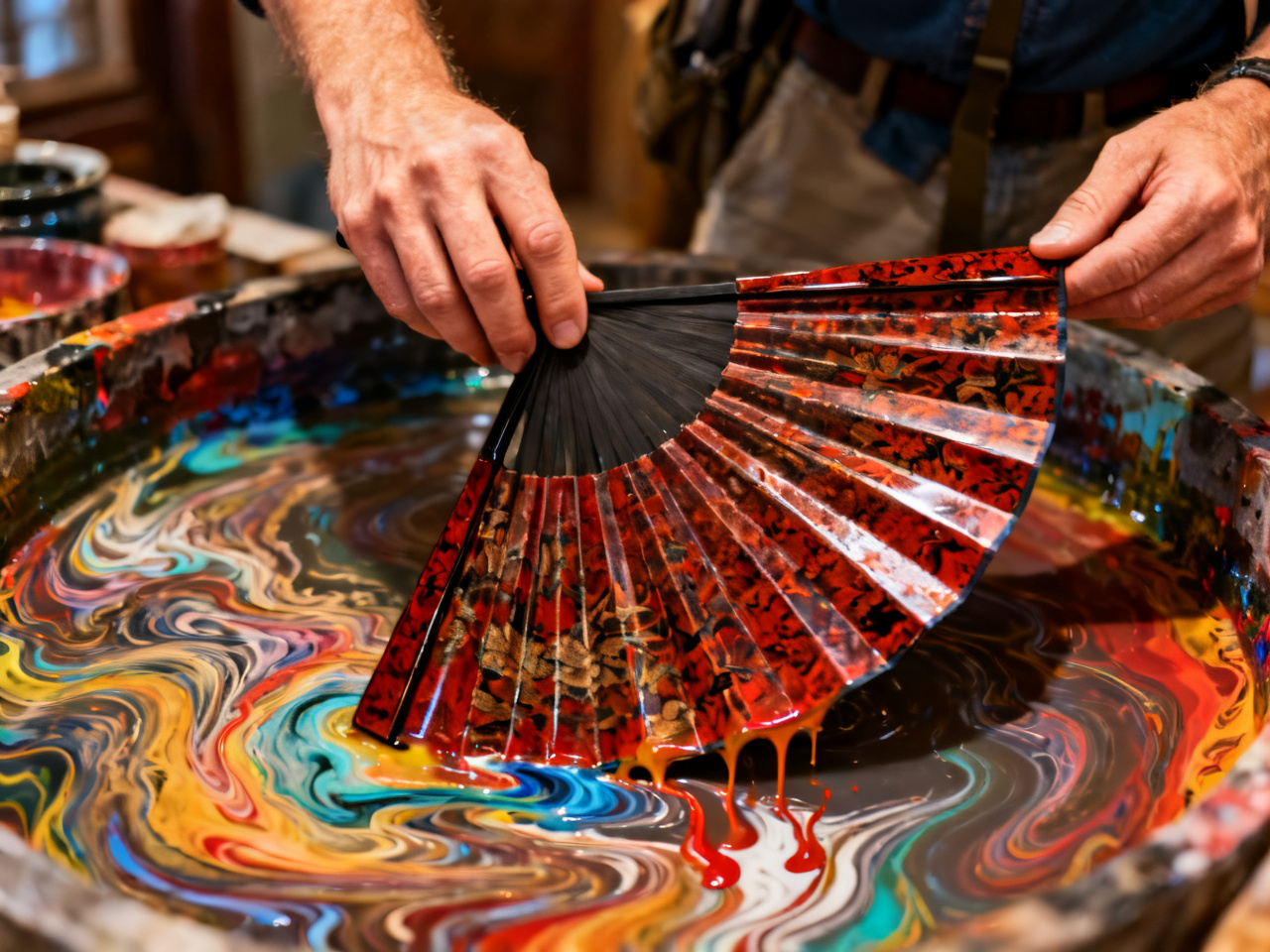
老师先给我们看示范。她把几种漆色依次点进水里,颜料没有立刻沉下去,而是在表面缓缓散开,像云、像烟,也像被风推着走的花瓣。接着她用小工具轻轻一拨,几条颜色立刻开始相互追逐,水面一下子有了纹路和方向。最后,她把白色扇面稳稳压下去,再轻轻提起,一幅完整的流纹就附着在扇子上了。整个过程其实只用了很短时间,可我站在旁边时完全没有觉得那是“简单”。因为每一步都带着一种不能重来的紧张感。
The instructor first demonstrated the process for us. She dropped several lacquer colors into a basin of water one after another. The pigments did not sink immediately, but slowly spread across the surface like clouds, smoke, or petals pushed by a breeze. Then she used a small tool to guide them lightly, and the colors at once began to chase one another, giving the water pattern and direction. Finally, she pressed a white fan surface down in one steady motion and lifted it again, and a complete flowing design had attached itself to the fan. The whole process took only a short time, yet I never felt it was simple. Every step carried the tension of something that cannot be repeated in exactly the same way.
轮到我自己动手时,我本来最担心的是颜色会不会搭配得太乱。结果真正难的根本不是“选什么颜色”,而是你有没有办法在颜色开始流动之后,不急着去把它们全部控制住。我一开始下意识地总想多拨几下,觉得也许这样图案会更丰富。可老师马上提醒我,漆扇最怕贪心。颜色一旦被扰得太多,原本自然的呼吸感就会消失,最后只剩下混浊和拥挤。那句话我记得特别清楚,因为它几乎一下子点出了这门手艺的核心:不是把一切做满,而是在最合适的时候停手。
When it was my turn, I thought my biggest problem would be whether I could choose colors well. But the real difficulty had nothing to do with selecting colors. It was whether, once the colors began to move, I could resist the urge to control all of them. At first I instinctively wanted to drag the pattern around a few extra times, thinking that might make it richer. But the instructor immediately reminded me that lacquer fans suffer most from greed. Once the colors are disturbed too much, their original breathing space disappears, and what remains is only muddiness and crowding. I remember that sentence vividly because it revealed the heart of the craft almost at once: the point is not to fill everything, but to know when to stop.
最吸引我的,是它既有偶然性,又特别讲分寸 | What attracted me most was that it combines chance with discipline
我一直很喜欢那些带一点不可预测性的手工艺,因为它们会让人觉得材料本身也在参与创作。漆扇正是这样。你当然可以决定大致的色调、方向和节奏,但最后落到扇面上的纹路,仍然会保留一点水的脾气、漆的脾气,还有手势轻重之间的差别。也就是说,你不是在命令图案出现,而是在和流动中的材料一起协商一个结果。对我这样的旅行者来说,这种感觉特别新鲜。它让我意识到,有些民艺真正珍贵的地方,不在于百分之百复制出某个标准答案,而在于每一次成形都带着一点“只属于这一次”的诚实。
I have always been drawn to crafts that contain some element of unpredictability, because they make the material itself feel like an active participant. Lacquer fans are exactly like that. Of course you can decide the general palette, direction, and rhythm, but the final pattern that lands on the fan still preserves something of the water’s temperament, the lacquer’s temperament, and the difference in pressure created by each gesture. In other words, you are not commanding an image to appear. You are negotiating a result together with moving material. For a traveler like me, that felt especially fresh. It made me realize that the real value of some folk crafts does not lie in reproducing a single standard answer perfectly, but in the honesty of each result belonging to one unrepeatable moment.
我后来做第二把的时候,明显比第一把克制了很多。第一把总想“再加一点”,第二把反而开始接受留白和不完全对称。结果很有意思:后者看上去比前者更松,也更耐看。那时我突然明白,漆扇为什么会让人上瘾。因为它表面上像是在玩颜色,实际上练的是判断力。你必须学会什么时候继续,什么时候等待,什么时候承认“已经够了”。这种训练非常温柔,却也非常直接。
When I made a second fan, I was clearly more restrained than with the first. With the first one, I kept wanting to add just a little more. With the second, I began to accept empty space and asymmetry. The result was interesting: the second fan looked looser and was much more pleasant to keep looking at. At that moment I suddenly understood why lacquer fans can become addictive. On the surface, it seems like a craft about playing with color. In reality, it trains judgment. You have to learn when to continue, when to wait, and when to admit that enough is enough. It is a gentle lesson, but also a very direct one.
它让我想到日本的漆器与扇文化,但表达方式完全不同 | It reminded me of Japanese lacquerware and fan culture, yet the mode of expression is completely different
因为我来自日本,我在做漆扇的时候,几乎不可能不联想到自己熟悉的漆器和扇子传统。日本当然也非常重视漆。无论是碗、盒、托盘,还是更讲究的工艺品,漆在日本常常给人一种很深、很稳、很内敛的感觉。我们也有自己的扇文化,折扇、团扇、能乐或茶道相关的用扇经验,都让扇子不仅是日常用品,也是一种带着礼仪和审美意味的物件。所以在来中国之前,我原本以为“漆”和“扇”的组合,对我来说应该不会太陌生。
Because I come from Japan, it was almost impossible for me not to think of the lacquerware and fan traditions I know from home while making a lacquer fan. Japan, of course, also places great importance on lacquer. Whether on bowls, boxes, trays, or more elaborate craft pieces, lacquer in Japan often gives an impression of depth, steadiness, and restraint. We also have our own fan culture. Folding fans, round fans, and fan use connected to Noh performance or tea practice make the fan not merely an everyday object, but something tied to etiquette and aesthetic meaning. So before coming to China, I assumed that the combination of lacquer and fan would not feel especially unfamiliar to me.
可真正体验之后,我还是感到很明显的差别。日本漆艺常让我先想到层层积累、表面光泽、细节修整,以及一种比较沉静的完成度;而这次中国漆扇最先打动我的,却是“流动中的生成感”。它不把所有美都压在最后那层平整和打磨上,而是让水纹、晕染和自然展开的轨迹直接成为主角。日本很多漆器之美更像是把时间慢慢压进表面,中国漆扇给我的感觉则更像是把一瞬间的变化留在扇面上。一个偏向沉着的凝聚,一个偏向轻盈的展开,我都很喜欢,但性格确实不一样。
But after truly experiencing it, I still felt a clear difference. Japanese lacquer art often makes me think first of layered accumulation, surface gloss, careful finishing, and a rather quiet sense of completeness. What moved me first in this Chinese lacquer fan workshop, by contrast, was the feeling of formation within movement. It does not place all beauty in the final stage of smoothness and polishing. Instead, it allows water patterns, diffusion, and naturally unfolding trajectories to become the main actors. The beauty of many Japanese lacquer objects feels as if time has been pressed slowly into the surface. Chinese lacquer fans, to me, feel more like preserving a passing transformation upon the fan. One leans toward composed concentration; the other toward airy unfolding. I love both, but their characters are undeniably different.
漆扇最打动我的,是它把“不可复制”变成了一种礼物 | What touched me most was the way it turns irreproducibility into a gift
旅行的时候,我们总会下意识地想买一些“最好和别人一样好看”的纪念品,仿佛标准化就比较保险。可漆扇刚好相反。哪怕同样的颜色、同样的动作、同样的扇面,也不可能做出两把完全一样的作品。起初我还担心这一点,怕自己做出来的纹路不够“标准”。但等真的把成品拿在手里,我反而觉得这正是它最值得珍惜的地方。因为你看到的不是一个被完美复制的样式,而是那天的水、那天的手势、那天的犹豫和判断,最后一起留下来的痕迹。
When we travel, we often instinctively want souvenirs that look reliably beautiful in the same way for everyone, as if standardization were safer. Lacquer fans are the opposite. Even with the same colors, the same motions, and the same fan surface, it is impossible to create two completely identical pieces. At first that worried me. I was afraid the pattern I made would not look “standard” enough. But once I held the finished fan in my hand, I felt that this was exactly what made it precious. What I was seeing was not a perfectly replicated style, but the trace left by that day’s water, that day’s gestures, and that day’s hesitation and judgment all together.
而且扇子这种载体本身也很特别。它不是单纯挂在墙上的装饰,而是可以被打开、合上、拿在手里、带着风一起使用的东西。也就是说,漆扇上的图案不是固定地给你看,而是会随着开合、角度和光线变化,呈现不同的表情。这个特点让我觉得它比很多平面的手作更有生命感。它不是一张静止的画,而是一件会跟身体动作发生关系的小型器物。
The fan itself is also a special kind of object. It is not merely a decoration to hang on a wall. It can be opened, closed, held in the hand, and used together with air and movement. That means the pattern on a lacquer fan is not presented in a fixed way. It changes with the opening angle, with the light, and with the movement of the wrist. This made it feel more alive to me than many flat crafts. It is not a static picture, but a small object that enters into relationship with the body.
如果你在中国旅行时遇到漆扇,我很建议你亲手做一次 | If you come across lacquer fan making while traveling in China, I strongly recommend trying it yourself
现在如果有朋友问我,哪一种中国民艺最容易让外国人同时理解“颜色的自由”和“分寸的必要”,我大概就会推荐漆扇。因为它一开始看起来门槛不高,甚至有点像一场轻松的色彩游戏;可你一旦真正把扇面压进水里,再把它提起来,就会立刻明白,这门手艺远不只是“好看”而已。它教你的不是如何追求复杂,而是如何在变化里看见秩序,在偶然里学会克制。
If friends now ask me which Chinese folk craft best helps a foreigner understand both the freedom of color and the necessity of restraint, I would probably recommend lacquer fans. At first, the threshold looks low. It even seems a bit like a relaxed game of color. But once you actually lower the fan into the water and lift it back up, you immediately understand that this craft is far more than simply making something pretty. What it teaches is not how to chase complexity, but how to recognize order within change and learn restraint within chance.
对我这个来自日本、原本以为自己已经很熟悉扇子和漆艺的人来说,中国漆扇最珍贵的地方,不是让我见到一种完全陌生的材料,而是让我重新理解了“轻”和“雅”原来还可以这样结合。它没有用很重的姿态展示传统,反而通过一把能拿在手里的扇子,让我看见颜色如何流动,审美如何停手,手艺如何在短短几分钟里把偶然变成值得纪念的东西。离开的时候,我拿着自己做的那把漆扇,一边觉得它很轻,一边又觉得它把那天下午的水纹和心情都认真留住了。
For me, as someone from Japan who had assumed I already knew fans and lacquer fairly well, the most precious part of Chinese lacquer fans was not that they introduced me to a completely unfamiliar material. It was that they made me understand again how lightness and elegance can be joined in a different way. This craft does not display tradition with heavy solemnity. Instead, through a fan that can be held in the hand, it shows how color flows, how aesthetics knows when to stop, and how craft can turn chance into something memorable within only a few minutes. When I left, holding the lacquer fan I had made, I felt that it was physically very light, and yet somehow it had carefully preserved the water patterns and mood of that entire afternoon.
- 第一次在中国社区医院挂普通门诊,我先学会的不是看病,而是先找分诊台 | The First Thing I Learned at a Chinese Community Hospital Was Not the Consultation, but Finding Triage First
- 重阳登高:全国最美山岳推荐 | Chongyang Hiking: China's Most Beautiful Mountains
- 中国丝绸制品 | Silk Products from China
- 西藏:世界屋脊 | Tibet: The Roof of the World
- 陪妈妈在无锡看五月太湖烟雨,我终于学会听她慢慢讲年轻时的事 | Walking with My Mother Through Taihu Mist in Wuxi, I Finally Learned to Listen to Her Younger Stories Slowly
- 宁波码头边的海鲜饭,不是菜单教会我的 | Seafood Rice Beside a Ningbo Pier Was Not Something the Menu Taught Me
- 配饰指南:扇子、帽子等 | Accessories: Fans, Hats, and More
- 中国街头小吃十选:从北到南,一路吃过去 | Ten Chinese Street Snacks: Eating Your Way from North to South
- 十二月的中国:北方玩雪,南方过冬 | December in China: Snow Up North, Warmth Down South
- 第一次在中国地铁安检口,我学会把保温杯先拿在手上 | The First Time at a Chinese Metro Security Check, I Learned to Hold My Thermos Before I Reached the Belt
Comments (0)