
刺绣体验:我第一次发现“安静”也可以有这么强的存在感 | Embroidery Workshop: The First Time I Realized Quietness Could Have Such a Strong Presence
刺绣体验:我第一次发现“安静”也可以有这么强的存在感 | Embroidery Workshop: The First Time I Realized Quietness Could Have Such a Strong Presence
- 编号: 08
- 类别: 6
- 主题: 民艺 / Folk Art
- 对比国家: 印度
我以前对刺绣的印象其实有一点肤浅。作为一个来自印度的外国人,我当然知道针线装饰可以多么华丽:节庆服饰上的金线、镜片、鲜亮颜色和密集纹样,常常远远看去就已经很有气场。所以刚到中国、第一次听说可以参加刺绣体验时,我心里想的还是“应该会很好看”。可真正坐到绣架前,看老师把一根细丝线慢慢分开、穿针、落下、再轻轻拉紧时,我才意识到,中国刺绣最先抓住人的,不是热闹,而是一种非常克制、非常稳定的安静感。它不是一下子向你扑过来的美,而是要你靠近一点、慢一点,才肯把细节交出来。
Before this, my impression of embroidery had been somewhat superficial. As a foreigner from India, I already knew how spectacular needlework decoration could be: metallic threads, mirrors, bright colors, and dense patterns on festive clothing can create a powerful presence from a distance. So when I first heard in China that I could join an embroidery workshop, I simply thought, this should be beautiful. But once I actually sat in front of an embroidery frame and watched the instructor separate a fine silk thread, thread the needle, lower it, and gently pull it through, I realized that what first captures you in Chinese embroidery is not spectacle, but a remarkably restrained and steady quietness. Its beauty does not rush toward you. It asks you to come closer and slow down before it reveals itself.
真正坐下来之后,我才知道“细”不是这门手艺最难的地方 | Once I sat down, I realized that fineness is not the hardest part of this craft
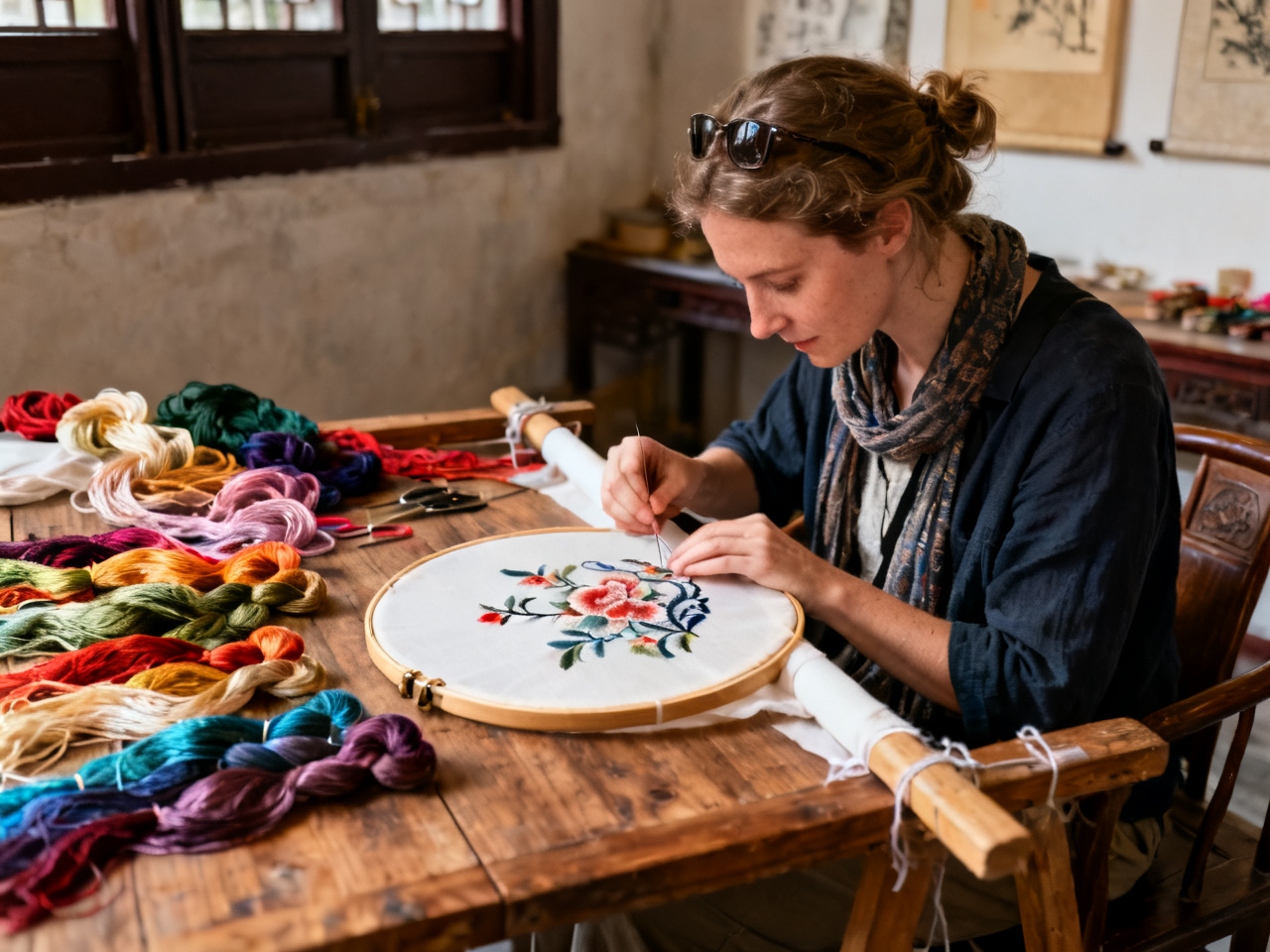
体验桌上放着绣绷、底布、绣样、小剪刀和一束束颜色很近、但又并不完全相同的丝线。老师先没有让我急着开始绣花瓣,而是让我观察已经完成的一小块样本。她让我从侧面看,说不要只看图案像不像,要看线的方向、光泽怎么变化、边缘是不是硬、颜色是不是一下子断开。那几分钟对我很重要,因为我第一次明白,刺绣并不是“把图案缝上去”那么简单。它更像是在布面上重新安排光线,让丝线代替颜料去表达明暗、层次和空气感。
On the table were hoops, base fabric, pattern guides, tiny scissors, and bundles of silk threads in colors so close to each other that I could barely distinguish them. The instructor did not ask me to start stitching petals immediately. Instead, she showed me a small finished sample and asked me to study it. She told me to look from the side, not only to judge whether the motif was recognizable, but to notice the direction of the threads, the shifting sheen, whether the edges felt hard, and whether the colors broke too suddenly. Those few minutes mattered a lot to me, because for the first time I understood that embroidery is not simply about sewing a pattern onto cloth. It is more like rearranging light on a surface, letting thread replace paint in order to express shade, layering, and air.
等到我自己真正开始动手,挫败感来得比想象中更快。老师给我选的是一个相对基础的花叶图案,面积不大,针法也不算最复杂,可我第一针下去就知道麻烦来了。线如果拉得太紧,布面会发皱;太松,又会浮起来。针脚长一点,表面就显得毛躁;针脚短一点,我又很容易失去方向。更难的是,刺绣不像画画那样可以退后一步“大致修改”,它要求你的耐心在每一针上都成立。那种感觉很特别,好像你不是在做一幅图,而是在和时间谈判。
When I finally began, frustration arrived faster than I expected. The instructor chose a relatively basic floral-and-leaf motif for me. It was not large, and the stitch technique was not the most complex, yet the moment I placed my first stitch I knew I was in trouble. If I pulled the thread too tight, the fabric puckered. If I left it too loose, it floated. If the stitch was slightly longer, the surface looked rough. If it was shorter, I lost my sense of direction. What was even harder was that embroidery does not allow the kind of broad correction that painting sometimes does. It demands that your patience be valid in every single stitch. The feeling was unusual, as if I were not making an image but negotiating with time.
我最佩服的,是它能把颜色做得像呼吸一样自然 | What impressed me most was the way it makes color feel as natural as breathing
老师给我示范叶片部分时,我几乎是立刻安静下来了。她没有用一种绿色直接绣完,而是拿出几种深浅不同、冷暖也略有区别的线,一层层往里压。远看时,那片叶子并不夸张,甚至显得很含蓄;可一旦靠近,你会发现它不是“平”的,而是有转折、有湿润感、有像风刚刚吹过一样的轻微起伏。我那时才突然理解,为什么很多人说中国刺绣有一种接近绘画的气质。它当然不是画,但它确实能用针线做出类似渲染和过渡的效果,而且这种效果带着丝线特有的光。
When the instructor demonstrated the leaf section, I became quiet almost immediately. She did not complete it with a single green thread. Instead, she took out several shades, some darker, some lighter, some cooler, some warmer, and layered them gradually into one another. From a distance the leaf was not dramatic. In fact, it looked rather restrained. But once I leaned closer, I saw that it was not flat at all. It had turning points, moisture, and the faint undulation of something just touched by wind. At that moment I suddenly understood why people often say Chinese embroidery has a quality close to painting. It is not painting, of course, but it can produce something like gradation and wash through needle and thread, while also carrying the unique sheen of silk.
我还注意到一件很有意思的事:这门手艺并不急着炫耀自己。很多民艺会在第一眼就把力量释放出来,比如强烈的色彩、夸张的造型、明显的节庆气氛;可刺绣常常相反。它要求你先停下来,再慢慢发现。你先看到的是完整图案,接着开始看针脚方向,然后才看见颜色之间那些几乎不动声色的过渡。它有点像一段说得很轻的话,声音不大,但你反而会为了听清楚而更认真。
I also noticed something else that fascinated me: this craft does not hurry to show off. Many folk arts release their force at first glance through strong color, dramatic shape, or obvious festive atmosphere. Embroidery often does the opposite. It asks you to pause first and then discover slowly. You see the whole motif, then begin to notice the direction of the stitches, and only later recognize the nearly silent transitions between one color and another. It feels a bit like a sentence spoken softly. The voice is not loud, but that is precisely why you listen more carefully.
它让我想到印度刺绣,但两种美感的表达方向很不一样 | It reminded me of Indian embroidery, yet the direction of beauty feels very different
因为我来自印度,我很自然会把中国刺绣和自己熟悉的传统放在一起比较。印度很多刺绣首先给人的印象是热烈。无论是服装、节庆布料,还是区域性的针线传统,常常都更愿意使用高对比的颜色、重复而饱满的图案,甚至加入金属线、亮片或镜片,让布面在光里主动发声。那种美很直接,也很有庆典感。它经常与身体移动、婚礼场景、公共节日和社群气氛连在一起。
Because I come from India, I naturally compare Chinese embroidery with traditions I know from home. In many forms of Indian embroidery, the first impression is warmth and exuberance. Whether in clothing, ceremonial textiles, or regional needlework traditions, there is often a greater willingness to use high-contrast colors, repeated and full-bodied motifs, and even metallic threads, sequins, or mirrors so that the fabric speaks actively in the light. That beauty is direct and festive. It is often tied to movement of the body, wedding scenes, public celebrations, and communal atmosphere.
中国刺绣给我的感受则更偏内收。它当然也可以华美,但它的华美常常不是往外扩张的,而是往细节里沉下去的。你会注意到花瓣边缘怎样一点点变浅,鸟羽怎样靠针脚方向做出柔顺感,水面怎样因为线的排列不同而显得安静。也就是说,印度刺绣常让我先感受到“热情”,中国刺绣则更容易让我先感受到“分寸”。两者都很动人,只是一个更像庆典中的音乐,一个更像窗边被光照到的一片叶子。
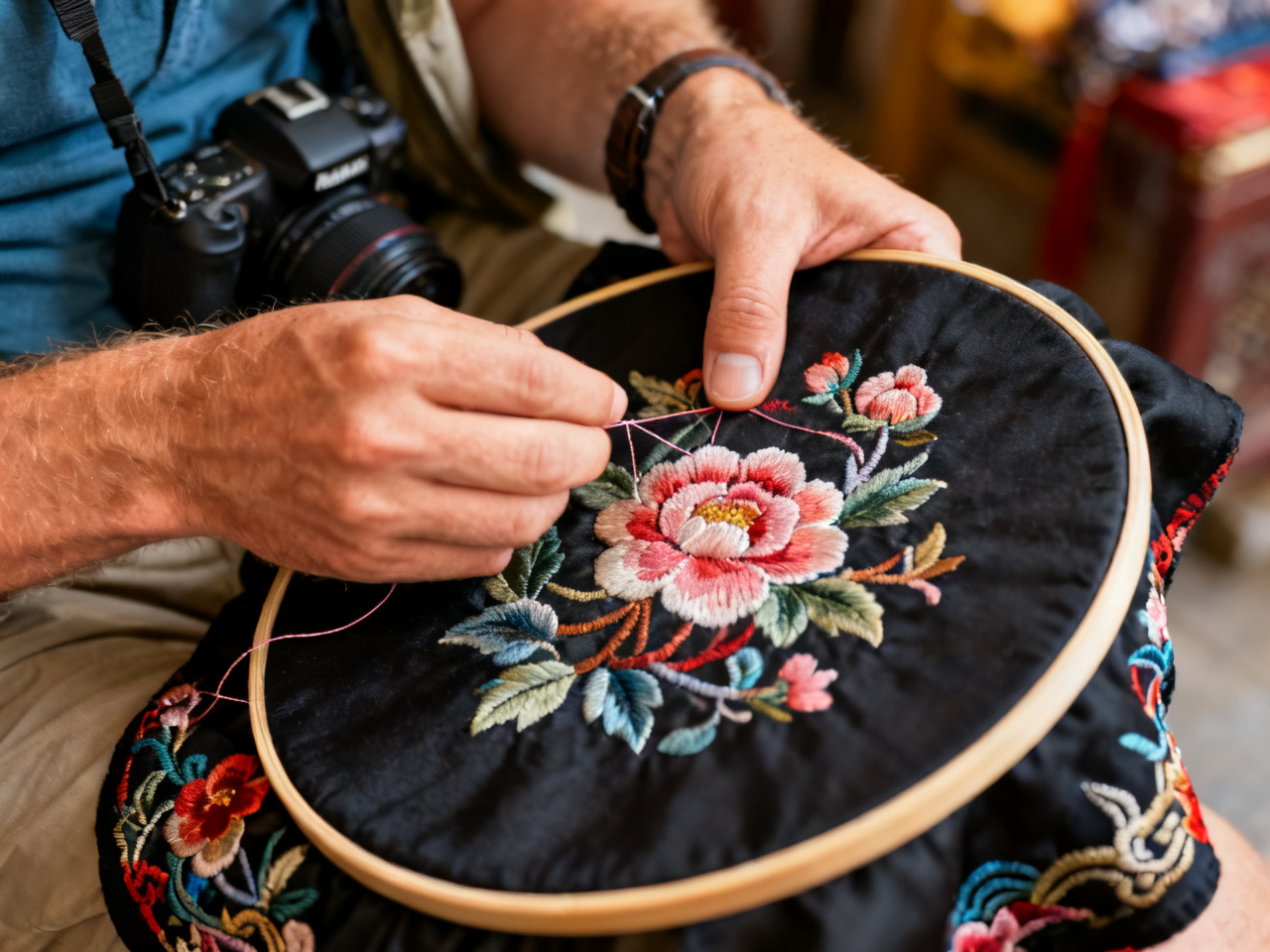
Chinese embroidery, by contrast, feels more inward to me. It can certainly be sumptuous, but its richness often does not expand outward. Instead, it sinks into detail. You notice how the edge of a petal gradually becomes lighter, how the direction of stitches makes a bird’s feathers feel soft, or how water appears calm because the threads are laid in a particular order. In other words, Indian embroidery often makes me feel enthusiasm first, while Chinese embroidery more readily makes me feel measure. Both are moving, but one resembles music in a celebration, while the other feels more like a leaf by a window touched by light.
如果旅行时遇到刺绣,我建议你一定要想办法靠近看 | If you encounter embroidery while traveling, I strongly recommend finding a way to see it up close
很多人看刺绣会犯一个很自然的错误,就是站得太远,把它当成一张已经完成的图来欣赏。可我这次体验之后最强烈的感受,就是刺绣不能只远看。你最好靠近一些,甚至换个角度,让丝线吃到光。那时你才会发现,有些地方看上去像一小片阴影,实际上是很多针脚方向共同造成的;有些地方像颜色天然地化开,其实背后是很精细的层层压线。如果能现场看老师绣几针,效果更明显,因为你会立刻知道这份“安静”并不是轻松得来的。
Many people make a very natural mistake when looking at embroidery: they stand too far away and admire it only as a finished image. But the strongest lesson I took from this workshop is that embroidery must not be seen only from a distance. You should come closer, perhaps shift your angle, and let the silk catch the light. Only then do you realize that what looked like a small shadow may actually be the result of many stitch directions working together, and what seemed like a naturally melting color transition may hide meticulous layered stitching underneath. If you can watch an instructor make even a few stitches in person, the effect becomes even clearer, because you immediately understand that this quietness was not achieved easily.
如果有机会亲手试一试,我也非常推荐。哪怕你最后只绣出很小的一片叶子,甚至针脚还有点歪,你也会一下子理解这门手艺为什么值得被尊重。旅行里我们常常容易被那些“大”的东西吸引:大建筑、大表演、大节庆;但刺绣提醒我,文化里还有一种力量来自极小的控制。它不喧哗,却能让人记很久。
If you have the chance to try it yourself, I would strongly recommend it. Even if you finish only a tiny leaf, and even if your stitches remain a bit crooked, you will immediately understand why this craft deserves respect. When we travel, we are often drawn to things that are large: great buildings, major performances, grand festivals. Embroidery reminded me that culture also contains a different kind of force, one that comes from extremely small acts of control. It does not make noise, yet it stays with you for a very long time.
为什么这次刺绣体验会一直留在我的旅行记忆里 | Why this embroidery experience will stay in my travel memory
离开作坊的时候,我带走的其实不只是那块练习布。我更像是带走了一种新的观看方式:原来“精细”并不只是技术形容词,它也可以是一种审美态度,一种对速度的反抗,一种愿意把心思慢慢放进表面的生活方法。对我这个来自印度、原本更熟悉热烈针线传统的人来说,中国刺绣最珍贵的地方,恰恰是它让我看见了另一种成立的美——不靠拥挤,不靠喧闹,而是靠耐心、节制和近距离才会显现的光。
When I left the workshop, what I carried away was not only a small practice cloth. I felt that I was carrying a new way of looking. I realized that fineness is not merely a technical adjective. It can also be an aesthetic attitude, a quiet resistance to speed, and a way of placing thought slowly into surface. For someone like me, coming from India and more accustomed to vivid and festive needlework traditions, the most precious thing about Chinese embroidery was precisely this: it showed me another kind of beauty that can fully exist—one that relies not on density or noise, but on patience, restraint, and a light that only appears when you come close.
- 少数民族服饰巡礼:苗族藏族彝族 | Ethnic Minority Costumes: Miao, Tibetan & Yi
- 重阳登高:全国最美山岳推荐 | Chongyang Hiking: China's Most Beautiful Mountains
- 春节民俗全攻略:年夜饭到庙会 | Spring Festival Guide: New Year Dinner to Temple Fairs
- 青岛海边的雾气,让我把拍照计划改成了散步计划 | Sea Fog in Qingdao Turned My Photo Plan into a Walking Plan
- 广东广西10日海陆游 | 10-Day Guangdong-Guangxi Sea & Land Tour
- 桂林那晚,老板娘一句“别搜了”比榜单更会点菜 | In Guilin, the Owner’s “Stop Searching” Guided Dinner Better Than Any List
- 苏州夜里最珍贵的经验,常常不是多走一座桥,而是在最好看的地方及时收住 | The Most Valuable Lesson in Suzhou at Night Is Often Not One More Bridge but Knowing When to Stop at the Beautiful Moment
- 在上海弄堂里学会慢下来 | Learning to Slow Down in Shanghai's Lanes
- 扇面书画体验:我第一次觉得“留白”也可以是一种邀请 | Fan Painting and Calligraphy: The First Time I Felt Blank Space Could Be an Invitation
- 在中国看病 | How to See a Doctor in China as a Foreigner
Comments (0)