
脸谱绘制体验:我第一次明白一张脸为什么可以先于台词说话 | Opera Face-Painting Workshop: My First Time Understanding How a Face Can Speak Before the Lines
脸谱绘制体验:我第一次明白一张脸为什么可以先于台词说话 | Opera Face-Painting Workshop: My First Time Understanding How a Face Can Speak Before the Lines
- 编号: 12
- 类别: 6
- 主题: 民艺 / Folk Art
- 对比国家: 墨西哥
在来中国之前,我当然见过京剧脸谱的图片。红、黑、白、蓝这些强烈颜色,加上对称又夸张的图案,哪怕不懂戏,也会觉得它非常有视觉冲击力。可老实说,我以前一直把它理解成一种“舞台化妆风格”,觉得重点大概是远距离看着醒目。直到我真的坐进一次脸谱绘制体验课,拿着画笔沿着底稿一点点上色,我才发现,脸谱远不只是把脸画得漂亮或者威风。它真正迷人的地方在于:人物还没开口,观众已经先被这张脸引导着去理解他的性格、立场和气场了。
Before coming to China, I had of course seen images of Peking opera face painting. The strong reds, blacks, whites, and blues, combined with symmetrical and exaggerated designs, create immediate visual impact even for someone who does not understand opera. But to be honest, I used to think of it mostly as a kind of theatrical makeup whose main purpose was to look striking from far away. Only when I actually joined a face-painting workshop and applied color bit by bit over a prepared outline did I realize that face painting is much more than making a face look beautiful or imposing. Its real fascination lies in this: before a character even speaks, the audience has already been guided by the face toward a sense of personality, moral position, and dramatic presence.
体验课一开始,老师没有急着让我们拿笔,而是先摆出几张不同角色的脸谱图样,讲红色、黑色、白色在传统理解里常常各自带着什么印象,又为什么某些线条要画得那么利落、那么对称。她讲得并不死板,更像是在提醒我们:脸谱不是随便设计的装饰图案,而是一套已经被观众长期读懂的视觉语言。你画的每一道弯线、每一块色面,背后都有角色逻辑。听她这样讲,我立刻意识到,自己之前把脸谱当成“漂亮图案”看,其实太表面了。
At the start of the class, the instructor did not rush us into painting. Instead, she placed several face-painting designs of different character types in front of us and explained the impressions traditionally associated with red, black, and white, and why certain lines had to be drawn with such decisiveness and symmetry. Her explanation was not rigid. It felt more like a reminder that these designs are not decorative patterns invented at random, but a visual language that audiences have learned to read over a long time. Every curve and every patch of color carries dramatic logic. Hearing this, I immediately realized that I had been looking at opera face painting far too superficially.
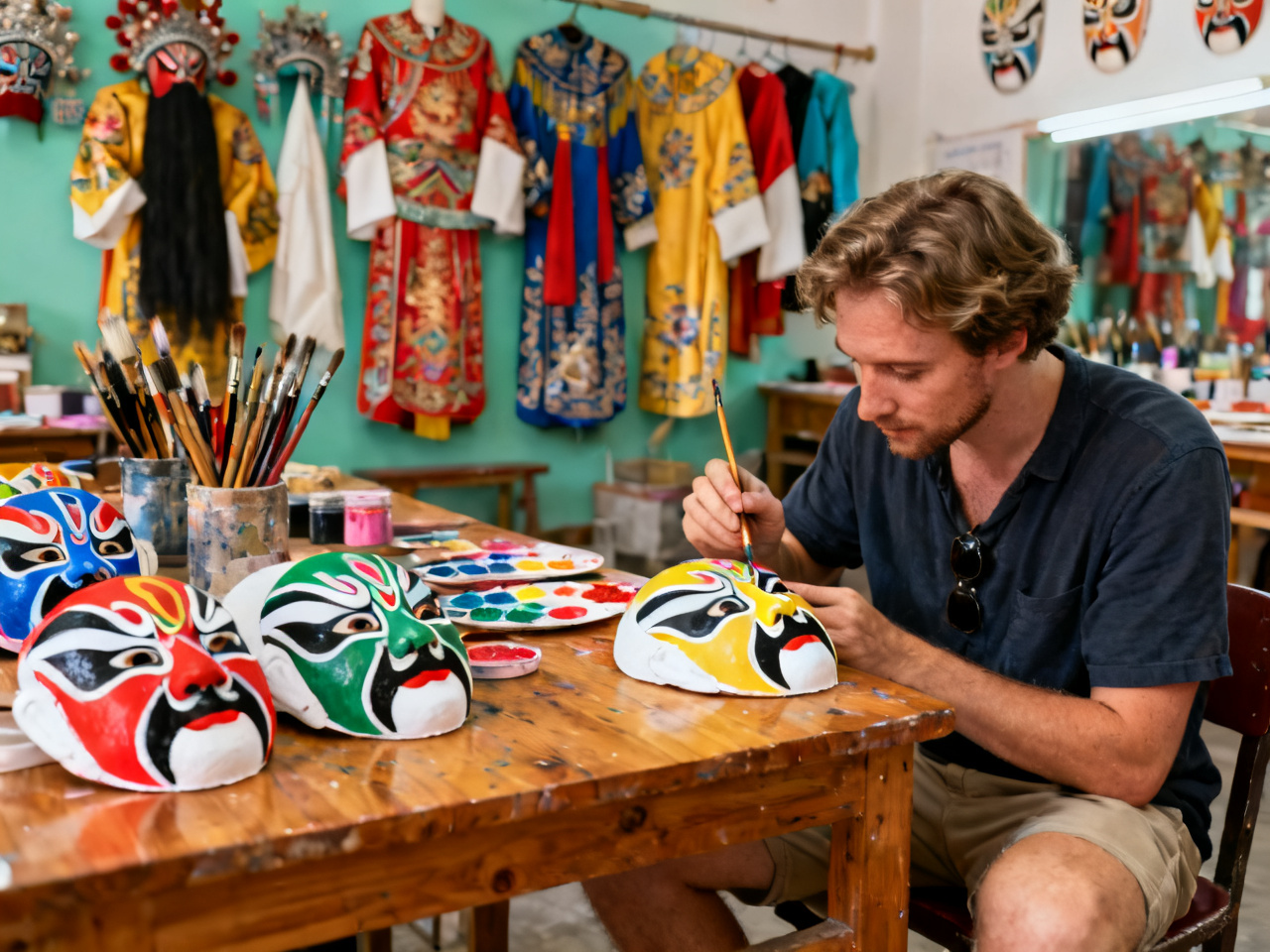
我画的是一张比较经典的脸谱底稿,先铺底色,再画额头、眼眶、鼻梁和脸颊的分区。看老师示范时好像并不复杂,可等到轮到自己,手一下子就紧张了。因为这和普通绘画不一样,它要求的不只是颜色准确,还要求线条有“角色感”。如果边缘发抖,整张脸就会显得没有精神;如果左右不平衡,那个原本应该强烈的形象马上就会散掉。我很少在旅行体验里因为一支小小的毛笔而这样专注,但那天我几乎一直在屏住呼吸。
I painted a relatively classic face outline, beginning with the base color and then defining the forehead, eye sockets, nose bridge, and cheeks. When I watched the teacher demonstrate, it did not look especially complicated. But when it was my turn, my hand instantly became tense. This was different from ordinary painting, because it demanded not only correct color, but lines that carried character. If the edges trembled, the whole face looked weak. If the left and right sides lost balance, the force of the image disappeared at once. I rarely become so focused over such a small brush in a travel activity, but that day I found myself holding my breath again and again.
最有意思的是,随着图案慢慢完整,我能明显感觉到这张脸在“成形”。一开始它只是几块颜色,后来眼神出来了,额头的纹样把气势定住了,鼻梁和嘴边的线条又给人物增加了某种决断感。也就是说,脸谱不是最后才突然有灵魂,而是在绘制过程中一点点长出戏剧性。对我这种平时并不熟悉中国戏曲系统的人来说,这种体验非常有帮助,因为它让我第一次不是靠文字介绍,而是靠自己的手去理解角色识别是如何发生的。
The most interesting part was that as the pattern gradually became complete, I could clearly feel the face taking shape. At first it was only areas of color. Then the gaze emerged, the forehead pattern fixed the character’s force, and the lines around the nose and mouth added a sense of decisiveness. In other words, the face painting does not suddenly gain life only at the end. Its theatricality grows during the process itself. For someone like me, who is not deeply familiar with the full system of Chinese opera, this was incredibly helpful, because for the first time I understood character recognition not through written explanation, but through my own hands.
这也让我想到墨西哥的一些传统视觉文化。作为一个来自墨西哥的人,我很自然会联想到节庆中的面具、宗教游行里的形象符号,以及亡灵节相关的彩绘视觉传统。我们也很习惯通过一张脸、一个面具或一组颜色,让人物或氛围在出现之前就先建立情绪。可中国脸谱给我的感觉更严格,也更系统。墨西哥很多节庆视觉符号更强调情绪外放、生命力和公共庆典氛围,而中国戏曲脸谱则更像一种被高度编码的舞台阅读系统:观众看到这张脸,不只是感到热闹,而是会被引导去预判角色类型和戏剧位置。
This also made me think of traditional visual culture in Mexico. As someone from Mexico, I naturally think of festival masks, symbolic figures in religious processions, and the painted imagery associated with Día de los Muertos. We too are used to using a face, a mask, or a group of colors to establish emotion before a figure even fully appears. But Chinese opera face painting feels more regulated and more systematic to me. Many Mexican festive visual symbols emphasize emotional intensity, vitality, and public celebration, while Chinese opera face painting functions more like a highly coded theatrical reading system. When the audience sees this face, they do not only feel excitement; they are guided toward expectations about the role type and dramatic position.
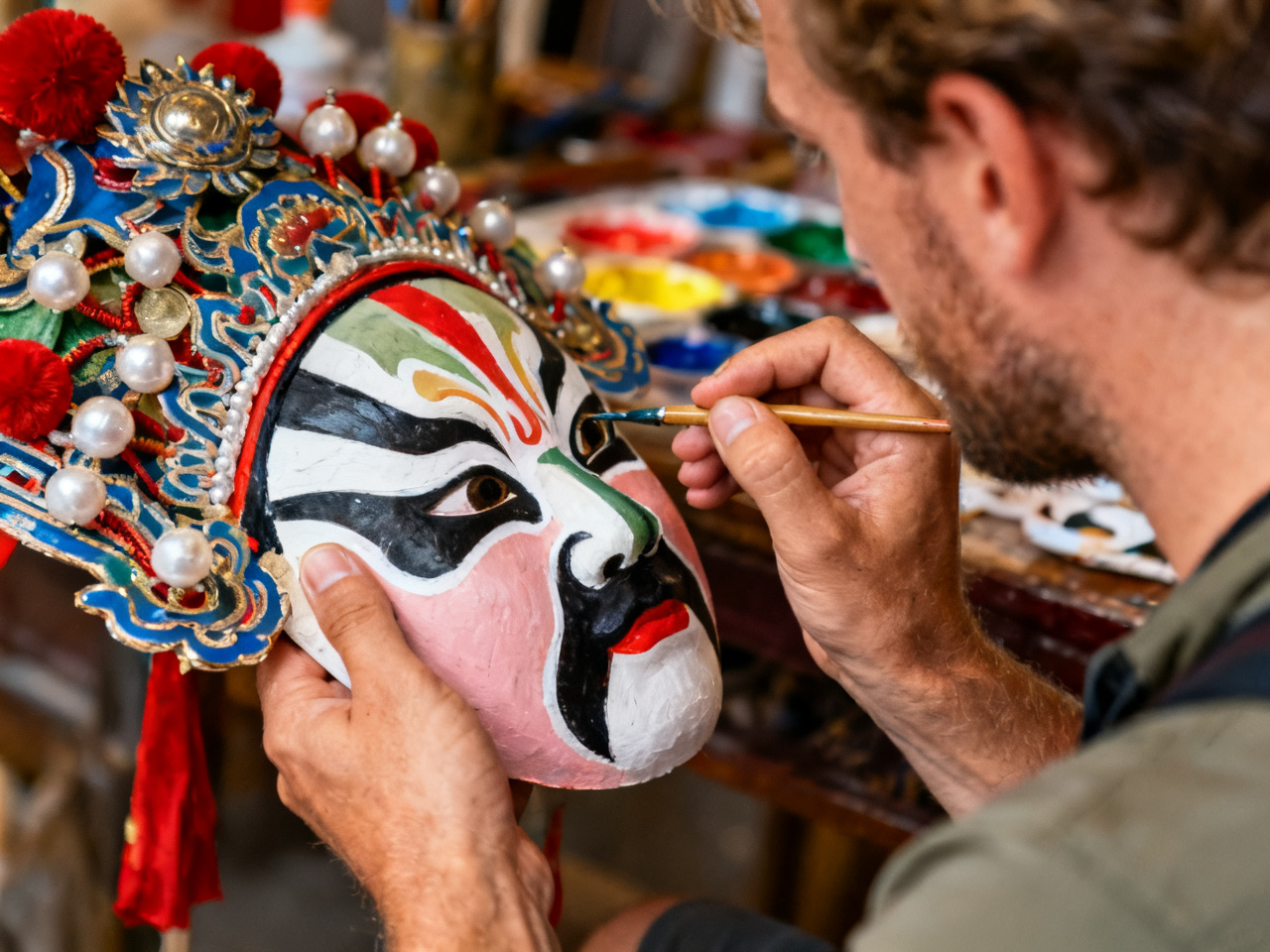
老师后来还让我们把几张完成度不同的脸谱摆在一起比较。近看时,我才真正明白“对称”在这门艺术里有多重要。不是机械地左右一样,而是要让整体气势稳住。某些地方可以略有手工痕迹,但人物的中心线、眼部力量和色块关系必须清楚。她还说,真正上脸的脸谱和画在板上的体验版当然不完全一样,因为舞台上还要考虑演员的五官、灯光和表演动作。听到这里,我反而更佩服这套系统了:它不是静态图案,而是为表演服务的活的视觉设计。
Later, the instructor asked us to compare several finished and unfinished designs together. Seen up close, I finally understood how important symmetry is in this art. It is not about making both sides mechanically identical, but about stabilizing the overall force of the face. Some traces of the hand can remain, but the central axis, the power around the eyes, and the relationship among color blocks must be clear. She also explained that a real painted face on a performer is not exactly the same as a workshop version on a board, because stage performance must also consider the actor’s features, lighting, and movement. That only made me admire the system more. It is not static decoration; it is living visual design in service of performance.
体验结束的时候,我拿着自己画好的那张脸谱,越看越觉得这不是一件轻飘飘的旅游纪念品。它更像一把钥匙,让我以后再看中国戏曲人物时,不会只觉得“颜色很鲜艳”,而会开始注意:这张脸想先告诉我什么?它的力量从哪里来?为什么这条线一定要这样走?对我来说,这就是好的文化体验——不是一次性消费,而是改变你以后观看方式的训练。
When the workshop ended, I looked at the face painting I had finished and felt more and more that it was not a light tourist souvenir. It was more like a key. The next time I encounter Chinese opera characters, I will not simply think, “the colors are bright.” I will start asking: what is this face trying to tell me first? Where does its force come from? Why must this line move in exactly this way? For me, that is what a good cultural experience does. It is not one-time consumption, but training that changes how you look from then on.
如果有第一次来中国的外国朋友问我,哪种民艺最能让人立刻感受到“视觉语言”这四个字的分量,我会很想推荐脸谱绘制。它有足够鲜明的外表让人一眼被吸引,也有足够深的规则让人越画越谦虚。作为一个来自墨西哥、习惯节庆视觉非常热烈的人,我原本以为自己很容易读懂这种强烈风格。结果中国脸谱让我学会的是另一件事:真正成熟的夸张,从来不是杂乱地堆满元素,而是每一笔都知道自己为什么存在。
If a foreign friend visiting China for the first time asked me which folk-art experience most quickly conveys the weight of the phrase “visual language,” I would strongly recommend opera face painting. It has an appearance vivid enough to attract anyone instantly, yet it also has rules deep enough to make you humble the longer you paint. As someone from Mexico, where festive imagery is often intense and exuberant, I thought I would read this strong style easily. Instead, Chinese face painting taught me something else: truly mature exaggeration is never a chaotic pile of elements. Every line knows exactly why it exists.
- 西藏:世界屋脊 | Tibet: The Roof of the World
- 本人在台州临海古城墙的五月雨雾里,第一次把“看景”变成了“听城” | In Linhai's May Mist, I Stopped Just Seeing the Scenery and Started Listening to the City
- 第一次在中国小区门口等人,我学会站在门侧别贴着门禁 | The First Time I Waited Outside a Chinese Compound Gate, I Learned to Stand to the Side Instead of Pressing Up Against the Access Door
- 熟食店玻璃柜前那句“几个人吃”,让我第一次学会在中国别只按克数点菜 | The Question “How Many People Are Eating?” at a Deli Counter Taught Me Not to Order Only by Weight in China
- 外国人在中国买东西被拒收现金怎么办? | What To Do When a Chinese Shop Refuses Your Cash
- 外国人第一次夜游中国城市的安全感 | The Sense of Safety I Felt on My First Night Walk in a Chinese City
- 去济南之前,我先把会让人慌张的那几样信息收进同一屏 | Before Jinan, I Gathered the Few Panic-Making Essentials onto One Screen
- 扬州雨后最动人的,不是园子名气,而是鞋底碰到湿石板的那一下 | In Rainy Yangzhou, the Most Moving Thing Is Not a Famous Garden but the Sound of Shoes on Wet Stone
- 第一次在中国自助快餐学会先找托盘回收口 | The First Thing I Learned in a Chinese Self-Service Fast Food Place Was to Find the Tray Return Area First
- 冷门但值得去的中国小城 | Hidden Gem Cities in China Worth Visiting
Comments (0)