
我坐绿皮火车从昆明晃到北京 | I Took a Slow Train from Kunming All the Way to Beijing
我坐绿皮火车从昆明晃到北京 | I Took a Slow Train from Kunming All the Way to Beijing
我承认,买这张票的时候我喝了点酒。
I'll admit it — I'd had a few drinks when I booked this ticket.
昆明到北京,K474次,硬卧,全程34小时。朋友说我疯了,高铁10小时就到,你非要坐一天半的绿皮?我说:就是因为快的方式太多了,我才想试试慢的。
Kunming to Beijing, train K474, hard sleeper, 34 hours total. Friends said I was insane — the bullet train takes 10 hours, why spend a day and a half on an old green train? I said: precisely because there are too many fast options, I wanted to try the slow one.
绿皮车的第一个小时:后悔
上车那一刻我就有点后悔了。车厢里弥漫着方便面和老干妈的混合气味,我的铺位是上铺,爬上去之后发现翻个身都费劲。空调声音很大,但效果存疑。
Hour One: Regret
I regretted it the moment I boarded. The carriage smelled like instant noodles mixed with Laoganma chili sauce. My berth was the top bunk — once I climbed up, I could barely roll over. The air conditioning was loud but its effectiveness was questionable.
对面下铺是个六十多岁的大爷,戴着老花镜看报纸。中铺是个回家的大学生,戴着耳机刷手机。我们三个人谁也没说话。我靠在枕头上想:接下来还有33个小时。
The lower bunk across from me held a man in his sixties, reading a newspaper through reading glasses. The middle bunk was a college student heading home, scrolling his phone with earbuds in. None of us spoke. I leaned against my pillow and thought: 33 hours to go.
过了贵州,事情开始变了
火车从昆明出发,先穿过云南东部的山区,隧道一个接一个,耳朵一直在鸣。进入贵州之后,窗外的风景突然打开了——层叠的梯田、峡谷里的小河、山腰上孤零零的几户人家。
Somewhere in Guizhou, Things Changed
The train left Kunming and first cut through the mountains of eastern Yunnan, tunnel after tunnel, my ears constantly popping. Once we entered Guizhou, the view outside suddenly opened up — layered terraces, small rivers in gorges, a few lone houses perched on mountainsides.
大爷放下报纸,问我去哪。我说北京。他说他也是,回老家看孙子。然后他从一个布袋子里掏出一包花生和两个茶叶蛋,递给我一个。"长途车上不吃东西会难受的。"
The old man put down his newspaper and asked where I was headed. Beijing, I said. He was going there too — back to see his grandson. Then he pulled a bag of peanuts and two tea eggs from a cloth sack and handed me one. "You'll feel miserable on a long train ride if you don't eat."
那个茶叶蛋是我那趟旅程里吃过最好吃的东西。不是因为它有多特别,是因为在一个封闭的铁皮盒子里,一个陌生人的善意特别明确。
That tea egg was the best thing I ate on the entire trip. Not because it was special, but because inside a sealed metal box on rails, a stranger's kindness hits different.
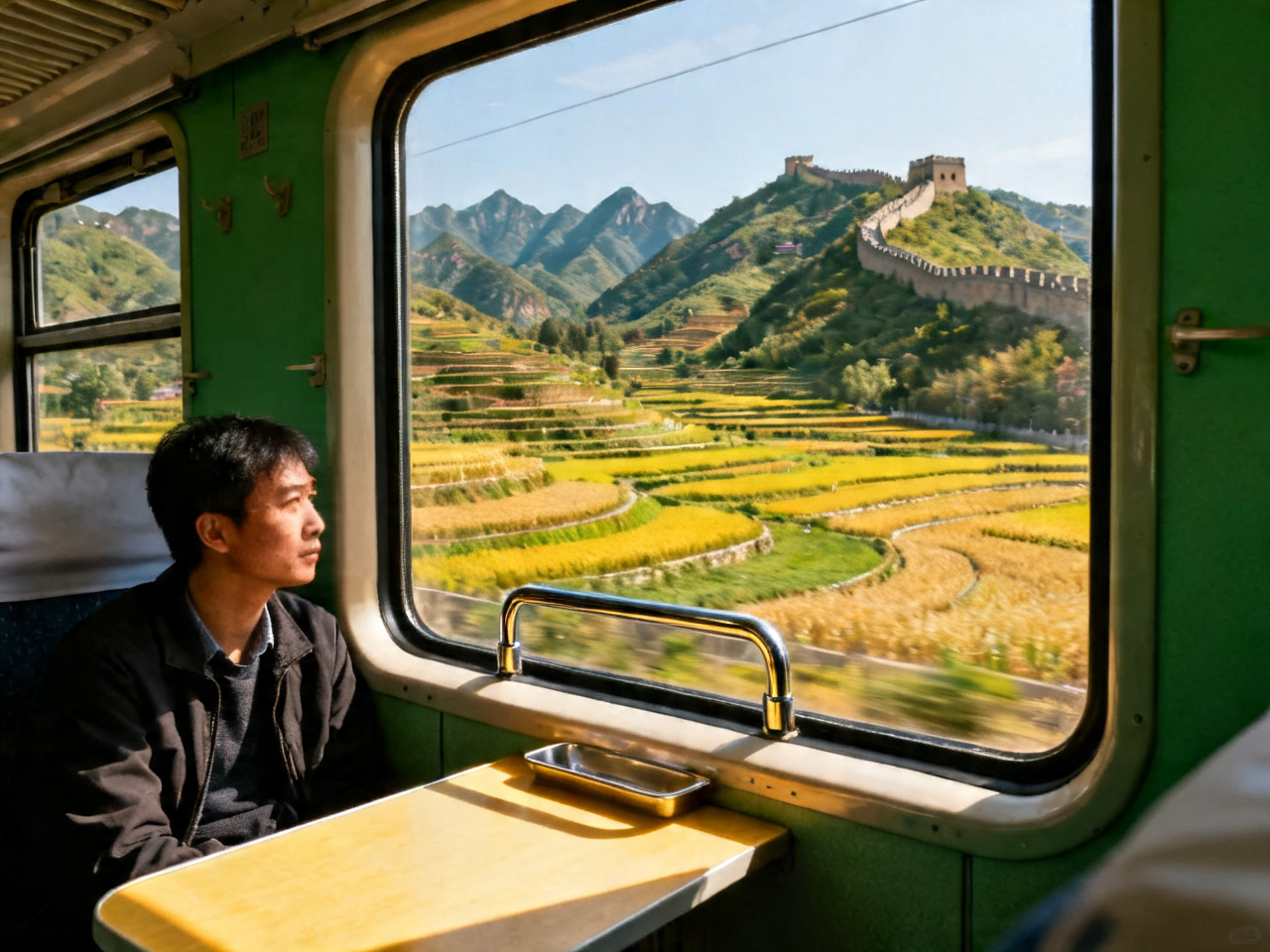
硬卧车厢里的中国切面
34小时的硬卧,你会见到一个微缩的中国。
A Cross-Section of China in a Hard Sleeper Car
Thirty-four hours in hard sleeper class, and you'll see a miniature China.
有带着蛇皮袋去城里打工的中年人,袋子里装着被褥和家里腌的咸菜。有放暑假回家的大学生,手机外放短视频但音量不算太大——在绿皮车上,这已经算很客气了。有抱着孩子的年轻妈妈,孩子从上车哭到睡着,妈妈的眼睛也跟着红了。
There were middle-aged migrant workers heading to the city with woven plastic bags stuffed with bedding and homemade pickled vegetables. College students going home for break, playing short videos on speaker — at a volume that, by slow-train standards, counted as polite. A young mother holding a baby who cried from departure until falling asleep, the mother's eyes reddening right along with the child's.
还有一对老夫妻,从湖南上车,要坐到石家庄。老太太晕车,老头就一直拿扇子给她扇风,从下午扇到天黑。我问他们为什么不坐高铁,老头说:"高铁贵啊,省下来的钱够给孙女买个新书包了。"
And there was an elderly couple who boarded in Hunan, riding all the way to Shijiazhuang. The wife got motion-sick, so the husband fanned her with a hand fan from afternoon until dark. I asked why they didn't take the bullet train. "Too expensive," he said. "The money we save is enough for a new school bag for our granddaughter."
那一刻我突然理解了,绿皮火车不只是一种交通方式,它是一个仍然存在的平行世界。在高铁把中国压缩成几个小时的今天,绿皮车上的人还在用最慢的速度丈量这个国家的宽度。
In that moment I suddenly understood: the slow train isn't just a mode of transport — it's a parallel world that still exists. In an era when bullet trains compress China into a few hours, people on these green trains are still measuring the width of this country at the slowest possible speed.
凌晨三点,窗外是谁的家乡
绿皮车有一种独特的夜间体验:你会在凌晨被停车的震动晃醒,拉开窗帘一角,看到一个你可能永远不会去的小站台。灯光昏黄,站名你念不出来,有几个人影在站台上抽烟等车。然后火车又动了,那个地方就从你的生命里永远消失了。
3 AM: Whose Hometown Is Outside the Window
Slow trains have a unique nighttime experience: you'll be jolted awake at 3 AM by the train stopping, pull back a corner of the curtain, and see a tiny station you'll probably never visit. Dim yellow lights, a station name you can't pronounce, a few silhouettes smoking on the platform. Then the train moves again, and that place disappears from your life forever.
我在凌晨三点醒过两次。第一次窗外是湖南某个小站,雨很大,站台上积了水,一个穿雨衣的工人在检查什么。第二次已经到了河南,天蒙蒙亮,窗外是一望无际的麦田,金黄色的,像有人把一整罐颜料泼在了地平线上。
I woke twice at 3 AM. The first time, outside was some small station in Hunan — heavy rain, water pooled on the platform, a worker in a rain poncho checking something. The second time we'd reached Henan, dawn barely breaking, and outside was an endless wheat field, golden, as if someone had spilled an entire can of paint across the horizon.
到站:北京西
第34个小时,火车晃进了北京西站。我拎着包走下车,腿有点麻,脖子有点酸,但心情很好。站台上的人都在赶路,只有我站在原地愣了几秒——从昆明的25度到北京的38度,从云南的山到华北的平原,我花了一天半穿越了大半个中国,沿途的每一个画面都还热乎着。
Arrival: Beijing West
At hour 34, the train rumbled into Beijing West Station. I grabbed my bag and stepped off, legs slightly numb, neck a bit stiff, but in good spirits. Everyone on the platform was rushing somewhere. Only I stood still for a few seconds — from Kunming's 25°C to Beijing's 38°C, from Yunnan's mountains to the North China Plain, I had spent a day and a half crossing most of China, and every scene along the way was still warm in my mind.
给想坐绿皮车的你
如果你真的想试一次中国的绿皮火车,这些是我的建议:
For Those Considering a Slow Train Ride
If you genuinely want to try China's old green trains, here's my advice:
选对线路。 不是所有绿皮线路都值得坐。风景好的经典线路包括:昆明→贵阳→北京(穿越云贵高原和华中平原)、成都→西安(穿秦岭)、兰州→乌鲁木齐(河西走廊和戈壁)。纯平原线路就别折腾了,12小时看玉米地会让你怀疑人生。
Pick the right route. Not every slow-train line is worth the ride. Classic scenic routes include: Kunming→Guiyang→Beijing (crossing the Yunnan-Guizhou Plateau and Central China plains), Chengdu→Xi'an (through the Qinling Mountains), Lanzhou→Ürümqi (Hexi Corridor and Gobi Desert). Pure flatland routes aren't worth the suffering — 12 hours of cornfields will make you question your life choices.
买硬卧,别买硬座。 硬座超过8小时是真正的酷刑。硬卧虽然空间小,但至少能躺平。下铺最贵但最舒服,白天可以坐着看窗外;上铺最便宜但最憋屈,只适合睡觉。中铺是性价比之选。昆明到北京硬卧大概400元左右,高铁二等座要800多。
Get a hard sleeper, not a hard seat. Hard seats beyond 8 hours are genuine torture. Hard sleepers are cramped but at least you can lie flat. Lower bunks are priciest but most comfortable — you can sit up and watch the scenery during the day. Upper bunks are cheapest but most claustrophobic — good only for sleeping. Middle bunks are the sweet spot. Kunming to Beijing in hard sleeper costs around ¥400; bullet train second class is over ¥800.
带够吃的,但别全靠泡面。 车上有热水,泡面当然方便,但连吃三顿你会崩溃。我建议带些水果、卤味、面包和零食混着吃。餐车的盒饭大概25-40元一份,味道一般但胜在有热菜。沿途大站停车时间长的话,站台上偶尔有卖当地小吃的,值得尝试。
Bring enough food, but don't rely entirely on instant noodles. There's hot water on board, so noodles are convenient, but three meals of them will break you. I suggest bringing a mix of fruit, braised snacks, bread, and munchies. The dining car sells boxed meals for about ¥25-40 — mediocre but at least it's hot food. At major stations with longer stops, vendors sometimes sell local snacks on the platform — worth a try.
跟人聊天。 绿皮车最好的部分不是窗外的风景,是车厢里的人。放下手机,跟对面铺位的人说句话,你会听到很多有意思的故事。我那趟车上的大爷,后来跟我聊了四个小时,从60年代挖煤讲到现在帮儿子带孙子,比任何纪录片都好看。
Talk to people. The best part of a slow train isn't the scenery outside — it's the people inside. Put down your phone, say something to whoever's in the bunk across from you, and you'll hear incredible stories. The old man on my trip ended up talking to me for four hours, from mining coal in the 1960s to babysitting his grandson today — better than any documentary.
我后来又坐过两次绿皮火车,一次是成都到西安,一次是兰州到张掖。每次都累,每次都觉得值。在一个什么都越来越快的时代,偶尔允许自己慢下来,你会发现中国比你以为的大得多,也温柔得多。
I've since taken slow trains twice more — once from Chengdu to Xi'an, once from Lanzhou to Zhangye. Exhausting every time, worth it every time. In an era where everything keeps getting faster, occasionally allowing yourself to slow down reveals a China much larger, and much gentler, than you imagined.
延伸阅读 / Related Reads
- 华东五城10日经典环线 | 10-Day East China Five-City Loop
- 丽江古城深度游:纳西文化与雪山美景 | Lijiang Old Town: Naxi Culture & Snow Mountain Views
- 张家界玻璃桥与天门山攻略 | Zhangjiajie Glass Bridge & Tianmen Mountain Guide
- 桂林漓江山水游全攻略 | Guilin Li River Scenic Tour Complete Guide
- 春季赏花地图:全国最美花海 | Spring Bloom Map: China's Most Beautiful Flower Fields
- 腾冲:火山热海之间的边地温度 | Tengchong: A Borderland Journey Between Volcanoes and Hot Springs
- 支付失败怎么办:来华游客应急指南 | Payment Failed? A Visitor's Emergency Guide
- 中国旅游美食点餐指南 | How to Order Food When Traveling in China
- 低价团不是不能报,但合同要比宣传页更重要 | Cheap Tours Are Not Always Bad, but the Contract Matters More Than the Brochure
- 从零下20度到四季如春:中国南北气候差有多离谱 | Minus 20 to Eternal Spring — China's North-South Climate Gap Is Wild
- 把中国拍成高铁大线以后,最值钱的内容其实藏在换乘和转场里 | Once China Becomes a High-Speed Rail Arc on Camera, the Real Value Hides in Transfers and Transitions
- 我把证件照片存进手机后,排队时少慌了很多 | Saving ID Photos on My Phone Made Queues Less Stressful
- 苹果园门口那双沾泥的鞋,让我走进昭通的劳动节奏 | Muddy Shoes at an Apple Orchard Led Me into Zhaotong’s Work Rhythm
- 走到一半就下城墙,是我在南京学会的第一个正确决定 | Getting Off the Wall Midway Was the First Right Decision I Learned in Nanjing
- 中国货币与支付指南 | China Currency and Payment Guide
Comments (0)